
The Rise of Contemporary Venezuelan Cuisine and Chef-Driven Dining (2026)
By: Venezuela Advisor — Published 2026 · Share
Caracas's dining scene has evolved considerably beyond the recovery described in our restaurant business guide. This guide looks specifically at the chef-driven, contemporary Venezuelan cuisine movement reshaping how the city eats and invests in food, and what it means for anyone considering a role in this growing sector.
- 1. What's actually on the menu across the corridor
- 2. Spending tiers and what drives them
- 3. The contemporary Venezuelan movement specifically
- 4. The economics of a chef-driven concept
- 5. How dining culture itself has shifted
- 6. Mistakes we see chef-driven concepts make
- Glossary
- The role of regional Venezuelan cuisine beyond Caracas
- Media attention and its double-edged role
- Key takeaways
1. What's actually on the menu across the corridor
Illustrative mix, not a formal survey: contemporary Venezuelan cuisine now represents a meaningful share of the dining corridor's offerings, alongside international fusion and traditional regional cooking.
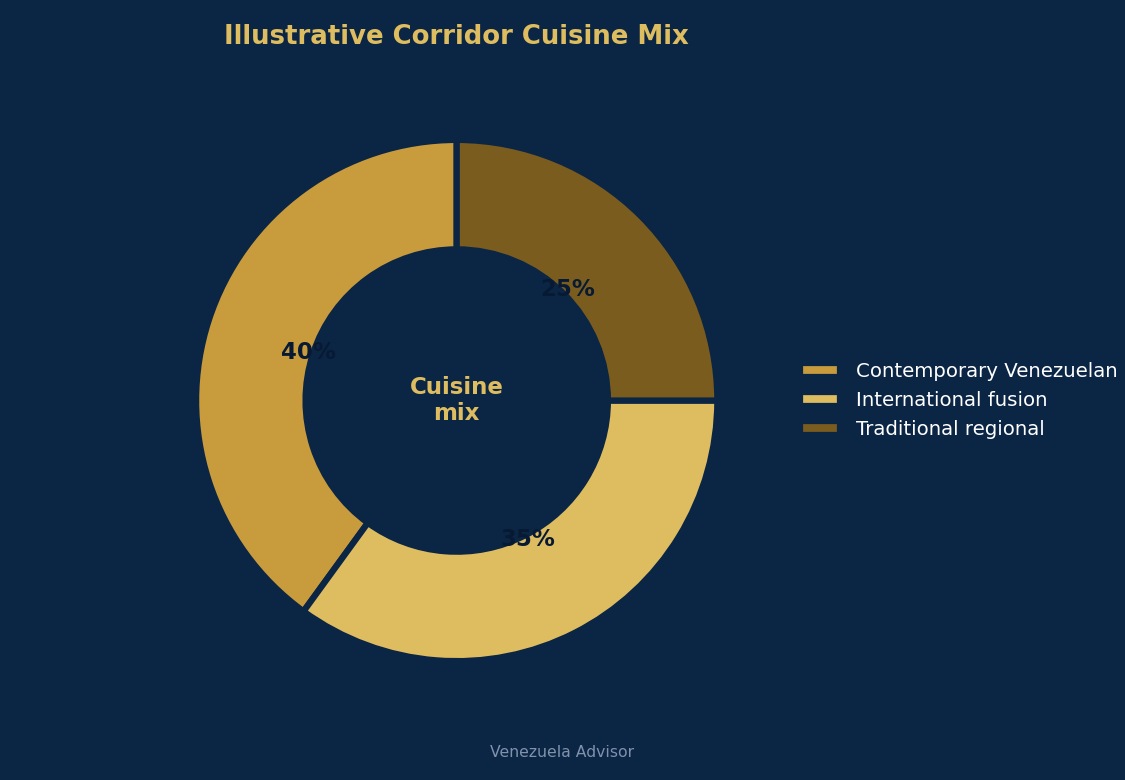
This mix reflects a genuine maturation of the market rather than a single passing trend. A decade ago, Caracas's dining scene leaned heavily on international fusion concepts, partly because opening a recognizable international format carried less risk than building a distinctly Venezuelan identity in an uncertain market. The current balance toward contemporary Venezuelan cuisine specifically signals growing confidence among both chefs and diners in a genuinely local culinary identity, one that no longer needs to borrow legitimacy from an internationally recognizable format to draw a discerning clientele willing to pay premium prices.
2. Spending tiers and what drives them
Illustrative figures, not confirmed pricing: the gap between a casual meal and a chef-driven tasting experience reflects genuine differences in sourcing, technique, and labor, not simply markup.
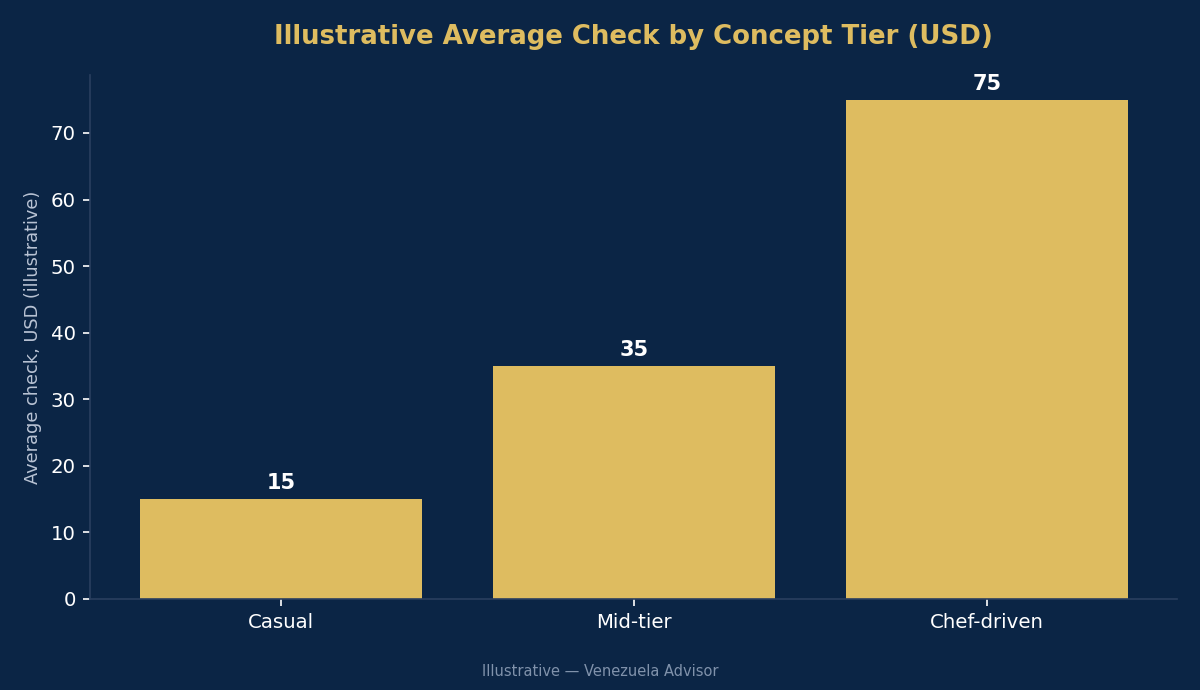
A diner comparing prices across these tiers without understanding what drives the difference might assume the highest tier is simply overpriced relative to more accessible options nearby. In practice, a chef-driven tasting menu typically involves a kitchen brigade several times larger relative to covers served than a casual concept, ingredients sourced specifically rather than through standard bulk suppliers, and considerably more prep time per dish — costs that scale directly into the final price in ways a casual concept's simpler operation doesn't carry, and that a well-run chef-driven restaurant should be able to explain clearly to a curious guest who asks.
3. The contemporary Venezuelan movement specifically
A growing number of Caracas chefs are reinterpreting traditional Venezuelan ingredients and dishes through contemporary technique, a movement paralleling similar culinary reinventions seen across Latin America over the past decade in cities like Lima and Bogotá.
What "contemporary Venezuelan" actually means on a plate
Rather than abandoning traditional dishes, the strongest examples of this movement reinterpret them — elevating a classic arepa or hallaca through refined technique and presentation rather than replacing them with imported culinary concepts wholesale and losing what made them distinctly Venezuelan in the first place. This approach mirrors what Peruvian chefs did with cuisine like ceviche a generation earlier, transforming a beloved everyday dish into something that could anchor a fine-dining concept without losing its essential identity or alienating diners who grew up with the traditional version.
Why this movement matters beyond the plate itself
Beyond its culinary merit, this movement carries real economic and reputational value for Venezuela's broader tourism and hospitality sector described in our business tourism guide. A city recognized internationally for a distinctive culinary identity draws a different kind of visitor — and a different kind of media attention — than one known only for imported international dining formats indistinguishable from any other global city, and this reputational effect compounds over time as more chefs and restaurants contribute to a recognizable, cohesive culinary narrative worth traveling for.
4. The economics of a chef-driven concept
Chef-driven restaurants typically carry higher labor costs, more demanding sourcing requirements, and a narrower, more curated menu than a conventional restaurant — economics that require the kind of careful financial modeling described in our restaurant business guide.
Why labor costs run higher in this format
A tasting menu concept typically requires a more skilled, more specialized kitchen team than a conventional restaurant serving a broader, simpler menu, and this skill premium shows up directly in payroll. Combined with the labor cost framework described in our hiring guide, a chef-driven concept's true labor cost as a percentage of revenue typically runs meaningfully higher than a casual concept's — a gap that must be reflected explicitly in pricing rather than absorbed as an unplanned margin erosion.
Sourcing as a genuine operational challenge
Specific, high-quality ingredients — particular cuts, specialty produce, imported components not available through standard suppliers — often require direct relationships with individual producers rather than standard wholesale purchasing, echoing the same sourcing complexity described in our import/export guide for imported components specifically. Building these relationships takes time and consistency, and a concept that hasn't secured reliable sourcing before opening risks a menu that looks impressive on paper but can't be executed consistently once service actually begins.
5. How dining culture itself has shifted
Beyond individual restaurants, the broader culture around dining out — reservation culture, willingness to pay for a tasting menu, interest in wine and cocktail pairing — has matured considerably alongside the dollarized recovery described throughout this guide series.
The return of reservation culture
A functioning reservation system — one that diners actually respect and restaurants actually enforce — is itself a signal of a maturing dining scene, since it requires enough demand density to make advance booking genuinely necessary rather than a formality. The most sought-after chef-driven concepts in the corridor now routinely book out days or weeks in advance, a pattern that would have seemed unlikely in the depths of the earlier economic contraction and signals real, sustained consumer confidence.
Growing sophistication in beverage pairing
Wine lists and cocktail programs at the top tier of Caracas dining have grown considerably more ambitious, reflecting both increased consumer sophistication and improved access to imported beverages through the trade channels described in our trade guide. This isn't a minor detail — beverage programs often carry meaningfully higher margins than food alone, making them a genuinely important part of a chef-driven concept's overall economics, not simply an accompaniment to the meal.
6. Mistakes we see chef-driven concepts make
Underestimating the sourcing complexity of a genuinely ambitious menu, pricing below what the concept's true costs require, and failing to train front-of-house staff to match the sophistication of the kitchen are the three mistakes we see most consistently.
Pricing to compete rather than pricing to cover true costs
New chef-driven concepts sometimes underprice their menu to seem more accessible relative to other options in the corridor, without fully accounting for the elevated labor and sourcing costs described earlier in this guide. This produces a concept that looks successful in terms of covers served but struggles financially once the true cost structure is reflected honestly — a pattern that eventually forces an uncomfortable price increase or a quiet decline in ingredient quality that erodes the concept's original identity.
Front-of-house service that doesn't match the kitchen
A sophisticated tasting menu delivered by service staff without matching training in wine knowledge, dish explanation, and pacing undermines the overall experience regardless of the kitchen's genuine skill. Investing in front-of-house training with the same seriousness applied to kitchen staff — not treating service as a lower-priority function — is what actually delivers the complete experience a chef-driven concept's pricing promises to guests.
Scaling too quickly before the original concept is fully proven
A successful chef-driven concept sometimes attracts pressure — from investors, from the chef's own ambition — to expand into a second location before the first has fully proven its operational model and built a reliable team beyond the founding chef's direct daily involvement. Expanding prematurely risks diluting exactly what made the original concept successful, a risk worth weighing carefully against the appeal of rapid growth.
Glossary
Chef-driven concept: a restaurant built around a specific chef's culinary vision, typically with a curated, frequently changing menu.
Tasting menu: a fixed, multi-course menu showcasing a chef's technique and seasonal ingredients, common in higher-tier concepts.
Covers: the number of individual guests served during a given period, a standard restaurant industry metric for measuring volume.
Front-of-house: restaurant staff responsible for guest-facing service, as distinct from kitchen ("back-of-house") staff.
The role of regional Venezuelan cuisine beyond Caracas
While this guide has focused primarily on the Caracas dining corridor, Venezuela's distinct regional cuisines — from the Andean highlands to the eastern coast — represent a further layer of culinary identity that some chef-driven concepts are beginning to draw on more deliberately. A chef incorporating specific regional techniques or ingredients not previously seen in a Caracas fine-dining context offers genuine differentiation in an increasingly competitive corridor, beyond what a purely "contemporary Venezuelan" label alone communicates to sophisticated diners.
This regional sourcing also connects to the broader investment opportunities described in our energy sector guide and coastal investment guide — regions with their own developing culinary identities that a forward-thinking restaurant group might eventually look to develop, extending the same contemporary Venezuelan movement beyond its current Caracas-centered starting point.
Key takeaways
- Contemporary Venezuelan cuisine represents a genuine, growing movement, not just isolated restaurants.
- The spending gap between casual and chef-driven dining reflects real cost differences, not just markup.
- Chef-driven concepts require more demanding financial modeling than conventional restaurant formats.
- Dining culture itself has matured alongside the broader dollarized economic recovery.
- Regional Venezuelan cuisine beyond Caracas represents an underexplored source of differentiation.
- Front-of-house training deserves the same investment as kitchen skill to deliver a complete experience.
If you're considering investing in or opening a chef-driven concept in Caracas, we can help you think through the specific economics and positioning that matter most for a concept to succeed long-term.
Media attention and its double-edged role
International food media has begun paying closer attention to Caracas's dining scene, a genuinely positive development for the sector's broader reputation but one that carries its own risks for individual restaurants unprepared for the sudden demand a favorable feature can generate. A restaurant that receives significant press coverage before its operations can reliably handle the resulting surge in reservations risks a wave of disappointed first-time guests who arrive with elevated expectations the kitchen and service team aren't yet consistently able to meet.
Building operational consistency before actively seeking press attention — rather than the reverse — tends to produce a more sustainable trajectory. A restaurant that earns organic word-of-mouth first, and only later attracts formal media coverage once its systems are genuinely solid, converts that attention into lasting reputation rather than a single spike in demand followed by a disappointing plateau once the initial curiosity fades.