
Hiring Staff in Venezuela: 5 Steps, Real Costs, and What the Labor Law Actually Requires From Employers (2026)

By: Venezuela Advisor — Published 2026 · Share
Venezuelan labor law (Ley Orgánica del Trabajo, los Trabajadores y las Trabajadoras — LOTTT) grants employees protections that go well beyond base salary, and underestimating this total cost is one of the most common financial mistakes we see among new employers, whether opening a restaurant, a retail store, or a professional office.
- 1. What "total compensation" actually includes
- 2. Five steps to hire your first employee
- 3. Prestaciones sociales: a worked example
- 4. Termination: cause vs. no-cause, and what changes
- 5. Mandatory benefits beyond salary
- Employment contract types and what they mean practically
- Independent contractor vs. employee: a distinction that matters legally
- 6. Mistakes employers make
- Glossary
- Key takeaways
1. What "total compensation" actually includes
Base salary is only one component of what an employee actually costs. Venezuelan law requires several additional elements, each accruing on its own schedule throughout the employment relationship. For an employer building a first-year budget, treating base salary as roughly 70% of the true monthly cost — with the remainder distributed across prestaciones sociales accrual, utilidades reserve, and social security contributions — produces a far more realistic staffing budget than one built on salary figures alone.
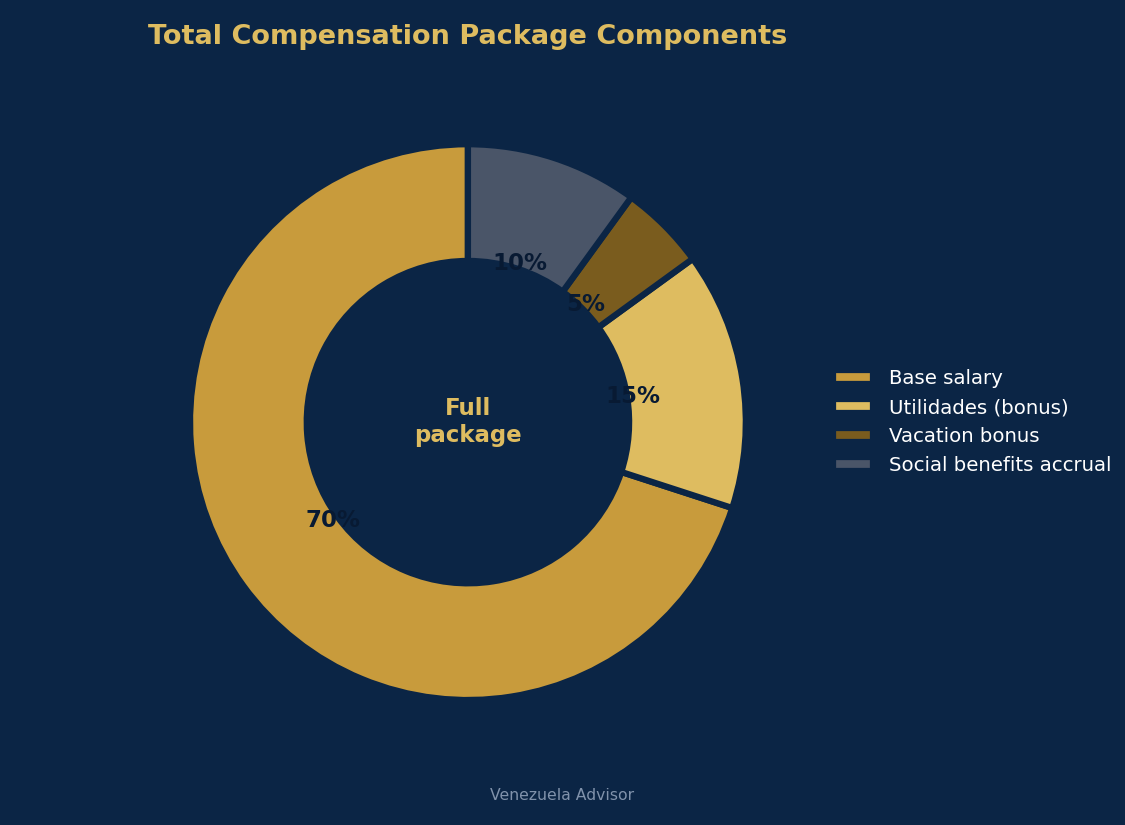
This gap between advertised salary and true employer cost is one reason job postings that only reference base salary can be misleading for budgeting purposes on both sides — an employee comparing offers, and an employer comparing hiring scenarios, both need the fully loaded figure to make an accurate comparison.
2. Five steps to hire your first employee
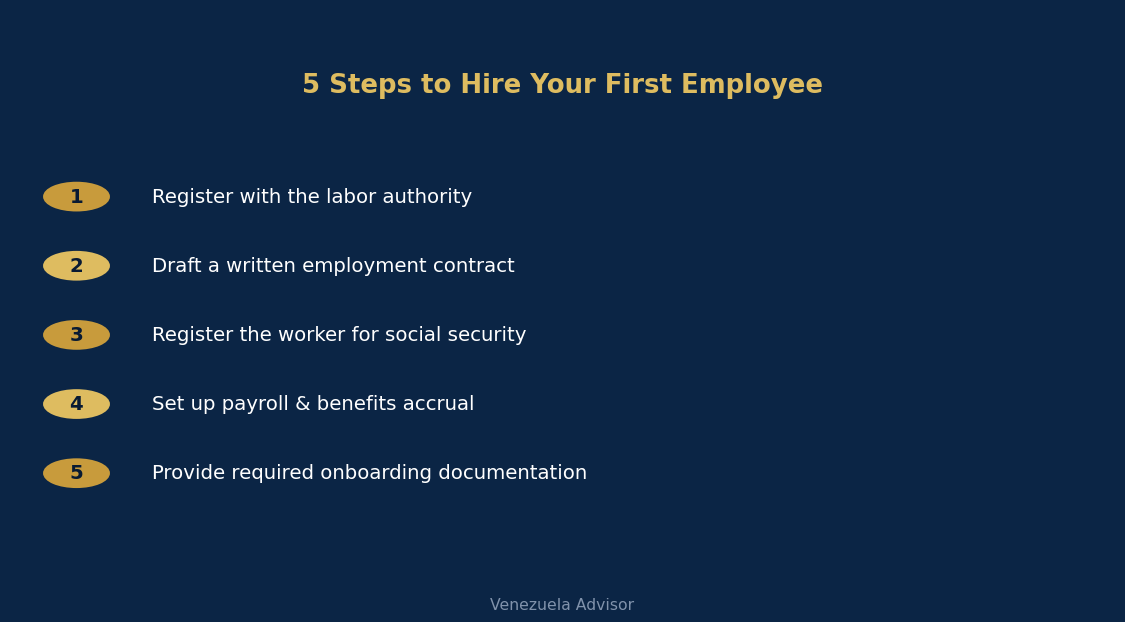
These five steps, completed in order, take most new employers between two and four weeks from decision to a fully compliant first hire — longer if your company itself hasn't yet completed the formation process described in our company formation guide, since several of these steps depend on your RIF and mercantile registration already being in place.
- Register your company with the relevant labor authority before your first hire, since this registration is a prerequisite for every step that follows.
- Draft a written employment contract specifying role, salary, and schedule.
- Register the worker with the Venezuelan Social Security Institute (IVSS), a step that must be completed within the timeframe the law specifies.
- Set up payroll accounting that tracks benefit accrual separately from base salary.
- Provide the onboarding documentation the law requires, including a copy of internal work regulations.
Why step four deserves more attention than employers give it
Setting up payroll accounting that tracks prestaciones sociales and utilidades accrual separately from routine salary expense — rather than lumping everything into a single "labor cost" line — is what makes the worked examples in this guide actually usable for your own budgeting. Employers who skip this separation typically discover their true accrued liability only when an employee leaves or a bonus payment comes due, at which point it's a surprise rather than a planned expense.
3. Prestaciones sociales: a worked example
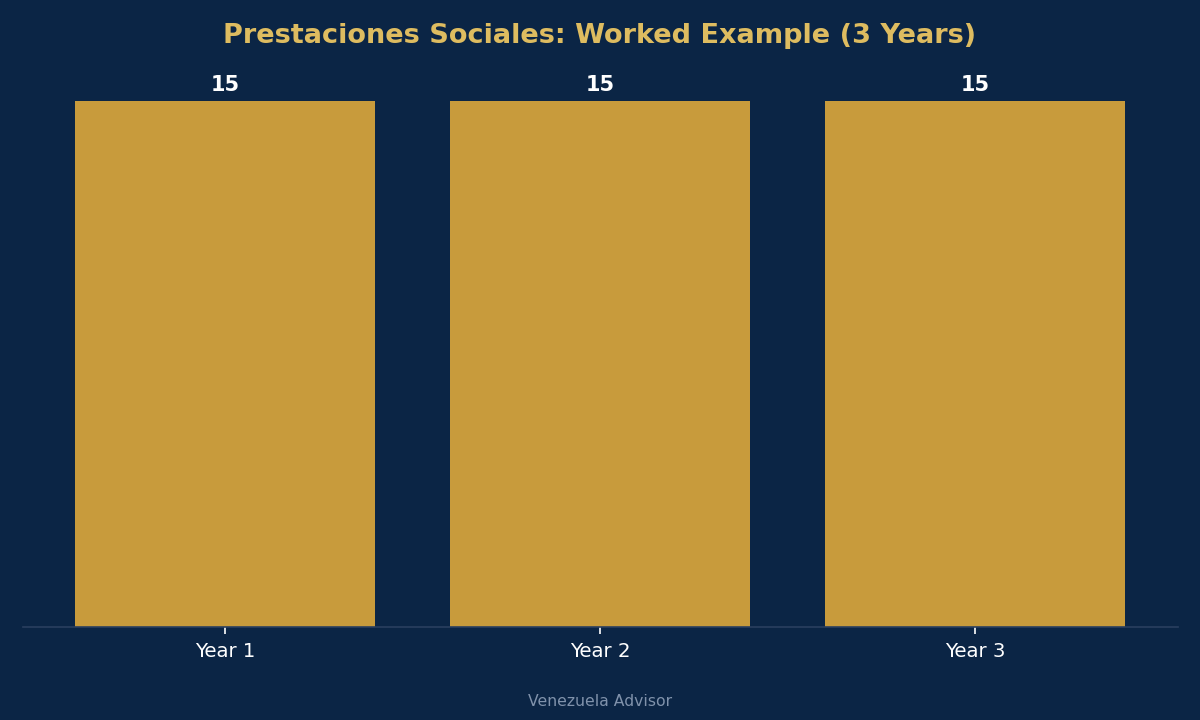
Prestaciones sociales — a severance-like benefit that accrues throughout employment, not just at termination — is the single most misunderstood cost among new employers. Under LOTTT, this accrues at a rate the law defines per quarter of service, deposited into a fund the employee can access under specific circumstances or upon termination.
| Year of service | What accrues |
|---|---|
| Year 1 | 15 days of salary, deposited quarterly |
| Year 2 | 15 days of salary, deposited quarterly |
| Year 3 | 15 days of salary, deposited quarterly |
For a hypothetical employee earning $500 a month, this quarterly accrual pattern means the employer is setting aside a meaningful sum specifically earmarked as prestaciones sociales well before any termination is even under consideration — treating it as a normal, planned payroll accrual rather than a contingent future liability produces a cleaner and more accurate monthly budget.
Why this differs from severance in many other countries
Employers coming from jurisdictions where severance is calculated only at termination, based on final salary and tenure, often assume Venezuela works the same way. The quarterly accrual structure means prestaciones sociales functions more like a mandatory ongoing savings mechanism the employer manages on the employee's behalf, which changes both the accounting treatment and the cash-flow planning required compared to a termination-only severance model.
[VERIFY: exact current accrual formula and any recent LOTTT amendments before using this as a precise payroll calculation — labor law details are exactly the kind of specifics that change and should be confirmed with a labor attorney before finalizing any employment contract.]
4. Termination: cause vs. no-cause, and what changes

Terminating an employee "with cause" (for documented misconduct) and "without cause" carry different obligations under Venezuelan law, and misclassifying a termination is one of the more expensive mistakes an employer can make, both financially and in terms of potential labor disputes.
A worked comparison: same employee, two termination paths
Consider an employee with three years of service and a base monthly salary of $600. If terminated without cause, the employer typically owes the accrued prestaciones sociales in full, any unused vacation days and their corresponding bonus, and — depending on specific circumstances — additional compensation the law provides for terminations without documented cause. If the same termination is properly documented as for cause (verified misconduct, meeting the law's specific standards), some of these additional obligations may not apply, though the accrued prestaciones sociales remains owed regardless, since it's earned throughout employment rather than tied to the reason for termination.
Why documentation matters more than the reason itself
An employer with a legitimate cause for termination who fails to document it properly, following the specific procedural requirements the law establishes, can end up facing the same obligations as a no-cause termination — losing the benefit of a legitimate cause simply through inadequate paperwork. Maintaining a documented record of performance issues or misconduct from the first occurrence, rather than only when termination becomes imminent, protects the employer's position if a termination is later disputed before a labor authority.
5. Mandatory benefits beyond salary
- Utilidades: an annual profit-sharing bonus, typically paid around year-end.
- Vacation bonus: an additional payment on top of paid vacation days.
- Social security contributions (IVSS): employer contributions toward the national social security system.
Utilidades: how the calculation works
LOTTT establishes a minimum of 30 days of salary as an annual utilidades payment for most employers, though the exact figure can vary based on company profits and specific sector regulations. This is paid in addition to the 12 months of base salary — not folded into it — and needs to be budgeted as a separate annual cash outflow, typically concentrated around year-end when many employers are already managing tight seasonal cash flow. For our earlier example of an employee earning $500 a month, a 30-day minimum utilidades payment translates to roughly an additional half-month of salary paid as a lump sum, a figure worth setting aside monthly in a dedicated reserve rather than scrambling to fund it in December.
Vacation entitlement and the vacation bonus
Employees accrue paid vacation days starting from their first year of service, with the specific number of days increasing modestly with tenure up to a defined cap. Alongside the vacation days themselves, the law requires a vacation bonus — an additional payment tied to the vacation period, separate from the salary the employee continues to receive while on leave. Employers who budget only for the vacation days themselves, without this additional bonus, consistently underestimate this cost, particularly once several employees' vacation periods happen to fall within the same fiscal quarter.
Working hours and overtime
Standard working hours under Venezuelan law are capped, with overtime compensated at a premium rate above the normal hourly rate. Employers in sectors with variable demand — restaurants during holiday season, retail during peak shopping periods — need to plan overtime costs explicitly into seasonal budgets rather than treating it as an unplanned exception each time it occurs. A restaurant staffing up for the December holiday rush, for instance, should model the overtime premium into that specific month's labor budget from the planning stage, not discover it as a surprise on the January payroll reconciliation.
Employment contract types and what they mean practically
Venezuelan labor law recognizes different contract structures, and choosing the right one for your specific hiring need affects both flexibility and cost.
| Contract type | Best for | Key characteristic |
|---|---|---|
| Indefinite (tiempo indeterminado) | Ongoing roles central to the business | No predetermined end date; standard termination rules apply |
| Fixed-term (tiempo determinado) | Defined projects or seasonal needs | Specific end date; limited renewal flexibility under the law |
| Per-task (por obra determinada) | Discrete, deliverable-based work | Ends when the specific task is complete |
Employers who default to fixed-term contracts across the board, assuming this reduces their obligations, sometimes discover the law treats repeated renewals of a fixed-term contract as functionally indefinite — eliminating the flexibility they thought they'd secured. Structuring contract type around the actual nature of the role, with attorney input, avoids this trap.
Independent contractor vs. employee: a distinction that matters legally
Some employers, particularly in early-stage businesses, try to reduce labor costs by classifying workers as independent contractors rather than employees. Venezuelan law, like most labor law systems, looks past the label in the contract to the actual nature of the working relationship.
Factors that indicate an employment relationship regardless of contract label
- The worker follows a fixed schedule set by the business, rather than controlling their own hours.
- The business provides the tools, equipment, or workspace the worker uses.
- The worker performs the same core function as the business's regular operation, on an ongoing basis, rather than a discrete project.
- The worker doesn't take on similar work for other clients simultaneously.
When several of these factors are present, a labor authority or court can reclassify a "contractor" relationship as employment retroactively — potentially exposing the employer to the full range of benefits and protections that should have applied from the start, plus penalties for the misclassification itself. This risk is worth weighing seriously against whatever short-term savings the contractor structure appeared to offer.
6. Mistakes employers make
Budgeting only base salary without the additional 25-35% in accrued benefits, treating prestaciones sociales as a termination-only cost rather than an ongoing accrual, and misclassifying independent contractors as a way to avoid labor obligations are the three mistakes we see most consistently — the last of which carries meaningful legal risk if the actual working relationship resembles employment regardless of the contract's label.
Verbal agreements standing in for written contracts
Some smaller employers operate on verbal agreements, particularly with their first few hires, assuming a written contract can wait until the business is more established. This exposes both parties to disputes about terms that were never clearly documented, and specifically disadvantages the employer in any later disagreement about role, salary, or working conditions, since the burden of proof around undocumented verbal terms tends not to favor the party without the paperwork.
Applying informal salary benchmarks instead of researching actual market rates
New employers, especially those entering the Venezuelan market from abroad, sometimes set salaries based on rough conversions from their home market or informal anecdotes rather than researching actual current market rates for the specific role and sector. This can result in either overpaying unnecessarily or, more commonly, underpaying in a way that produces the exact high-turnover pattern discussed in our restaurant staffing guide — a cycle that costs more in recruiting and training over time than a competitive starting salary would have.
Glossary
LOTTT: Ley Orgánica del Trabajo, los Trabajadores y las Trabajadoras — Venezuela's core labor law.
Prestaciones sociales: a severance-like benefit accruing throughout employment, not only paid at termination.
Utilidades: a mandatory annual profit-sharing bonus paid to employees.
IVSS: Instituto Venezolano de los Seguros Sociales, the national social security institute.
Fully loaded cost: an employee's total cost to the employer, including base salary plus all mandatory accrued benefits and contributions.
Key takeaways
- Fully loaded employee cost runs meaningfully above base salary once mandatory benefits are included.
- Prestaciones sociales accrues continuously, not just at termination — budget for it as an ongoing liability.
- Cause vs. no-cause termination carries different legal and financial obligations that must be classified and documented correctly.
- Independent contractor misclassification carries real legal risk if the working relationship functions as employment.
- Choose employment contract type (indefinite, fixed-term, per-task) based on the actual nature of the role, not assumed cost savings.
- Research actual current market salary rates rather than relying on informal benchmarks or home-market conversions.
If you're hiring your first employee in Venezuela, we can connect you with a labor attorney to confirm current requirements and structure your payroll correctly from day one — the same coordinated approach we recommend for company formation, real estate transactions, and every other guide in this series.