
Restaurants and Food Trucks in Caracas: Building a Genuinely Profitable Business (2026)
By: Venezuela Advisor — Published 2026 · Share
Gastronomy was one of the first sectors to genuinely benefit from de facto dollarization, described in our dollarization guide: clear dollar margins, fast cash turnover, and a concentrated upper-middle-class demand in zones like Las Mercedes, which now functions as the city's main gastronomic corridor. This guide walks through what it actually takes to open one profitably, from the permits and location decisions covered in the first sections to the financial modeling and staffing questions that determine whether a well-conceived restaurant actually survives its first year — the details that separate a strong concept from a strong business.
- 1. Fixed restaurant vs. food truck: a practical comparison
- 2. Permits and paperwork you'll need
- 3. Choosing your location
- 4. Costs founders consistently underestimate
- 5. Staffing in a high-turnover industry
- 6. Common mistakes we see
- Glossary
- Building a realistic first-year financial model
- Key takeaways
1. Fixed restaurant vs. food truck: a practical comparison
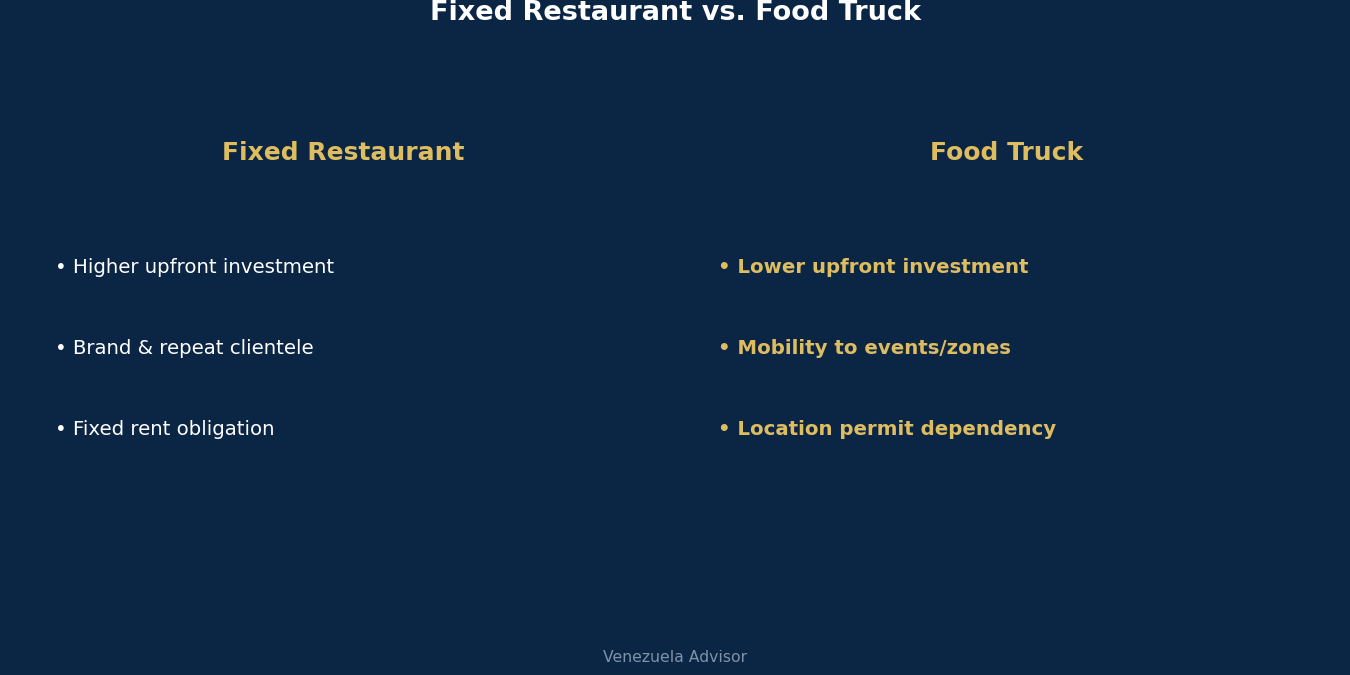
A fixed restaurant demands greater initial investment (space, renovation, furniture) but also greater capacity to build a brand and a loyal clientele. A food truck demands less initial investment, offers flexibility to move toward events and high-demand zones, but is more limited in capacity and depends on location permits in public space. Both models share the same underlying requirement, however: a realistic financial plan that accounts for the specific costs and risks of operating in Caracas rather than assuming figures imported from a different market's playbook.
Neither model is universally superior — the right choice depends on your available capital, your risk tolerance, and how confident you are in your concept before committing to a fixed lease. A food truck can also function as a lower-risk way to validate a concept before investing in a permanent location, an approach we've seen work well for founders entering the Caracas market for the first time. Several of the most successful fixed restaurants we've observed in Las Mercedes actually started as food trucks or pop-up concepts, using that lower-risk period to refine their menu and build initial brand recognition before committing to a permanent lease, a sequencing that meaningfully reduced the capital at risk during the concept's most uncertain early months.
2. Permits and paperwork you'll need
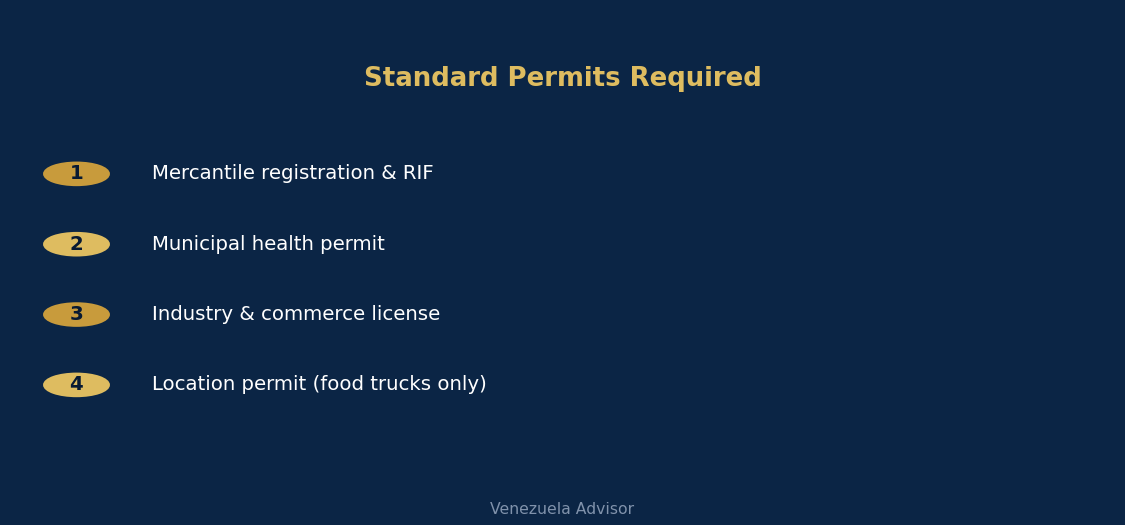
These four permits form the baseline for any food service operation, though the specific process and timeline vary meaningfully between municipalities.
- Mercantile registration of the company and RIF, as described in our company formation guide, remains the foundation everything else in this list builds on.
- Municipal health permit for food handling, typically the longest-lead-time item on this list.
- Industry and commerce license (patente) from the corresponding municipality, renewed annually in most jurisdictions.
- For food trucks, specific public-space location authorization, which varies by municipality and is often the least standardized of the four requirements.
Chacao, Baruta, and other eastern municipalities each administer their own patente and health permit processes independently, with different documentation requirements and processing timelines. Confirming the exact requirements for your specific municipality before finalizing a lease avoids the frustrating scenario of a signed lease sitting unused while permits are still pending. We generally recommend starting the health permit application the same week you sign a lease, rather than waiting until renovation is complete, since inspection scheduling alone can add unexpected weeks to your opening timeline — weeks that translate directly into rent paid on a space that isn't yet generating any revenue at all.
3. Choosing your location
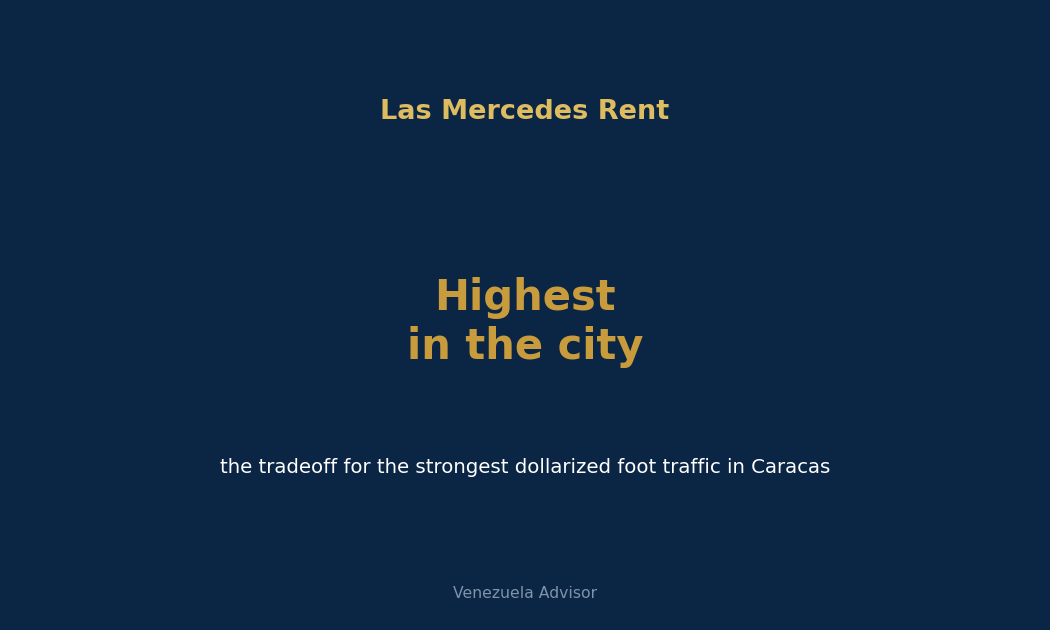
Las Mercedes commands the highest commercial rents in the city, precisely because it also carries the strongest dollarized foot traffic — the tradeoff is real and must be modeled explicitly rather than assumed away by enthusiasm for the location.
El Rosal and parts of Altamira offer a secondary tier of foot traffic at somewhat lower rent, and can represent a more defensible entry point for a first location, with expansion into Las Mercedes considered once the concept has proven itself and generated the cash flow to support the higher rent tier. Chasing the most prestigious address for your first location, before validating the concept anywhere, is a pattern we've seen sink otherwise promising restaurant concepts under rent obligations the early revenue simply couldn't support. A methodical approach — prove the concept somewhere more affordable, then expand into the premium corridor — consistently outperforms leading with the biggest bet on day one, particularly for a founder without an existing track record in the local market to fall back on if the first months prove slower than hoped.
4. Costs founders consistently underestimate
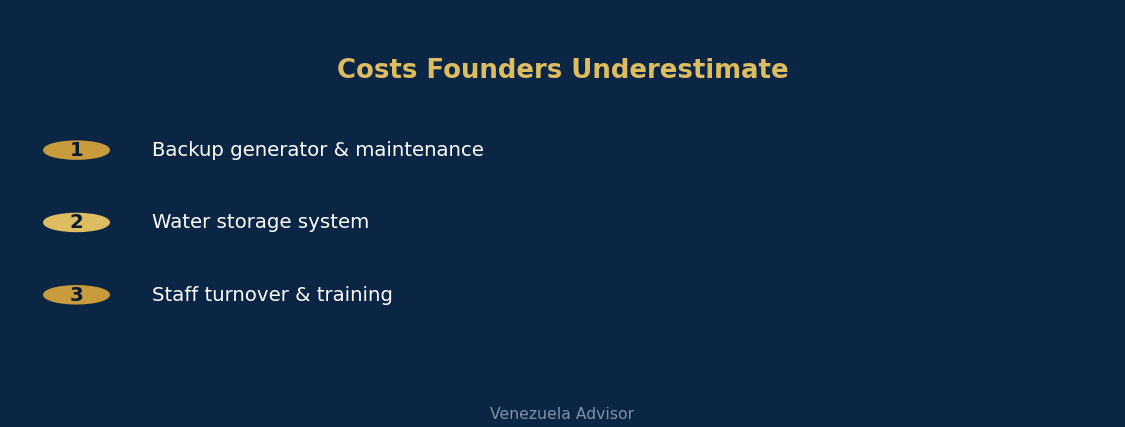
Backup power and water storage aren't optional add-ons given the electrical instability that still affects different zones — they're operational infrastructure as fundamental as the kitchen equipment itself. A restaurant that loses power during dinner service loses not just that night's revenue but potentially the customer relationship entirely, in a market where diners have increasingly reliable alternatives to choose from instead. Guests who arrive to a dark dining room once rarely give a second chance when a competitor down the same corridor never had the problem at all.
Staff turnover, discussed further below, is the third consistently underestimated cost. Recruiting and training a new hire carries real cost even before they're fully productive, and budgeting for a baseline level of turnover — rather than assuming your initial hires will stay indefinitely — produces a far more realistic operating budget from the start. A generator sized correctly for your kitchen's actual peak load, not a generic estimate, and a water tank sized for a genuine multi-day outage rather than a few hours, are both worth the upfront engineering conversation before you commit to equipment.
5. Staffing in a high-turnover industry
Staff turnover in gastronomy tends to run high, and budgeting for ongoing training as a recurring cost — not a one-time setup expense — protects service quality through the inevitable staffing changes. This challenge isn't unique to Caracas, but the dollarized wage expectations described below add a layer of local specificity worth planning for from the start.
Restaurants that build a lightweight, repeatable training process — a written checklist, a short shadowing period, clear service standards — recover from staff turnover faster than those relying entirely on informal, verbally-passed knowledge from departing staff to new hires. This investment pays for itself the first time a key staff member leaves unexpectedly and the replacement can be brought up to standard within days rather than weeks. Documenting your recipes and service standards in writing, rather than keeping them only in the head chef's memory, is a small upfront effort that protects the business from being overly dependent on any single individual staying indefinitely — a risk that materializes far more often than most first-time operators expect.
Competitive wages in a dollarized segment
Restaurants operating in the dollarized consumer segment described throughout this guide generally need to offer competitive dollar or dollar-equivalent compensation to attract and retain reliable staff, particularly in a corridor like Las Mercedes where several establishments are competing for the same limited pool of experienced service and kitchen staff. Underpaying relative to the local competitive set, even by a modest margin, tends to produce exactly the turnover pattern that then makes the training investment described above even more critical to get right — a cycle that's far cheaper to avoid at the outset than to break once it's already established itself as the norm at your restaurant.
6. Common mistakes we see
Underestimating backup infrastructure costs, choosing a location based on rent alone without validating foot traffic, and treating staff training as a one-time event rather than a continuous process are the three mistakes we see most consistently among new operators — a pattern that echoes the sequencing mistakes covered throughout our other business guides in this series.
Skipping a soft-open period
Launching at full capacity from day one, without a soft-open period to work out kitchen and service kinks with a smaller crowd, exposes new operators to their worst possible first impression precisely when word-of-mouth matters most. A short soft-open window, even just a few days, lets you catch and fix problems before the broader public forms their first opinion of the concept — problems that are far cheaper to fix quietly during a soft open than publicly during a fully booked opening week.
Underpricing to compete on cost in a segment that doesn't reward it
In the dollarized zones this guide focuses on, customers are generally paying for experience and consistency, not hunting for the lowest price on the block. Restaurants that underprice to compete on cost in this segment often erode their own margins without actually winning the loyalty of price-sensitive customers, who were never the target demographic for a Las Mercedes location in the first place — a mismatch between pricing strategy and actual customer base that's easy to avoid once named explicitly.
Treating the menu as fixed from opening day
The most resilient restaurants we've observed treat their menu as a living document for at least the first several months, adjusting based on what actually sells versus what looked good on paper during planning. Founders who resist adjusting a menu item that consistently underperforms, out of attachment to the original concept, leave money on the table that a more flexible approach would have captured. Reviewing sales data weekly during the first quarter, rather than waiting for a formal quarterly review, catches these signals early enough to act on them meaningfully — and a menu that evolves visibly in response to what customers actually order tends to build more loyalty, not less, than one that never changes.
Glossary
Patente de industria y comercio: the municipal business license required to legally operate a commercial establishment.
Location permit: specific authorization required for food trucks to operate in public space, which varies by municipality.
Soft open: a limited-capacity trial period before full public launch, used to identify and fix operational issues.
Ramp-up period: the months after opening during which revenue builds toward a stable run rate as word-of-mouth spreads.
Contingency reserve: cash set aside specifically to cover a slower-than-expected ramp-up, sized against a defined downside scenario rather than an arbitrary figure.
Building a realistic first-year financial model
Beyond the individual line items covered above, a realistic first-year model should assume a ramp-up period rather than immediate full capacity — most new restaurants in this corridor take several months to reach a stable, predictable revenue run rate as word-of-mouth builds and initial operational kinks are resolved. Modeling break-even at month six or eight, rather than month one, produces a far more defensible plan for both your own decision-making and any conversation with potential investors or lenders. A model that assumes immediate full capacity isn't just optimistic — it's the kind of projection that leads directly to a cash crunch during the exact months when the business needs breathing room most.
It's also worth explicitly modeling a downside scenario: what happens to your cash position if ramp-up takes twice as long as expected? Founders who've stress-tested this scenario in advance make calmer, better decisions during an actually slow opening period than those encountering that possibility for the first time in real time, with real money and real anxiety involved. Setting aside a specific contingency reserve, sized against this downside scenario rather than an arbitrary round number, gives you a concrete answer to "how long can we sustain this" rather than a vague sense of unease as the first few months unfold.
A useful discipline borrowed from the real estate transactions covered elsewhere in this guide series: treat your restaurant's opening budget the way you'd treat a property's total acquisition cost, including every closing-adjacent expense, rather than just the headline number. Permits, backup infrastructure, initial inventory, and a genuine cash runway for the ramp-up period all belong in that total, not just the build-out and first month's rent that tend to dominate a founder's initial mental estimate.
Key takeaways
- Las Mercedes and similar zones concentrate demand but also carry the city's highest commercial rents, a tradeoff to model explicitly.
- A food truck reduces initial investment in exchange for greater dependence on location permits and public-space authorization.
- Budgeting backup power and water infrastructure is as essential as budgeting the menu itself — treat it as core infrastructure, not an optional upgrade.
- Recurring training investment protects service quality through inevitable staff turnover, and competitive dollar-equivalent wages reduce that turnover in the first place.
- A soft-open period and menu flexibility in the first months meaningfully improve odds of long-term success versus launching rigid and at full capacity.
- Model a realistic ramp-up period and a downside scenario before opening, not after cash gets tight and options narrow.
If you're planning to open a restaurant or food truck in Caracas, we can help you evaluate locations and connect you with attorneys experienced in municipal permitting, and think through the full financial model before you sign a lease you can't yet be sure the business can support — the same disciplined approach we recommend across every guide in this series.