
Venezuela's Trade Ties with Colombia and Panama: What Business Owners Should Know Before Choosing a Corridor
By: Venezuela Advisor — Published 2026 · Share
For businesses covered throughout this guide series — from the import/export operations to franchise concepts sourcing goods from abroad — Colombia and Panama function as the two most practically relevant trade corridors, each with a genuinely different profile that a business should understand thoroughly before committing significant volume to either one.
- 1. Two corridors, two different profiles
- 2. The Colombia border corridor
- 3. The Panama re-export hub
- 4. Choosing between them for your specific business
- 5. Why diaspora networks matter more than they might seem to
- 6. Mistakes we see businesses make
- Glossary
- Scaling from occasional shipments to a recurring trade relationship
- Documentation requirements specific to each corridor
- Currency and payment considerations across both corridors
- Key takeaways
1. Two corridors, two different profiles
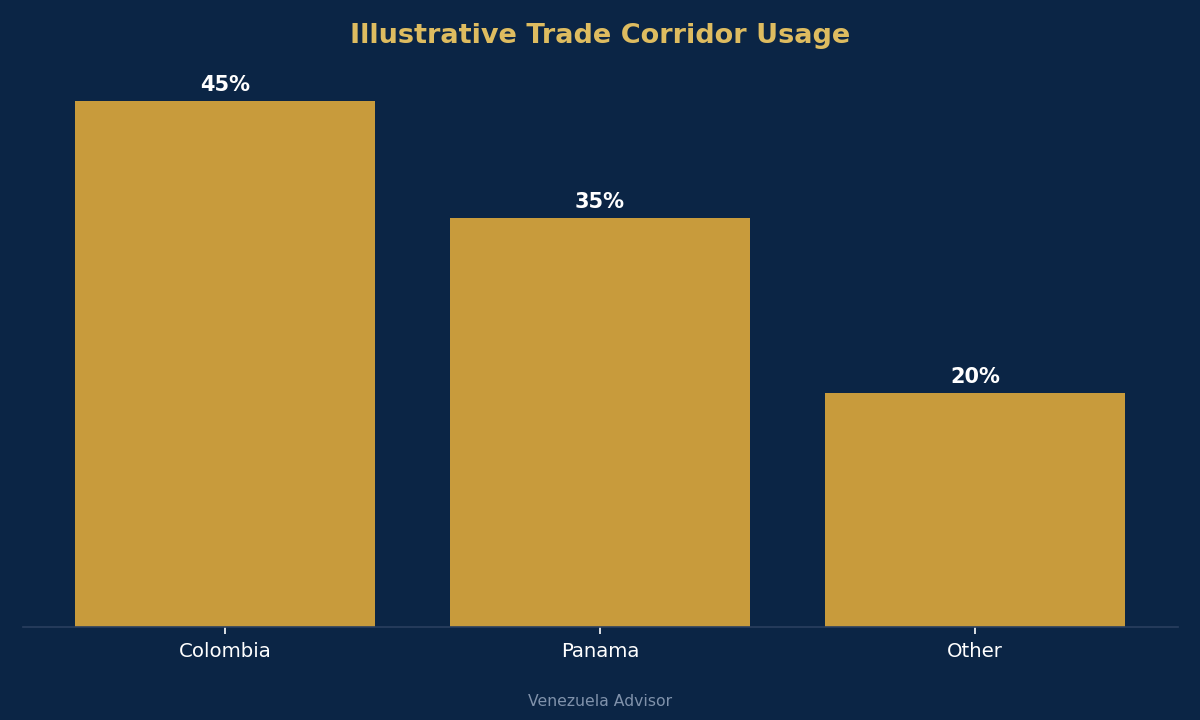
Illustrative distribution, not a precise trade survey: Colombia and Panama together account for the large majority of practical trade flow relevant to Venezuelan businesses, with each corridor favored for different reasons depending on the product, timeline, and margin structure involved.
Neither corridor emerged by accident — each reflects decades of accumulated trade infrastructure, business relationships, and institutional knowledge that a brand-new corridor would take years to replicate from nothing. Understanding why each corridor developed the way it did helps explain which one is likely to fit your specific business need going forward.
2. The Colombia border corridor
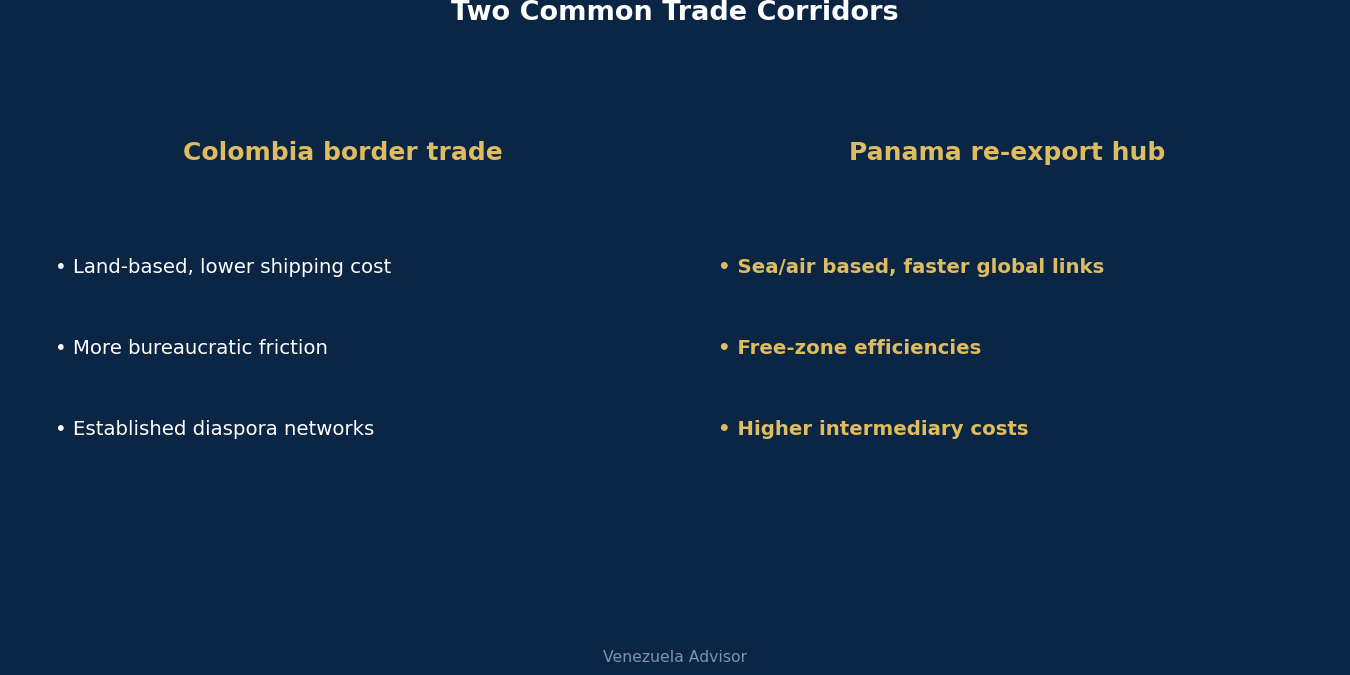
Land-based trade through Colombia typically offers lower shipping costs than sea or air alternatives, but comes with more bureaucratic friction at the border and greater exposure to the specific customs procedures described in our import/export guide.
The Colombia corridor tends to favor businesses with high-volume, lower-margin goods where the cost savings from land transport meaningfully outweigh the added time and paperwork of crossing a land border with variable processing speeds. Businesses that have built relationships with a specific, experienced customs broker at this border consistently report smoother operations than those treating each shipment as a fresh negotiation with an unfamiliar intermediary, and that relationship itself becomes a real competitive asset as shipment frequency increases over time.
3. The Panama re-export hub
Panama's free-zone infrastructure and established logistics industry offer faster global connections and more efficient re-export processing, at the cost of an additional intermediary layer that typically adds cost compared to direct sourcing arrangements a more established business might pursue instead.
The Colón Free Zone, one of the largest of its kind in the hemisphere, has decades of institutional experience handling exactly this kind of re-export trade, which translates into more predictable processing times than a less established alternative might offer today. This predictability matters most for businesses with time-sensitive inventory or seasonal demand patterns, where the Colombia corridor's variable border processing times pose a genuine operational risk that Panama's more mature infrastructure meaningfully reduces overall.
When the intermediary cost is worth paying
The additional cost of routing goods through a Panamanian intermediary is easiest to justify when the alternative — direct sourcing without that layer — would require establishing relationships and logistics capacity your business doesn't yet have in the origin country. For a business just beginning to import from Asia or Europe, for instance, working through an established Panama-based re-export operation can be more cost-effective in practice than attempting to build direct sourcing relationships from scratch, since the cost of building those relationships independently — travel, failed supplier vetting, learning-curve mistakes — often exceeds what an experienced intermediary charges to handle that complexity on your behalf.
4. Choosing between them for your specific business
Neither corridor is universally better — the right choice depends on your product category, your sourcing countries, and how much you value speed versus cost.
| Factor | Favors Colombia | Favors Panama |
|---|---|---|
| Product margin | Lower margin, cost-sensitive | Higher margin, can absorb intermediary cost |
| Sourcing origin | Regional, land-adjacent countries | Asia, Europe, other overseas origins |
| Time sensitivity | Flexible timelines | Seasonal or time-sensitive inventory |
| Business maturity | Established local relationships already in place | Early-stage, still building sourcing capacity |
Some businesses, particularly those with a diverse product catalog, end up using both corridors simultaneously — Colombia for regionally sourced, cost-sensitive goods, and Panama for overseas-sourced, higher-margin items. This dual approach adds coordination complexity but can outperform forcing every product category through a single corridor that doesn't fit all of them equally well.
5. Why diaspora networks matter more than they might seem to
Both Colombia and Panama host substantial Venezuelan diaspora populations, and the informal business networks within these communities often provide practical trade knowledge — reliable customs agents, trustworthy freight forwarders — that's harder to access through formal channels alone.
These networks function similarly to the local partnership dynamic described in our business tourism guide: a business owner who taps into an established diaspora network in Bogotá or Panama City gains access to vetted service providers and practical warnings about which intermediaries to avoid — information that would otherwise take months of trial and error to accumulate independently. Attending Venezuelan business association events in either city, even informally, is often a more efficient way to build this network than cold outreach to service providers found only through online search, and the relationships formed this way tend to carry a level of trust and accountability that a purely transactional vendor relationship doesn't offer in the same way.
6. Mistakes we see businesses make
Choosing a corridor based on general reputation rather than product-specific fit, underestimating the intermediary costs in a re-export structure, and failing to build relationships with local diaspora business networks are the three mistakes we see most consistently.
Defaulting to the corridor a competitor uses
Businesses sometimes choose a trade corridor simply because a competitor or acquaintance uses it successfully, without verifying that the underlying product category, margin structure, and timeline requirements actually match their own situation. What works well for a competitor's specific product mix may be a poor fit for a different product entirely — the evaluation described in the table above should be run independently for your own business, not inherited from someone else's decision made under different circumstances and for a different product altogether.
Underestimating true landed cost through Panama
As with the import cost planning described in our import/export guide, businesses routing goods through Panama sometimes calculate cost based only on the intermediary's quoted fee, without fully accounting for the additional handling, storage, and onward-shipping charges that accumulate at each stage of a multi-leg re-export journey. Requesting a complete, itemized cost breakdown before committing to a specific re-export provider avoids this underestimation, and gives you a real basis for comparing quotes from different providers rather than comparing headline figures that may not represent the same actual scope of service.
Glossary
Re-export: the practice of importing goods into an intermediary country and then exporting them onward, often to take advantage of that country's logistics or free-zone infrastructure and established trade relationships.
Free zone: a designated area with reduced customs and tax requirements, commonly used to facilitate re-export trade and attract international logistics operations.
Trade corridor: an established route and set of practices used for moving goods between two or more countries, built up over years of accumulated commercial activity.
Landed cost: the total cost of a shipment once fully delivered, including freight, duties, intermediary fees, and any additional handling charges — as opposed to the headline quote alone, which rarely captures the true final cost.
Transit documentation: paperwork specific to goods physically crossing a land border, distinct from standard import documentation for sea or air freight.
Scaling from occasional shipments to a recurring trade relationship
A business's first few shipments through either corridor often function as much as a learning process as a commercial transaction — discovering which documentation genuinely matters, which intermediaries are reliable, and what realistic timelines actually look like in practice rather than what's promised upfront. Treating these early shipments with that expectation, rather than assuming the first shipment will run as smoothly as a fifth or tenth one, sets more realistic expectations for cost and timeline, and reduces the frustration when an early shipment inevitably surfaces a gap in your initial planning.
As shipment volume grows, businesses that have documented what worked and what didn't in these early transactions are positioned to negotiate meaningfully better terms with intermediaries, freight forwarders, and customs brokers than those starting each new shipment without that accumulated institutional knowledge already in hand. This mirrors the process-documentation discipline described throughout our restaurant and hospitality guides: the value of writing things down compounds over time, even when it feels like unnecessary overhead in the moment, and becomes a genuine competitive advantage once a handful of shipments have accumulated real, hard-won institutional knowledge.
Key takeaways
- Colombia and Panama offer genuinely different trade profiles, not interchangeable options, each suited to different products and specific business circumstances.
- Land-based Colombia trade favors lower cost; Panama's re-export infrastructure favors speed and global connectivity.
- Diaspora business networks in both countries provide practical knowledge that formal channels alone don't fully replace, and are genuinely worth cultivating deliberately.
- Some businesses benefit from using both corridors simultaneously, matched carefully to different product categories and margin profiles at once.
- Run your own product-specific evaluation rather than defaulting to whichever corridor a competitor happens to use for entirely different reasons and circumstances.
- Confirm payment currency and method with each supplier before finalizing a sourcing relationship, rather than assuming dollar payment is always accepted without any friction whatsoever.
- Document lessons from early shipments to negotiate better terms as trade volume grows over time and business relationships mature further.
If you're evaluating trade corridor options for a Venezuelan business, we can help you think through which profile fits your specific product and sourcing needs, and connect you with brokers and logistics providers experienced in the corridor that fits your business best.
Documentation requirements specific to each corridor
Beyond the general import documentation described in our import/export guide, each corridor carries its own specific paperwork conventions that a business should confirm before its first shipment rather than discovering mid-transaction.
Colombia-specific documentation considerations
Land-border trade with Colombia typically requires specific transit documentation beyond standard import paperwork, covering the goods' movement across the physical border crossing itself. An experienced customs broker at this specific border crossing — not a general import consultant without land-border-specific experience — is the right resource for confirming exactly what's required for your product category, since requirements can vary by crossing point and have historically been less standardized than sea or air freight documentation. Two businesses importing similar goods through different crossing points along the same border have, in practice, sometimes faced meaningfully different documentation experiences, which is why generic advice about "the Colombia border" is less useful than crossing-specific guidance from someone who works that exact route regularly.
Panama-specific documentation considerations
Goods routed through the Colón Free Zone carry their own specific re-export documentation requirements, distinct from a standard direct import. Working with a Panama-based logistics provider experienced specifically in Venezuela-bound re-export — not simply general Panama import/export experience — reduces the risk of documentation gaps that only surface once goods have already left the free zone and are en route to Venezuela, at which point correcting a gap is considerably more difficult and costly than catching it before departure, and can leave a shipment sitting in limbo at exactly the point in the journey where delays are hardest to resolve quickly.
Currency and payment considerations across both corridors
Both corridors typically operate on dollar-denominated pricing for the intermediary and logistics fees involved, which aligns naturally with the dollarized transaction environment described throughout this guide series. Where this alignment breaks down is in supplier payments at the origin: a supplier in Colombia may expect payment in Colombian pesos for certain transaction types, while a supplier working through Panama may have their own currency preferences depending on where their own goods originate.
Confirming the expected payment currency and method with each specific supplier and intermediary before finalizing a sourcing relationship — rather than assuming dollar payment will always be accepted without complication — avoids a late-stage payment friction that can delay an otherwise-ready shipment. This is a small confirmation step that costs little time upfront and prevents a genuinely disruptive delay later in the process, particularly for a business on a tight seasonal timeline where a payment-related delay of even a few days can mean missing a target delivery window entirely, with consequences that ripple through the rest of that season's inventory and sales planning.
Building payment terms into your supplier relationships
As a trade relationship matures beyond the first few transactions, negotiating standing payment terms — net-30 arrangements, established wire instructions, agreed currency — with a regular supplier removes friction that a first-time, ad hoc transaction inevitably carries. This kind of standing relationship takes time to build and generally requires a track record of reliable, on-time payment from your side first, but it meaningfully smooths the logistics of recurring trade once established, and often unlocks better pricing as well, since suppliers value predictability from a counterparty they've come to trust over repeated transactions and multiple successful shipping cycles together.