
Business Tourism in Venezuela: Where Hotels, Coworking Spaces, and Live Events Actually Make Sense (2026)

By: Venezuela Advisor — Published 2026 · Share
Business tourism sits at the intersection of two recoveries described throughout this guide series: the dollarized consumer economy concentrated in eastern Caracas, and the renewed interest in coastal destinations like Isla de Margarita. This guide looks at where hospitality and business-travel investment actually makes sense today, and where it doesn't yet — a distinction that matters more in this sector than almost any other covered in this series, given how capital-intensive a hospitality misstep can be.
- 1. Where hotel capacity actually concentrates today in Venezuela
- 2. Boutique hotel vs. coworking space: two genuinely different bets
- 3. Where business travel demand actually concentrates today
- 4. Events and MICE tourism: a smaller, more specific market opportunity
- 5. Operating realities specific to hospitality
- 6. Mistakes we see investors make in this sector
- Glossary of hospitality terms
- Financing considerations specific to hospitality projects today
- Why local operating partnerships outperform solo foreign ventures
- Key takeaways and how to start
- Staffing considerations specific to hospitality roles
1. Where hotel capacity actually concentrates
Illustrative distribution, not a precise market survey: the large majority of Venezuela's formal hotel capacity sits in Isla de Margarita, reflecting decades of tourism infrastructure investment that Los Roques and Chichiriviche never received at comparable scale, as detailed in our coastal investment comparison. Caracas itself carries meaningful hotel capacity as well, though skewed toward business-traveler-oriented properties rather than the leisure-focused inventory concentrated on the coast.
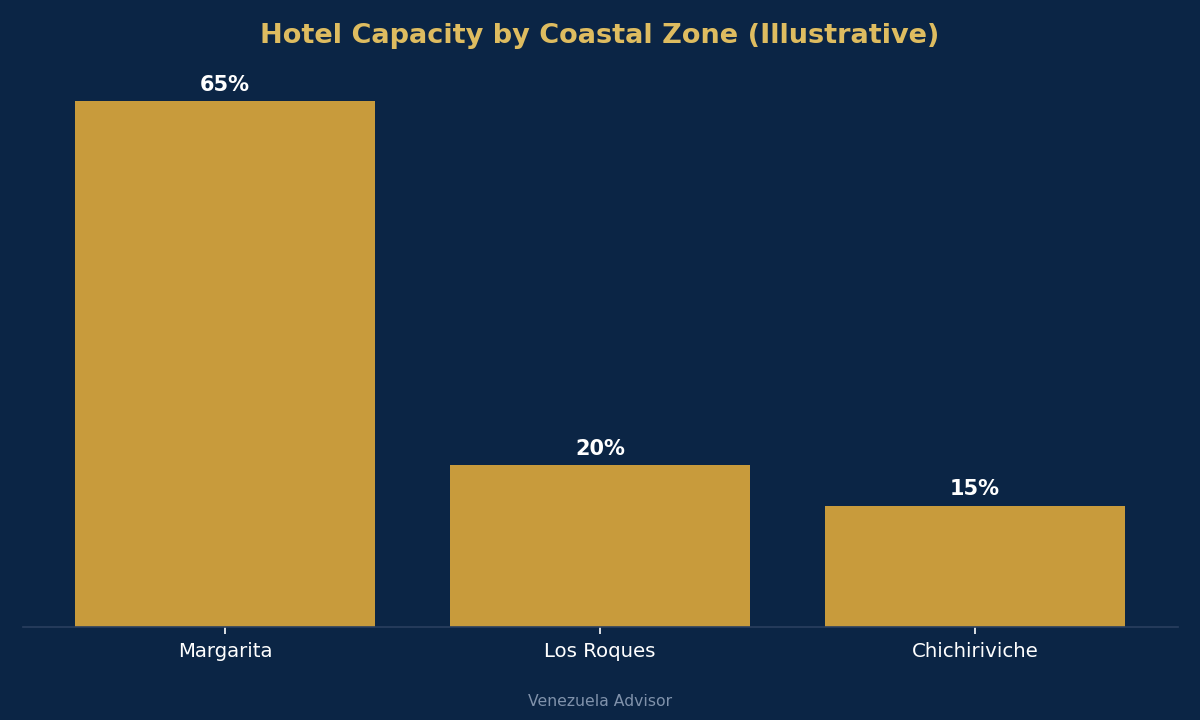
This concentration matters for anyone evaluating a hospitality investment: Margarita offers an existing customer flow, established supply chains for hotel operations, and a workforce with relevant experience — advantages that a first mover in a less developed destination simply doesn't have access to, regardless of how appealing the underlying location might look on paper. A first mover into a genuinely underserved destination can succeed, but should budget for a longer path to profitability than a comparable property entering an already-established market like Margarita.
2. Boutique hotel vs. coworking space: two different bets
These represent genuinely different, distinct investment profiles, not variations on the same idea, and conflating them is a common early-stage mistake. A boutique hotel requires substantially higher upfront capital — rooms, furnishings, hospitality-grade infrastructure — and its revenue depends heavily on tourism cycles, seasonality, and destination-level demand that a single operator has limited ability to influence. A coworking space, by contrast, requires meaningfully less capital to launch, draws on steadier local demand from independent professionals and small businesses rather than tourism flows, but also carries a lower revenue ceiling per square meter than a well-run hotel property in a strong location.
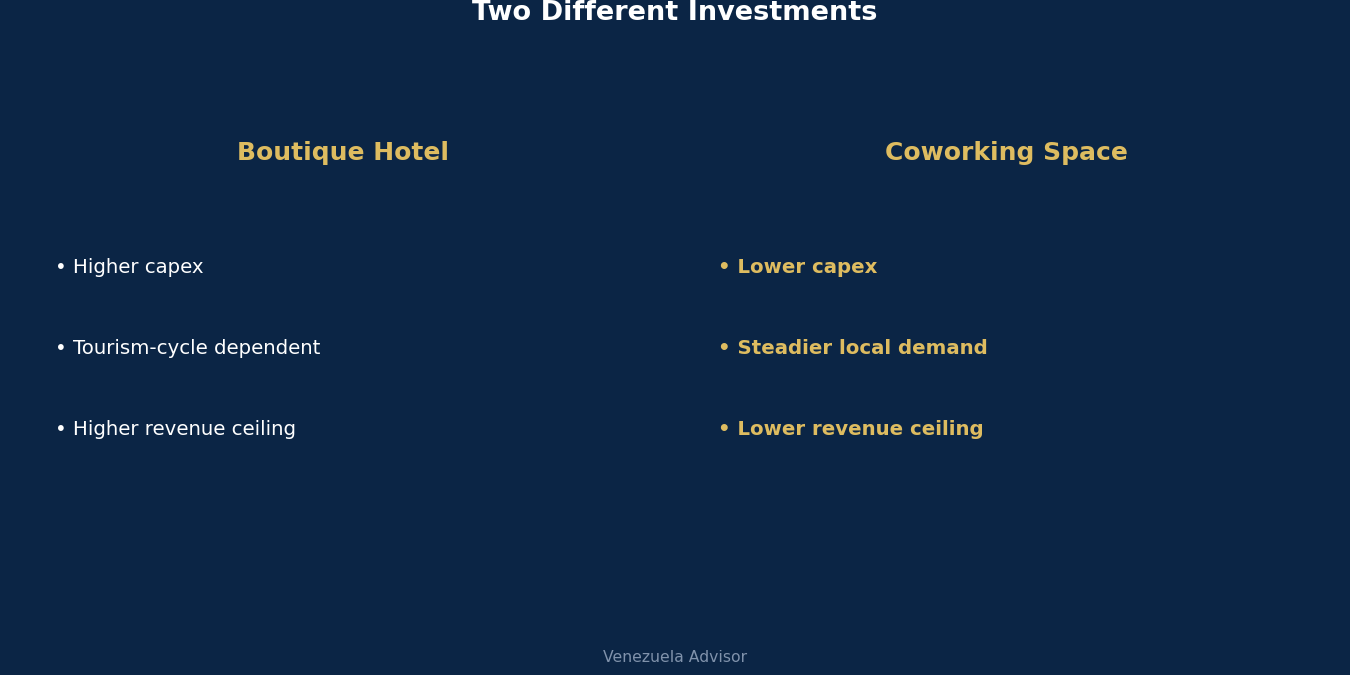
The right choice depends less on which model is "better" in the abstract and more on which risk profile matches your available capital and your tolerance for tourism-cycle volatility. An investor with substantial capital and a multi-year horizon may find the hotel model's higher ceiling worth the additional risk; an investor with more modest capital and a preference for steadier, if lower, returns may find coworking the more defensible entry point into hospitality-adjacent real estate. Neither choice is inherently wrong — the mistake is choosing without explicitly weighing this tradeoff first.
3. Where business travel demand actually concentrates
Caracas captures the majority of pure corporate business travel — executives, consultants, professionals attending to operational matters — while Margarita captures a growing share of leisure-adjacent business travel and small-scale corporate events.
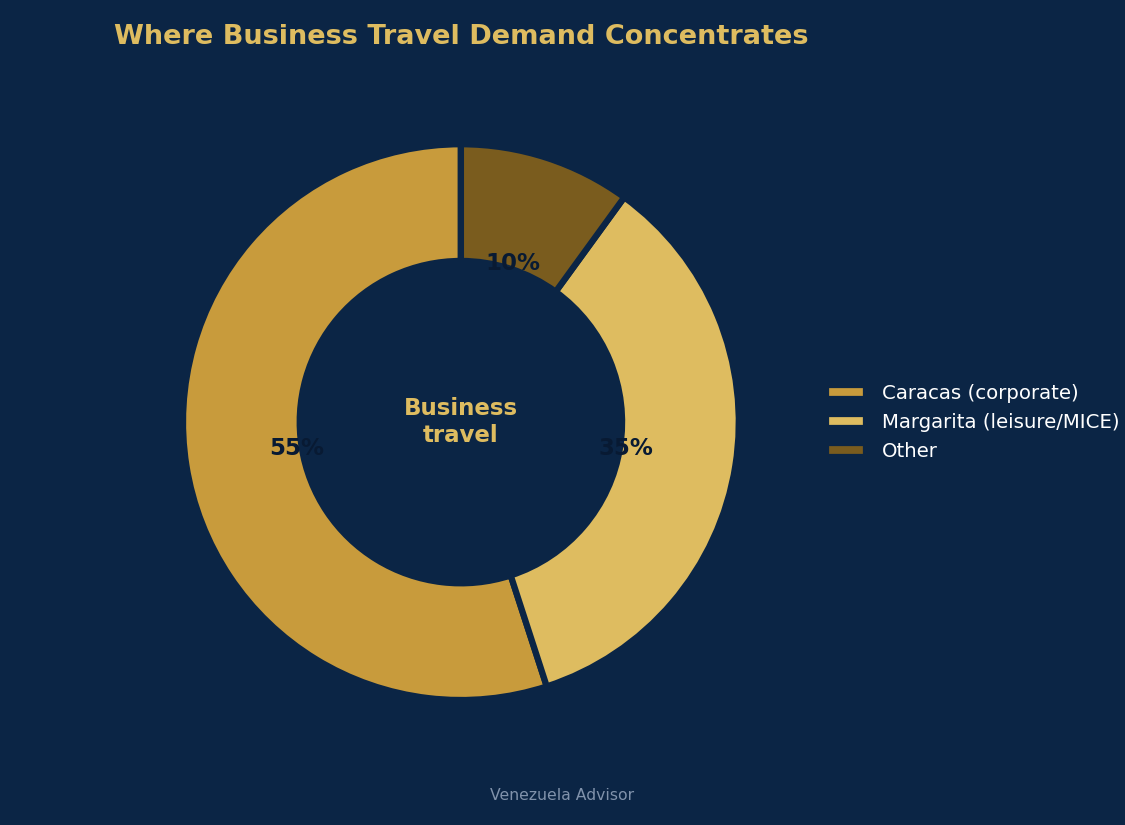
This distinction matters for site selection: a business hotel or serviced-apartment concept aimed at pure corporate travel belongs in Caracas's eastern corridor, close to the commercial districts described in our neighborhood guide, while a concept blending business and leisure — the kind of trip where an executive extends a work visit into a few personal days — fits Margarita's profile far better. Positioning a purely corporate-styled property in a leisure destination, or vice versa, tends to underperform regardless of how well-executed the physical space itself is.
4. Events and MICE tourism: a smaller, specific opportunity
Meetings, incentives, conferences, and exhibitions (MICE) tourism remains a narrower opportunity in Venezuela than in more established regional hubs, constrained by limited large-venue infrastructure and international flight connectivity. That said, small-to-mid-size corporate events and incentive trips do occur, particularly in Margarita, and represent a real if modest revenue stream for well-positioned properties.
A realistic MICE strategy for Venezuela today means targeting groups of dozens rather than hundreds, and building relationships with regional corporate clients — companies with existing ties to Venezuela through trade or family connections — rather than competing for large international conference business that requires infrastructure the country doesn't yet have at scale. Properties that have found success in this niche tend to emphasize flexibility and personal service precisely because they can't compete on venue size with larger regional hubs.
Building a realistic MICE pipeline rather than waiting for large bookings
Properties that succeed in this segment typically build a steady pipeline of smaller, recurring bookings — a company's quarterly retreat, a professional association's annual meeting — rather than betting the business model on landing one or two large international conferences a year. This steadier approach produces more predictable cash flow and reduces the risk of a single cancelled booking creating a significant revenue gap, a real risk for any property that becomes overly dependent on a small number of large-scale events. Building relationships with a handful of recurring corporate clients, even modest ones, provides a more resilient foundation than chasing occasional large bookings that may or may not materialize each year.
5. Operating realities specific to this sector
Backup power and water infrastructure — a theme throughout this guide series — matter even more in hospitality than in most other sectors, since a hotel or coworking space's entire value proposition depends on consistent service delivery that a restaurant or retail store can more easily work around during a temporary outage.
A guest who books a hotel room expects reliable air conditioning, hot water, and Wi-Fi as baseline features, not amenities. A coworking member expects the same for power and internet connectivity specifically. Properties in this sector that treat backup infrastructure as a differentiator to market, rather than table stakes to simply have in place, are misreading what guests and members actually expect walking in the door — the infrastructure needs to work silently in the background, not serve as a selling point that implies it might not, and marketing it too heavily can backfire by raising doubts a guest wouldn't otherwise have had.
6. Mistakes we see in this sector
Modeling hotel occupancy on international benchmarks rather than Venezuela-specific patterns, underestimating the true capital intensity of hospitality relative to other business types, and treating backup infrastructure as a secondary concern rather than a core service requirement are the three mistakes we see most consistently.
Borrowing occupancy assumptions from unrelated markets
A developer modeling a Margarita property on occupancy rates typical of a mature Caribbean destination like Punta Cana is very likely overstating achievable performance. Venezuela's coastal destinations, while recovering, don't yet carry the same international brand recognition or booking-platform visibility that drives occupancy in more established markets — a gap that closes over time but shouldn't be assumed away in an initial financial model. A more conservative starting assumption, revised upward only as actual booking data accumulates, protects against the kind of overoptimistic projection that later forces uncomfortable conversations with investors or lenders.
Underestimating total capital requirements
Hospitality properties carry higher fit-out and furnishing costs per square meter than most other commercial uses, and imported furniture, fixtures, and equipment face the same landed-cost considerations described in our import/export guide. Founders who budget hospitality fit-out costs using general commercial renovation estimates consistently underestimate this specific line item, sometimes significantly enough to require raising additional capital mid-construction rather than having planned for the true cost from the outset.
Treating a single property as a full portfolio strategy
A single hospitality property, however well-run, carries the same concentration risk described in our family business guide — the entire investment depends on one location's performance, one set of local conditions, one competitive landscape. Investors planning to build a genuine hospitality portfolio over time benefit from thinking about diversification across locations and segments from the first property forward, rather than treating each property as an entirely separate decision disconnected from a broader strategy. This mindset shift, adopted early, shapes site selection and concept decisions in ways that a purely single-property mentality never would.
Glossary
MICE tourism: Meetings, Incentives, Conferences, and Exhibitions — the segment of business travel built around organized group events rather than individual corporate trips.
Occupancy rate: the percentage of available rooms or space actually booked over a given period, the core metric for hospitality profitability.
Capex: capital expenditure — the upfront investment required to establish a business, as distinct from ongoing operating costs.
Fit-out: the furnishing, fixtures, and finishing work required to bring a commercial space to operational standard for its intended use.
Financing considerations specific to hospitality projects
Without an active mortgage market, hospitality projects in Venezuela are financed almost entirely through owner equity, sometimes supplemented by private investor groups pooling capital for a specific property. This financing reality shapes project scale directly: a hotel concept requiring capital beyond what a founder or small investor group can assemble in cash simply isn't viable in the current market, regardless of how sound the underlying business case might be in a market with active project financing readily available elsewhere.
This constraint pushes many hospitality investors toward phased development — opening a smaller initial property, proving the concept and building a track record, then expanding with reinvested profits rather than external financing. This approach takes longer to reach full scale than a project financed all at once, but it matches the capital reality most investors actually face in this market, and it reduces the risk of a single overextended project consuming capital the investor can't easily replace if the initial assumptions prove optimistic. Investors coming from markets with active hospitality lending sometimes find this phased approach frustratingly slow at first, but it's the approach that actually matches how capital moves in this specific market today.
Why local operating partnerships often outperform solo foreign ventures
Foreign investors entering Venezuelan hospitality frequently underestimate how much locally specific operational knowledge — supplier relationships, staffing networks, municipal permit navigation — a successful property depends on beyond the physical space and concept itself. A local operating partner, even a minority one, often accelerates a property's path to profitability far more than the additional capital a foreign-only structure might otherwise bring to the table.
This mirrors a pattern we've described across other sectors in this guide series: businesses that pair foreign capital with genuine local operating expertise, rather than treating local involvement as a formality, consistently outperform structures where all meaningful decisions are made from outside the market. In hospitality specifically, where guest experience depends heavily on staff who understand local service expectations, this partnership dynamic matters even more than in less guest-facing business types — a local partner's network alone can shave months off the time it takes to reach reliable, well-trained staffing levels.
Key takeaways
- Formal hotel capacity concentrates heavily in Margarita, reflecting decades of prior tourism infrastructure investment.
- Boutique hotels and coworking spaces represent genuinely different investment profiles with different capital and demand characteristics.
- Caracas captures most pure corporate travel; Margarita captures a growing share of leisure-adjacent business travel.
- Backup infrastructure is a core service requirement in hospitality, not an optional upgrade.
- MICE opportunities are real but modest in scale — target regional corporate clients, not large international conference business.
- Budget hospitality-specific fit-out costs separately from general commercial renovation estimates.
- A local operating partner often accelerates a property's path to profitability more than additional foreign capital alone.
If you're evaluating a hospitality or coworking investment in Venezuela, we can help you think through location, capital structure, and local partnership options specific to your target segment, drawing on the same due diligence approach that runs throughout this entire guide series.
Staffing considerations specific to hospitality
Hospitality staffing carries the same dollar-competitive wage pressures described in our hiring guide, compounded by the need for guest-facing staff with specific service training that takes longer to build than in most other retail or food service roles. A hotel or coworking space that treats front-desk and hospitality roles as interchangeable with general retail staffing consistently underperforms on the guest experience that actually drives repeat business and referrals in this sector.
Investing in a structured onboarding process for guest-facing roles specifically — beyond the general training discipline described in our restaurant staffing guide — pays off disproportionately in hospitality, where a single poor guest interaction can outweigh weeks of otherwise flawless service in how a guest describes the property to others afterward. Properties that invest early in this kind of structured training tend to see it reflected directly in repeat bookings and referral-driven demand, which over time becomes a meaningfully cheaper acquisition channel than continuous paid marketing.