
Safety in Venezuela: Practical Guidance and Recommended Zones for Newcomers (2026)
By: Venezuela Advisor — Published 2026 · Share · Updated for current conditions
Safety is a legitimate and common concern for anyone considering Venezuela, and it deserves a direct, practical answer rather than either dismissal or exaggeration. This guide focuses on what actually helps: which zones maintain stronger security infrastructure, and which daily habits matter most, drawing on the same practical, verification-focused approach used throughout this entire guide series.
- 1. Private security infrastructure varies sharply by zone
- 2. Daily habits that matter more than location alone
- 3. What to check about a specific building
- 4. Transportation-specific considerations
- 5. Keeping perspective without dismissing real risk
- 6. Mistakes we see newcomers make
- Glossary
- Security considerations specific to businesses
- Considerations specific to families with children
- Documentation as a form of practical protection
- Key takeaways
1. Private security infrastructure varies sharply by zone and municipality
Illustrative index, not a crime statistic: eastern Caracas municipalities like Chacao maintain the most developed private security infrastructure in the country, a direct extension of the same demand concentration described throughout this guide series.
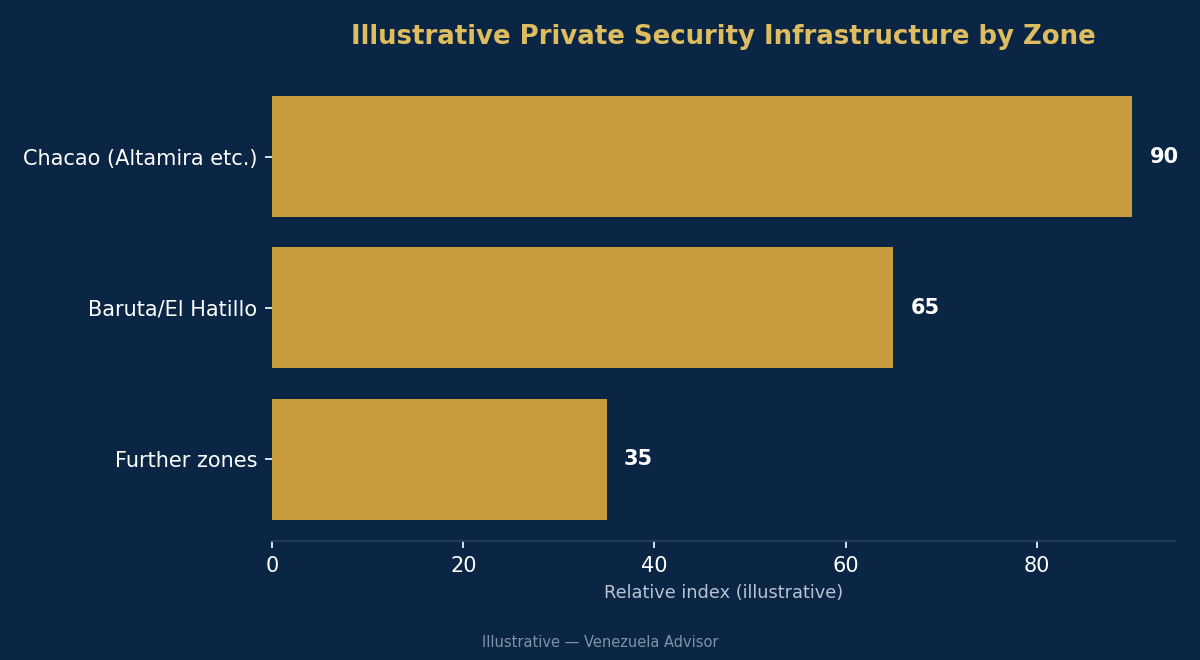
This infrastructure didn't develop by accident — it reflects decades of sustained private investment by residents, businesses, and building associations in zones with the highest concentration of dollarized wealth, a pattern consistent with the real estate and commercial dynamics described throughout this guide series. Newcomers evaluating a neighborhood should look specifically at this private infrastructure layer, not just general reputation, since it's the private investment that most directly shapes daily lived experience for anyone actually residing there day to day.
2. Daily habits that matter more than location alone
Even in the most secure zones, everyday habits meaningfully affect personal safety in ways that no amount of neighborhood-level infrastructure alone can fully offset.
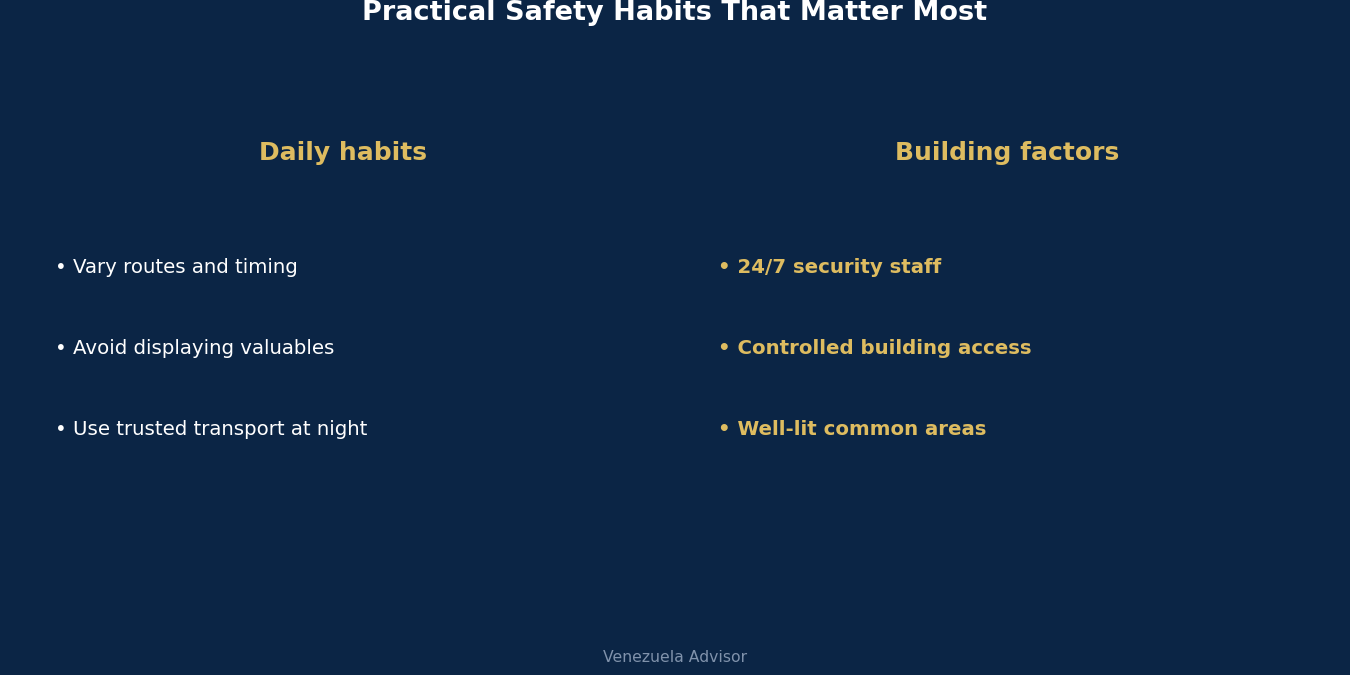
Varying routes and timing for regular trips, avoiding the visible display of valuables in public, and using trusted transportation at night are habits that cost nothing to adopt but meaningfully reduce exposure regardless of which zone you live in specifically. These aren't Venezuela-specific precautions in isolation — they're standard practice in any major city with meaningful income inequality — but they matter more here given the specific security context, and residents who maintain them consistently report a more comfortable daily experience than those who don't bother with this kind of basic planning.
3. What to check about a specific building before signing
Beyond the general neighborhood, a specific building's own security measures — staffed access control, camera coverage, well-lit common areas — vary considerably even within the same well-regarded zone, and deserve the same direct verification recommended throughout this guide series for other infrastructure questions.
Questions worth asking directly during a building visit
Ask specifically how many security staff are on duty at different times of day, whether visitor access is genuinely controlled or merely nominal, and how long the current security arrangement has been in place without interruption or significant staffing changes. A building that recently reduced security staffing due to cost pressures, even one with an otherwise strong general reputation, may not currently offer the same level of protection its reputation suggests — a detail that only surfaces through direct, specific questions rather than a general impression formed during a brief viewing appointment.
Recognizing burnout risk in security staff themselves
A less obvious but genuinely important factor: security staff working long or poorly compensated shifts are more prone to lapses in attention than well-supported staff, regardless of a building's nominal security arrangements on paper. Buildings that invest in reasonable shift lengths and fair compensation for security personnel tend to see this reflected in more consistently alert, attentive staff over time — a detail worth asking about, even indirectly, when evaluating a building's genuine security quality rather than just its formal staffing numbers and stated policies on paper.
Building management has an obvious incentive to present security measures favorably, while current residents can offer a more candid, lived assessment of whether those measures actually function as described day to day. Asking a prospective building's management to speak with a current resident, or seeking out residents independently through the same neighborhood networks described in our return guide, provides a valuable second perspective before committing to a lease or purchase.
4. Transportation-specific safety considerations to plan for
Using trusted transportation services rather than hailing unfamiliar vehicles, particularly at night, and being deliberate about timing and routes for regular trips, reduces exposure more than most other single precaution available to a newcomer.
Ride services and trusted drivers
Establishing a relationship with a specific, trusted driver — whether through a formal ride-hailing service or a personal referral from a colleague or neighbor — provides more consistent safety than relying on unfamiliar transportation options each time, particularly for regular routes like a daily commute or a child's school run. Many residents in the eastern corridor build this kind of standing relationship specifically because the consistency itself, not just the individual driver's care, adds a meaningful layer of predictability to daily transportation that a rotating cast of unfamiliar drivers simply can't match.
Night travel specifically
Travel after dark warrants more deliberate planning than daytime travel, including confirming a trusted transportation option in advance rather than arranging it in the moment, and informing someone of your expected route and arrival time for longer trips or unfamiliar destinations. These aren't extreme precautions — they're the kind of reasonable planning many residents already build into their routine without much active thought once it becomes habitual and second nature over time.
5. Keeping a fair, balanced perspective without dismissing real risk
International news coverage of Venezuela doesn't always capture the significant variation in daily life across neighborhoods and cities described throughout this guide series, and residents of the more secure eastern corridors often describe daily life as considerably more routine than outside coverage might suggest — without that observation minimizing the genuine precautions worth taking seriously.
Why this balance matters for decision-making
Both overstating and understating risk lead to poor decisions in practice. A prospective resident who assumes the worst based on international headlines alone may rule out a genuinely workable relocation prematurely, while one who dismisses all safety considerations as media exaggeration may fail to take reasonable precautions that meaningfully reduce actual risk in practice. The most useful approach treats safety as a specific, researchable factor — like the infrastructure and cost questions covered throughout this guide series — rather than either an unexamined fear or an unexamined assumption of safety based on secondhand impressions alone.
Talking to current residents for a grounded perspective
Residents already living in a prospective neighborhood offer a far more calibrated perspective than either alarmist media coverage or defensive dismissal from someone with an interest in selling you on the area's supposed safety. Seeking out these conversations directly, through the same reconnaissance approach described in our return guide, produces a more accurate and actionable picture than relying on either extreme, and often surfaces specific, practical details that neither general media coverage nor a real estate agent's pitch would think to mention on their own.
6. Mistakes we see newcomers repeatedly make in practice
Assuming a well-regarded general zone means every building within it maintains equally strong security, displaying visible signs of wealth in public without adjusting to local norms, and ignoring local guidance about specific areas or times to avoid are the three mistakes we see most consistently among newcomers making this transition.
Standing out unnecessarily in public settings
Visibly displaying expensive jewelry, electronics, or other markers of wealth in public settings — a habit that might draw no particular attention in a newcomer's home country — can meaningfully increase risk in contexts where income inequality is more visible and more acute than what many newcomers are accustomed to. This isn't about hiding who you are; it's a practical adjustment similar to precautions many people already take instinctively in any unfamiliar city, whether abroad or in their own country of origin.
Dismissing local guidance as overly cautious
Newcomers sometimes dismiss specific local guidance about certain areas or times as overly cautious, particularly if their own home country experience didn't require similar vigilance. Local residents' specific, current guidance — not generalized fear, but concrete knowledge about particular streets, times, or situations — deserves genuine weight, since it reflects lived experience that a newcomer, however well-intentioned, simply hasn't yet accumulated after only a short time in the country.
Underestimating the value of a consistent daily routine
Predictable daily patterns can, somewhat counterintuitively, reduce certain risks by allowing trusted contacts, drivers, and neighbors to notice quickly if something is genuinely out of the ordinary in a resident's usual schedule and daily rhythm. This isn't a reason to avoid all spontaneity, but it's worth recognizing as one more small factor in the broader picture of daily safety that this guide has tried to describe practically rather than alarmingly, alongside the infrastructure and habit factors covered throughout the rest of this article.
Glossary of relevant safety and security terms
Access control: building or neighborhood systems restricting entry to authorized residents, guests, and staff, ranging from a simple front-desk check to more sophisticated credentialed entry systems with logged records and visitor tracking.
Security infrastructure: the combination of staffing, physical measures, and technology a building or zone maintains to support resident safety, distinct from general neighborhood reputation alone and worth verifying independently.
Reconnaissance visit: a preliminary trip taken to verify current conditions firsthand, including neighborhood safety impressions, before committing to a specific location, lease, or property purchase.
Security considerations specific to businesses
Businesses covered throughout this guide series — from restaurants to hospitality properties — face security considerations distinct from residential safety, particularly around cash handling, closing procedures, and staff safety during late hours of operation and shift changes. A business's security plan deserves the same specific, verified approach recommended throughout this guide for residential buildings, rather than a generic assumption that operating in a well-regarded commercial zone alone is sufficient protection on its own.
Coordinating with neighboring businesses on shared security concerns — a common practice in established commercial corridors like Las Mercedes — often produces better outcomes than each business independently managing security in isolation from its neighbors and competitors. This kind of informal cooperation, built over time through the same local business networks described in our trade guide, provides practical value beyond what any single business could arrange entirely on its own without that broader coordination and mutual trust.
Considerations specific to families with children
Families relocating with children face additional safety planning beyond what a single adult or couple might consider, including school transportation safety, supervised activity locations, and age-appropriate guidance for children about neighborhood awareness and personal boundaries. Coordinating closely with a chosen school, as discussed in our education guide, on their specific transportation and campus security arrangements provides an important layer of information beyond general neighborhood safety research alone, and is worth confirming directly with school administration rather than assuming it matches the general reputation of the surrounding area.
Establishing clear, age-appropriate guidelines with children about neighborhood boundaries, trusted contacts, and what to do in an unfamiliar situation — the same kind of practical guidance many families already provide in any city, regardless of country — deserves particular attention during the adjustment period covered in our return guide, when children are also adapting to new surroundings and routines simultaneously alongside their parents, teachers, and new classmates in an unfamiliar environment.
Documentation as a form of practical protection
Beyond physical security measures, maintaining copies of important documents — identification, insurance policies, property records — in a secure location separate from originals provides a practical layer of protection against loss, whether from a security incident or simply an accident or natural event affecting a home. This is a low-cost precaution that costs little time to set up but provides real peace of mind and practical recovery capability if something does go wrong unexpectedly, and it pairs naturally with the broader documentation discipline recommended throughout this entire guide series for financial, legal, and property matters alike.
Digital copies stored securely, in addition to physical ones, offer an additional layer of redundancy worth considering as part of the same practical planning discipline recommended throughout this guide series for financial and legal documentation. This isn't a security-specific recommendation so much as a general resilience practice that happens to matter more in a context where replacing lost documents can involve more bureaucratic complexity than in some other countries, making prevention meaningfully more valuable than recovery after the fact once something has already gone missing.
Key takeaways
- Private security infrastructure is heavily concentrated in specific eastern Caracas zones.
- Daily habits matter as much as location, even in the most secure neighborhoods.
- Verify a specific building's actual security measures rather than assuming zone reputation alone is sufficient.
- Local guidance about specific areas or times to avoid deserves genuine attention, not dismissal.
- Businesses and families with children each face security considerations beyond general residential safety.
- Maintain secure copies of important documents as a practical, low-cost form of protection.
If you're planning a move to Venezuela, we can help you think through neighborhood and building-specific safety considerations for your particular situation and family circumstances, drawing on the same practical, verification-first approach used across every guide in this series rather than generic reassurance or unexamined alarm.