
Margarita, Los Roques or Chichiriviche: 7 Things to Know Before You Invest in Venezuela's Coast (2026)
By: Venezuela Advisor — Published 2026 · Share
- Why Venezuela's Caribbean coast is still underpriced
- The three destinations, side by side
- 1–2. Isla de Margarita: scale and liquidity
- 3–4. Los Roques: a national park, not a normal market
- 5. Chichiriviche: the road-access option
- Infrastructure due diligence: the question almost nobody asks first
- 6. The legal process, step by step
- Who each destination actually fits
- Best time to visit each destination before deciding
- How financing and payment actually work here
- An illustrative negotiation example
- 7. Common mistakes buyers make in these markets
- Glossary of local terms
- Key takeaways and how to start
Why Venezuela's Caribbean coast is still underpriced
Venezuela has one of the longest Caribbean coastlines in South America, and — for reasons tied to more than a decade of low tourism infrastructure investment — one of the least commercially developed. For an investor, that translates into a simple but uncomfortable rule: entry prices are low, but so is resale liquidity compared to more consolidated Caribbean destinations like Punta Cana or Cartagena.
This guide compares the three coastal destinations that come up most often in conversations with our clients: Isla de Margarita, Los Roques, and Chichiriviche. Each has a genuinely different legal status, access model, and investor profile — and confusing them is the single most common mistake we see.
None of the three should be evaluated the way you'd evaluate a condo in Miami or Cartagena. Each carries its own regulatory reality, its own logistics, and its own definition of what "liquidity" even means. Reading this guide before your first property tour will save you weeks of misdirected searching, and it pairs naturally with our broader Caracas buying guide if you're weighing a coastal purchase against an urban one.
The three destinations, side by side
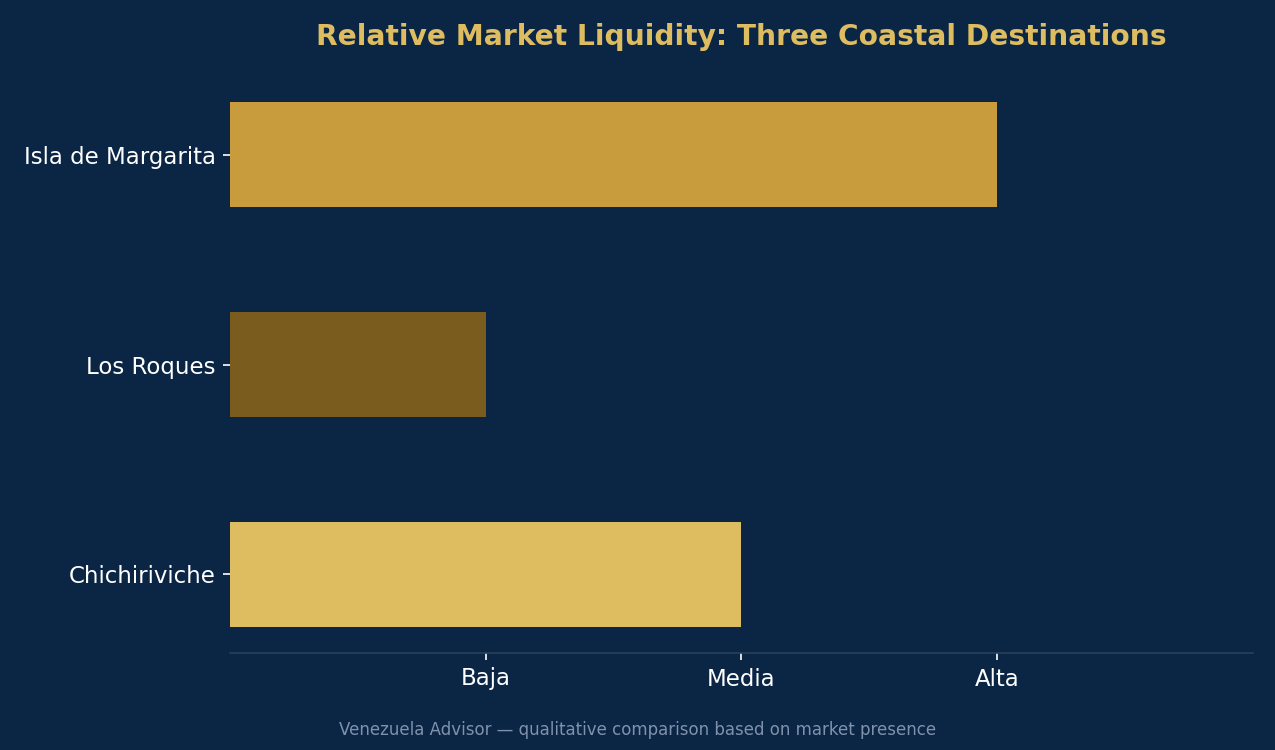
Before diving into each destination individually, it's worth internalizing one structural point: "coastal Venezuela" is not one market. Treating Margarita, Los Roques, and Chichiriviche as interchangeable variations of the same opportunity is the fastest way to misprice risk, misjudge liquidity, and — in Los Roques' case specifically — misunderstand what you're legally allowed to do with the asset at all.
| Destination | Access | Legal status | Best for |
|---|---|---|---|
| Isla de Margarita | Air and sea | Conventional real estate market | Active rental income, resale liquidity |
| Los Roques | Air/sea only | Protected national park | Exceptional personal legacy asset |
| Chichiriviche | Road from Caracas/Valencia | Conventional market (partial park overlap nearby) | Personal weekend property |
1–2. Isla de Margarita: scale and liquidity
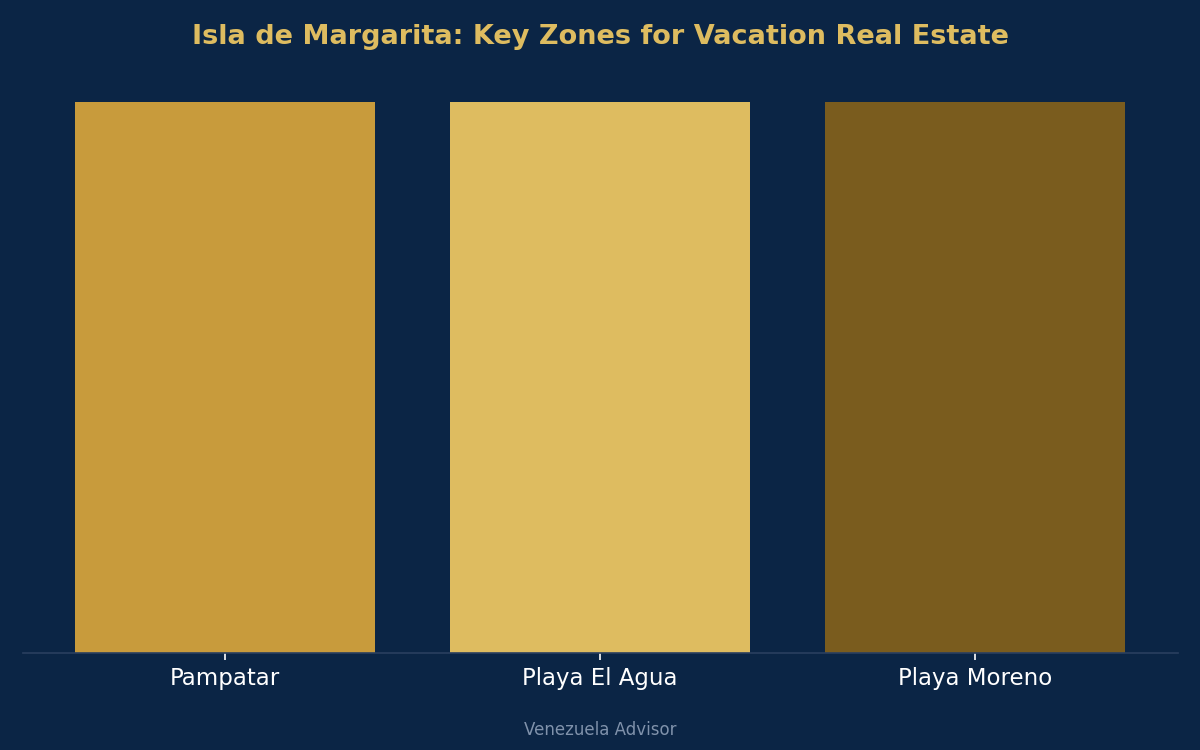
Isla de Margarita, in Nueva Esparta state, is without comparison the most developed coastal destination in Venezuela: an international airport, the country's largest hotel supply, and a vacation real estate market that has existed for decades, with recognized zones like Pampatar, Playa El Agua, and Playa Moreno. That scale is exactly what gives it more relative liquidity than any other Venezuelan coastal market — there are simply more buyers and sellers active at any given time.
If active rental income is your goal, Margarita's year-round tourism flow (with peaks during school holidays) reduces vacancy risk compared to the other two destinations covered here — a point we develop further in our rental yield guide for Caracas, whose underlying math applies just as directly to a coastal rental.
3–4. Los Roques: a national park, not a normal market
Los Roques is a decreed National Park — a fact I know with certainty and that changes the rules of the game entirely compared to Margarita or Chichiriviche. Construction and real estate development inside a national park are subject to strict environmental protection regimes in virtually every jurisdiction in the world, and Venezuela is no exception.
5. Chichiriviche: the road-access option
Chichiriviche, in Falcón state, has one practical advantage neither Margarita nor Los Roques offer: it's reachable by road from Caracas or Valencia, without depending on flights or maritime transport. In exchange, its real estate market is considerably smaller and its formal hotel infrastructure more limited — making it better suited to buyers seeking a personal second home than an active short-term rental asset.
Its proximity to Morrocoy National Park, with its characteristic calm-water cays, is the main draw sustaining tourism interest in the area, though — similar to Los Roques, though to a lesser degree — part of that area is also subject to environmental regulation worth verifying before any development project.
Infrastructure due diligence: the question almost nobody asks first
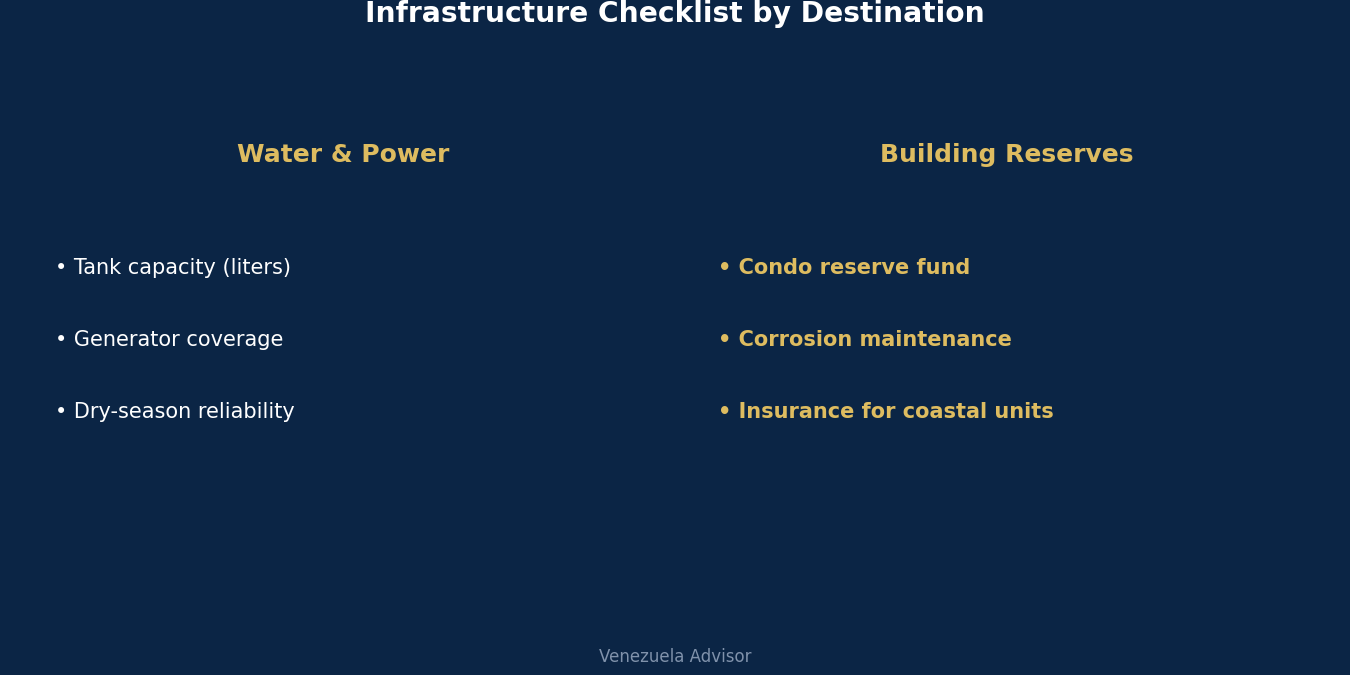
Before evaluating price or legal regime, any serious buyer in these three destinations should ask about the specific property's water and electricity supply. In island and remote coastal locations, dependence on private generators and water storage systems isn't a nice-to-have the way it can feel in Caracas — it is, in many cases, the difference between a property you can actually use and one that sits empty most of the year because the building's systems can't keep up.
- Water storage capacity: ask for the tank size in liters and how many days of normal consumption it covers during dry-season shortages.
- Backup generator coverage: confirm whether it covers the whole building or only common areas — a distinction that matters enormously during extended outages.
- Condominium reserve fund: a coastal building's maintenance costs (corrosion, humidity) run higher than an equivalent inland building; ask to see the reserve fund balance, not just the monthly fee.
6. The legal process, step by step
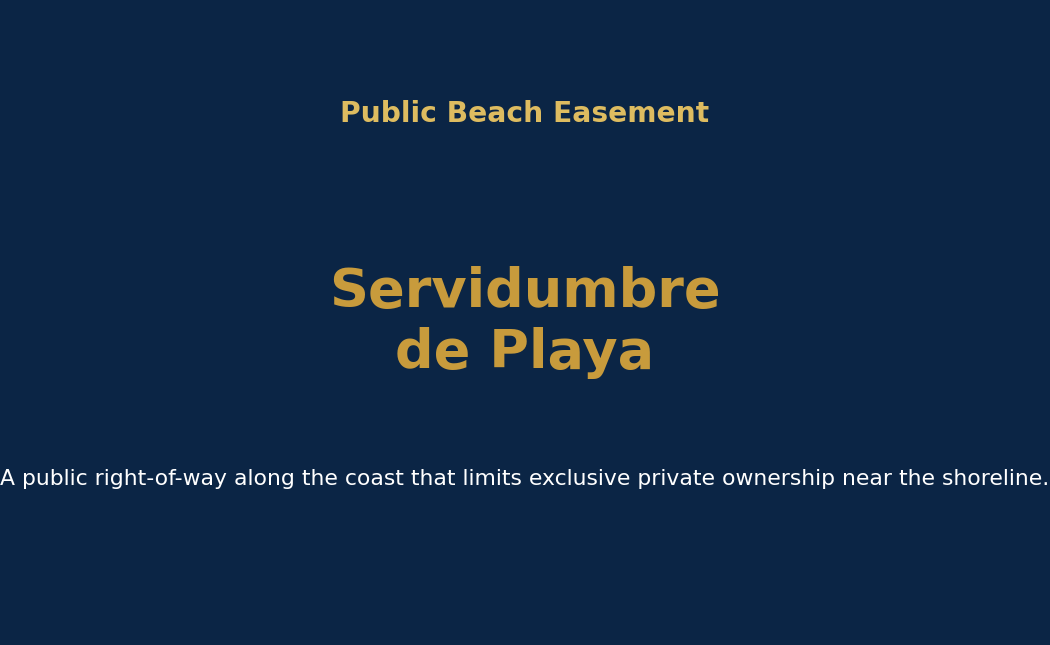
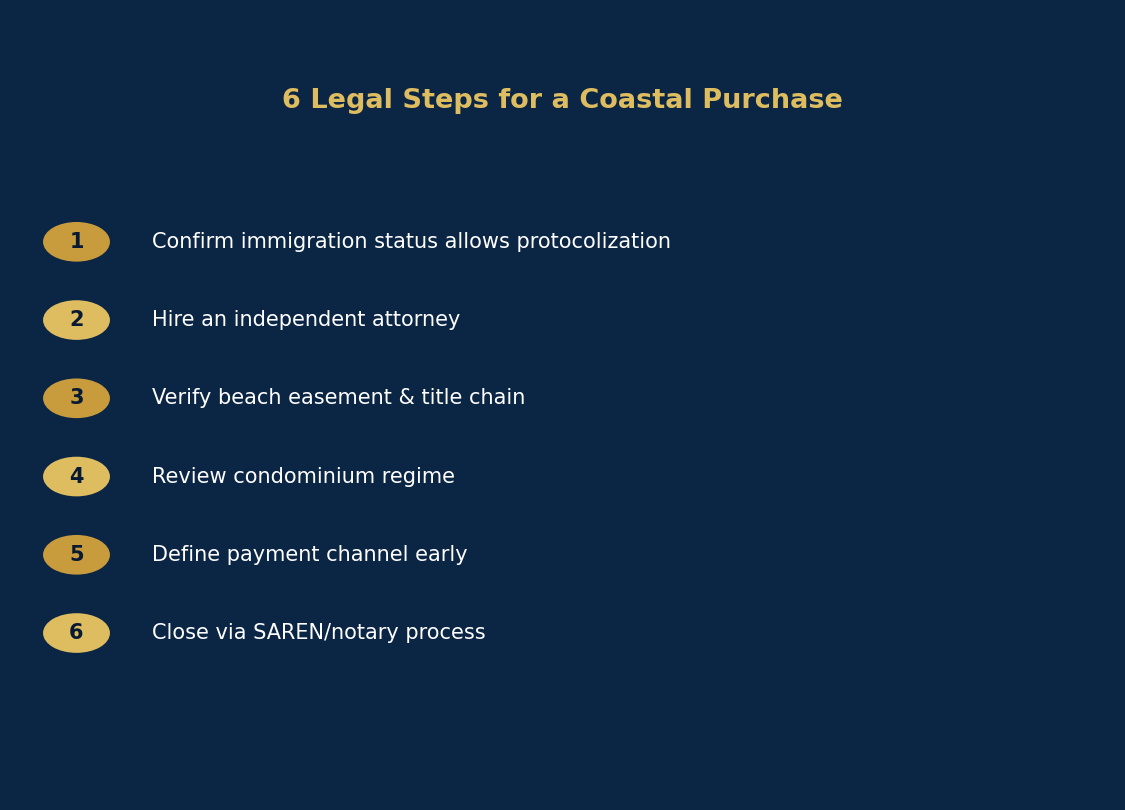
Regardless of which of the three destinations you choose, the underlying legal process mirrors what we describe in full in our Caracas buying guide: an apostilled passport, a Venezuelan RIF, and — critically for coastal property — verification that the parcel respects the public beach easement that exists under Venezuelan law, as it does in most coastal jurisdictions worldwide.
- Confirm your immigration status allows protocolization (a tourist visa is not sufficient).
- Hire your own attorney, independent from the seller, with specific coastal-property experience.
- Verify the beach-easement boundary and title chain before any deposit becomes non-refundable.
- Review the specific condominium regime if the unit sits inside a resort-style complex.
- Close through the same SAREN/notary process described in our closing-costs guide.
7. Common mistakes buyers make in these markets
Treating Los Roques like a normal listing search
Buyers who start by browsing photos of Los Roques properties, rather than by consulting a lawyer about the national park regime, waste months chasing a transaction structure that may not be available the way they assume.
Ignoring water and electricity infrastructure
In island and remote coastal locations, dependence on private generators and water storage systems isn't a luxury add-on the way it can feel in Caracas — it's frequently the difference between a usable property and one that sits empty most of the year.
Skipping a low-season visit
A buyer who visits only once, during peak season, and decides based on that single impression, misses how the property actually feels most of the year. We recommend a second, off-season visit before committing capital in any of these three markets.
Who each destination actually fits
Beyond the side-by-side comparison above, it helps to think in terms of investor goals rather than destination names alone.
The active rental investor
If your primary objective is dollar-denominated rental income with the ability to exit the position within a reasonable timeframe, Margarita is, with the information available today, the more defensible choice. Its year-round tourism base — bolstered by both domestic Venezuelan travelers and a growing share of regional visitors — reduces the vacancy risk that smaller markets carry by default.
The legacy-asset buyer
For a buyer whose primary motivation is an exceptional, once-in-a-lifetime landscape asset rather than liquidity or rental income, Los Roques remains genuinely unmatched in the region. The tradeoff is real: you are buying into a National Park's regulatory framework, not a conventional deed, and that distinction must be understood and accepted before any capital moves.
The weekend-house buyer
Chichiriviche's road access from Caracas and Valencia makes it the practical choice for a family that wants a second home reachable without flights or ferries, accepting in exchange a smaller resale market and more limited formal hospitality infrastructure nearby.
The diversifying diaspora investor
For Venezuelans abroad who already own — or are considering — a residential property in Caracas as described in our Caracas buying guide, a small coastal unit can serve a different purpose entirely: a personal-use asset for family visits rather than a primary income-generating investment. Sizing expectations correctly from the start avoids the disappointment of judging a lifestyle purchase by rental-yield math that was never the point.
Best time to visit each destination before deciding
A buyer who visits only once, during peak season, and decides based on that single impression, misses how the property actually feels most of the year. In Margarita, an off-season visit reveals the real state of the building's services — pool maintenance, elevator function, security staff responsiveness — without the activity that can mask small deficiencies during high season. In Los Roques, low season sharply reduces available flight frequency, a logistical factor any prospective owner should weigh if they plan to use the property regularly. In Chichiriviche, a midweek, off-season visit is the only realistic way to judge how the property would feel most of the year, versus the high-traffic weekends.
How financing and payment actually work here
None of these three markets has an active mortgage system for foreign buyers, so — exactly as in Caracas — you are working with cash transactions. The practical difference in coastal markets is that international wire transfers sometimes route through a different intermediary bank depending on the closing attorney's location, so confirming the exact receiving account and required documentation early avoids a last-minute scramble.
An illustrative negotiation example
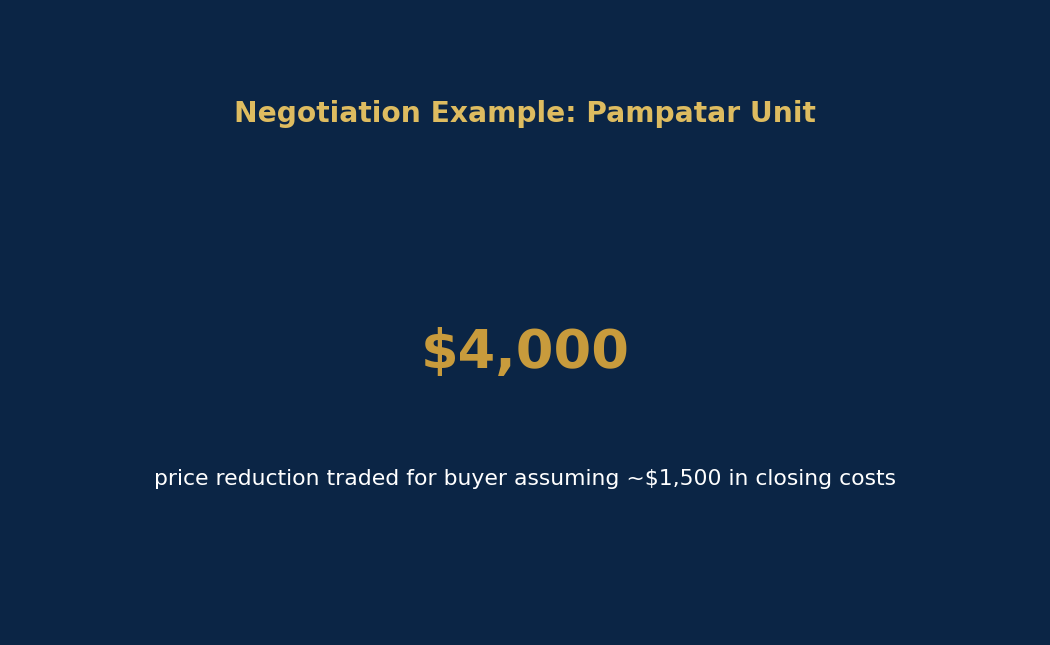
Consider a buyer evaluating a two-bedroom unit in Pampatar listed at $220,000. The seller, based abroad, has overestimated how much the standard 0.5% seller-side ISLR advance and their share of the municipal ITBI will actually cost them — a pattern we cover in detail in our closing costs guide. A workable opening line: "I'll handle all the notarial and registry paperwork and associated costs, provided we bring the price down by $4,000." The seller feels relieved of an administrative burden; in practice, the buyer has traded roughly $1,500 in assumed costs for a $4,000 price reduction — a pattern that repeats across virtually every coastal transaction we've been part of.
A second, equally common scenario: a seller anchored to a round number — say $300,000 for a Los Roques-adjacent property on the mainland side — who won't move on price at all. In that case, shifting the conversation to who absorbs the ITBI split and the registry fees can produce an effective discount of several thousand dollars while letting the seller tell their own family they got their asking price. Understanding exactly which costs belong to which party, as laid out in our closing costs guide, is what makes this kind of negotiation possible in the first place — you cannot trade away a cost you don't understand.
Glossary of local terms
Servidumbre de playa: the public beach easement that limits exclusive private ownership along the coastline.
Parque Nacional: National Park designation, which in Los Roques' case imposes strict development restrictions.
RIF: Registro de Información Fiscal, Venezuela's tax ID, required of every buyer including foreigners.
Opción de Compraventa: the Venezuelan purchase-option contract that binds buyer and seller to specific terms and a closing timeline before the final deed is signed.
Key takeaways and how to start
- Margarita offers the greatest scale and liquidity of the three coastal destinations.
- Los Roques requires specialized legal advice from day one due to its national park status — this is not optional.
- Chichiriviche trades a smaller market for the practical advantage of road access.
- In all three, water and electricity infrastructure deserve the same scrutiny as price and location.
If you're evaluating a coastal property in Venezuela, we can walk you through the legal, financial, and practical steps specific to whichever of these three markets fits your goal. We coordinate directly with independent local attorneys and agents in each destination, so you're never relying solely on a single seller-side contact for either the legal review or the market read.