
Culture and Leisure in Caracas: How Residents Actually Spend the Weekend (2026)
By: Venezuela Advisor — Published 2026 · Share · Updated for current conditions
Beyond the dining scene covered in our gastronomy guide, understanding how residents actually spend free time helps anyone settling in feel less like a permanent visitor and more genuinely at home, faster and with less friction than figuring it out alone through trial and error.
- 1. What weekends actually look like across eastern Caracas
- 2. Arts and culture specifically
- 3. Outdoor and nature access from the city
- 4. Popular day trips and their travel times
- 5. Building a social circle through shared activities
- 6. Mistakes we see newcomers make
- Glossary
- Seasonal events worth planning around
- Family-specific leisure considerations
- Key takeaways
1. What weekends actually look like in eastern Caracas
Illustrative mix, not a formal survey: dining and social gatherings anchor most weekends, with outdoor activity and arts/culture rounding out the typical pattern among residents in the eastern corridor.
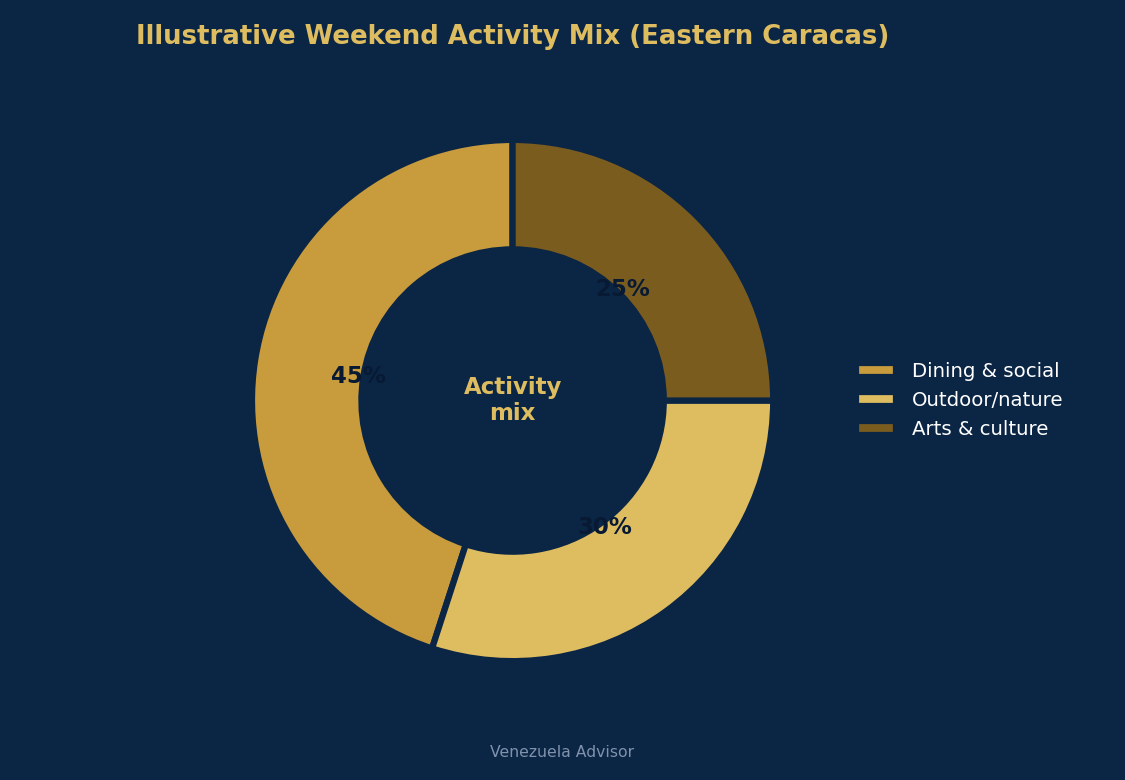
This mix reflects the same dollarized recovery pattern described throughout this guide series — as disposable income and confidence have grown, so has the range of activities residents genuinely engage in, rather than the narrower, more survival-focused pattern common during more difficult economic periods. A newcomer arriving with outdated impressions of daily life in Caracas often discovers a considerably richer and more varied social calendar than expected.
2. Arts and culture specifically
Weeknight versus weekend patterns
Weekday evenings in eastern Caracas follow a noticeably different rhythm than weekends, typically centered on shorter, closer-to-home activities given work schedules and earlier commitments the next morning, whereas weekends allow for the longer outings, day trips, and extended social gatherings described throughout this guide. Understanding this distinction helps a newcomer calibrate expectations correctly — a weeknight dinner invitation, for instance, generally implies a shorter, more casual gathering than the same invitation extended for a Saturday, when guests typically expect a longer, more elaborate evening.
Weekday evenings in eastern Caracas follow a noticeably different rhythm than weekends, typically centered on shorter, closer-to-home activities given work schedules and earlier commitments the next morning, whereas weekends allow for the longer outings, day trips, and extended social gatherings described throughout this guide. Understanding this distinction helps a newcomer calibrate expectations correctly — a weeknight dinner invitation, for instance, generally implies a shorter, more casual gathering than the same invitation extended for a Saturday, when guests typically expect a longer, more elaborate evening.
Caracas maintains a genuine, if sometimes underappreciated internationally, cultural infrastructure — galleries, theater, live music venues — that has seen renewed investment alongside the broader dollarized recovery described throughout this guide series.
Galleries and visual arts
A number of established and newer galleries across the eastern corridor showcase both Venezuelan contemporary artists and, occasionally, touring international exhibitions, offering a genuine cultural outlet for residents with an interest in visual art rather than requiring travel abroad to engage with a serious gallery scene at all. Several of these spaces also host regular openings that double as informal social events, providing another natural venue for building the kind of social connections described later in this guide, particularly valuable for newcomers looking to meet people who share a specific cultural interest.
Live music and theater
Live music venues spanning genres from traditional Venezuelan music to jazz and contemporary genres have grown in both number and quality in recent years, alongside a theater scene that, while smaller than before the country's more difficult economic period, has shown genuine signs of revival and renewed audience interest. Checking current listings through local cultural publications or venue social media accounts, rather than assuming a static or limited scene based on outdated impressions, reveals considerably more activity than general secondhand impressions might otherwise suggest to a newcomer arriving without current information.
3. Outdoor and nature access from the city
Caracas's location in a valley bordered by Ávila National Park offers genuinely convenient access to hiking and nature within the city's own boundaries, a geographic advantage relatively rare among major Latin American capitals.
Ávila as a weekly, not occasional, activity
Multiple trailheads accessible directly from eastern Caracas neighborhoods mean a resident can genuinely incorporate hiking into a regular weekly routine rather than treating it as a rare special occasion requiring significant travel planning and advance preparation. Trail difficulty varies considerably, from accessible paths suitable for a casual morning walk to more demanding routes requiring genuine fitness and preparation, giving residents at every fitness level a realistic option within the same broader park system spanning the city's northern edge.
The teleférico as an easier alternative
For residents or visitors less inclined toward a strenuous hike, the cable car connecting Caracas to the mountain's upper reaches offers a considerably easier way to access Ávila's views and cooler climate, complete with restaurants and recreational facilities at the top station for a full day out. This makes the mountain's benefits accessible to a wider range of ages and fitness levels than hiking alone would allow, an important consideration for families with young children or older visitors who might otherwise miss out on this distinctive local advantage entirely.
4. Popular day trips and their travel times
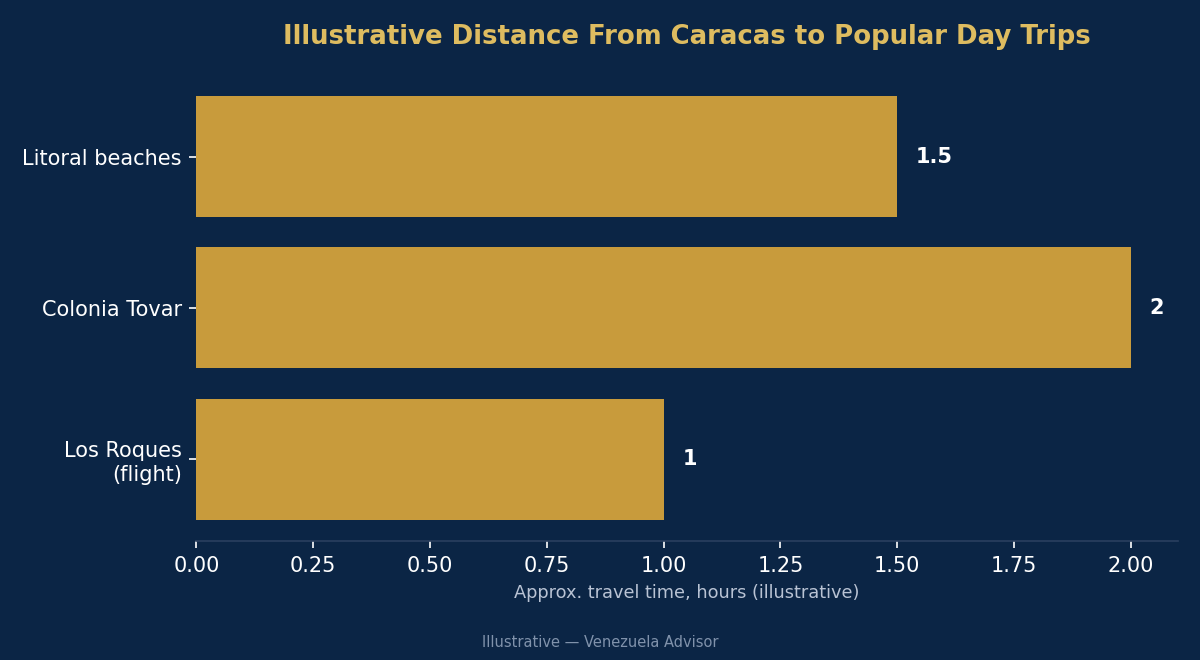
Illustrative travel times, not confirmed schedules: several genuinely appealing destinations sit within a reasonable day-trip distance of Caracas, each offering a distinctly different experience from city life.
Colonia Tovar: a distinctly different atmosphere close by
This mountain town, founded by German immigrants in the 19th century and retaining a distinctive architectural and culinary character, offers a genuinely different atmosphere within a relatively short drive from Caracas — a popular choice for residents wanting a change of scenery without a full-day commitment to travel or complex logistics. Weekend traffic on the route can extend travel times considerably beyond typical weekday estimates, worth planning around for anyone making this trip specifically on a Saturday or Sunday rather than during the week when roads are typically clearer.
The central coast beaches
Venezuela's central coast, accessible within roughly the same travel window, offers beach access considerably closer than the coastal destinations described in our coastal investment guide, making it a practical option for a spontaneous beach day rather than a planned multi-day trip requiring extensive advance preparation. Water and general infrastructure quality varies by specific beach, and asking current residents for their preferred spots produces better results than assuming any beach along this stretch offers an equivalent experience to another nearby option.
Los Roques: further, but worth the extra planning
Los Roques requires a short flight rather than a road trip, placing it in a different category from the other destinations described here — genuinely feasible as a long day trip for a visitor with flexible time, but more commonly treated as an overnight or multi-day destination given the archipelago's exceptional natural beauty described in our coastal investment guide and the logistics involved in reaching it. Flight schedules and availability should be confirmed directly given their tendency to change, rather than assumed to match any general online listing found during initial trip research.
5. Building a social circle through shared activities
Joining a recurring activity — a hiking group, a sports league, a class — tends to build genuine social connections faster than passive socializing alone, particularly for newcomers still rebuilding the local network described in our return guide.
Why recurring activities work better than one-off events
A single social event, however enjoyable, rarely produces lasting relationships on its own — it's the repetition of seeing the same people in a shared, low-pressure context over weeks and months that actually builds genuine friendship over time. A weekly hiking group, a recurring sports league, or a regular class provides exactly this kind of repeated, natural interaction, in contrast to a one-time party or dinner where connections often fail to develop further without deliberate follow-up effort from at least one side.
Sports leagues as a particularly effective option
Amateur sports leagues — soccer, padel, running clubs — have grown considerably in the eastern corridor, offering a structured, regular commitment that naturally produces recurring social contact with the same group of people over an extended season and beyond. For newcomers with an existing interest in a particular sport, joining an established league often proves more effective for building a social circle than more general social events, since the shared activity itself gives every interaction a natural, low-pressure starting point that doesn't rely on small talk alone.
Professional and interest-based groups
Beyond sports specifically, professional networking groups and interest-based communities — book clubs, language exchange groups, hobby-specific meetups — offer similar structured opportunities for newcomers whose interests lie outside athletics entirely. Searching for these communities through the same local networks described throughout our diaspora return guide, rather than assuming they don't exist in a city of this size, typically surfaces more options than a newcomer might initially expect, particularly once they start asking colleagues, neighbors, and other new acquaintances directly.
6. Mistakes we see newcomers make
Assuming Caracas offers limited cultural or outdoor activity based on outdated impressions, underestimating Ávila's accessibility as a weekly rather than occasional activity, and waiting too long to join a recurring social activity are the three mistakes we see most consistently.
Relying entirely on outdated impressions
Newcomers who haven't visited Venezuela in years, or who form their expectations primarily from international media coverage, sometimes arrive assuming a far more limited cultural and leisure landscape than what actually exists today across the city. Actively seeking out current listings and talking to current residents, rather than relying on secondhand impressions that may be years out of date, produces a considerably more accurate — and usually more encouraging — picture of what weekend life genuinely offers a new resident.
Treating Ávila as a rare special occasion
Residents who treat Ávila as an occasional special trip rather than a regular, easily accessible option miss out on one of Caracas's most distinctive genuine advantages over comparable cities in the region and beyond. Building a hike or cable car visit into a regular routine — even just once or twice a month — provides both a fitness benefit and a reliable mental reset that residents who treat the mountain as a rare novelty simply don't get to enjoy as consistently or as fully over time.
Waiting for social connections to happen passively
Newcomers sometimes wait for social connections to develop organically through chance encounters, rather than actively seeking out the recurring activities and groups described earlier in this guide from the very start of their time in the city. Given how much faster genuine friendships tend to develop through repeated, structured interaction rather than passive hope, actively joining at least one recurring activity within the first few months of settling in produces noticeably better results than waiting for connections to simply happen on their own over an indefinite period.
Glossary
Ávila: the national park and mountain range bordering Caracas to the north, offering hiking access directly from several eastern neighborhoods within the city itself.
Day trip: a destination reasonably visited and returned from within a single day without any overnight stay required.
Teleférico: the cable car system connecting Caracas to the upper reaches of Ávila, offering an accessible alternative to hiking for reaching the mountain.
Seasonal events worth planning around
Beyond the recurring weekly patterns described throughout this guide, Caracas hosts a number of seasonal cultural events — art fairs, seasonal festivals, holiday-specific celebrations — that offer a concentrated dose of local culture worth planning a visit or social calendar around specifically, rather than encountering by chance. Checking a current cultural calendar upon arrival, rather than discovering these events only after they've already passed, helps newcomers make the most of a genuinely rich annual cultural cycle that many first-time residents underestimate entirely.
Family-oriented seasonal events in particular tend to draw large, genuinely festive crowds, offering an accessible entry point for newcomer families looking to experience local culture in a welcoming, low-pressure setting alongside other families doing exactly the same thing at the same time. These events also often overlap naturally with the community-building activities described earlier in this guide, providing another practical avenue for meeting people beyond structured recurring groups alone, and often serve as a natural bridge into those more regular commitments over time.
Key takeaways
- Weekend life in eastern Caracas centers on dining, outdoor activity, and a genuine, growing cultural scene worth exploring fully.
- Ávila National Park offers rare, convenient nature access directly from the city itself, unlike most comparable capitals.
- Several appealing day-trip destinations sit within reasonable travel distance of Caracas for weekend getaways.
- Joining a recurring activity builds social connections faster than passive socializing alone ever does.
- Seasonal cultural events offer a concentrated, welcoming entry point for newcomer families specifically settling in.
If you're planning a move to Venezuela, we can help you think through what daily and weekend life would actually look like for your specific situation and interests, based on the same practical framework used throughout this guide series.
Family-specific leisure considerations
Families with children benefit from the same activity-based approach to building community described throughout this guide, with the added consideration of age-appropriate options — youth sports leagues, family-oriented cultural events, parks with genuine play infrastructure — that connect both children and parents to a local peer network simultaneously and efficiently. Coordinating with the school community described in our education guide often provides a natural starting point, since many family social circles form initially around shared school connections before expanding into other shared activities and eventually into lasting friendships beyond the school gate itself.
Weekend family outings to Ávila, the central coast beaches, or Colonia Tovar described earlier in this guide offer accessible options that work well across a range of children's ages, provided reasonable precautions around timing, sun protection, and physical demands are taken into account for younger family members specifically before setting out. Building these outings into a predictable, recurring family routine — rather than treating them as rare special occasions — helps children adjust more quickly to their new environment while giving the whole family a positive, shared reference point for their new life in the country going forward.