
Moving Back to Venezuela: A Practical, Step-by-Step Guide for the Diaspora Returning Home (2026)

By: Venezuela Advisor — Published 2026 · Share
For anyone who's spent years abroad, the Venezuela you left may be genuinely different from the one you're returning to — for better and for worse, in ways that only become clear once you're actually back on the ground. This guide lays out a realistic, documented process for a return, drawing on the same practical planning discipline covered throughout this series.
- 1. Before deciding to return: a reconnaissance visit
- 2. A documentation timeline that starts several months out
- 3. Rent first, before you commit to buying
- 4. Income sources returning professionals actually rely on
- 5. Budgeting backup infrastructure into your plan from day one
- 6. A realistic adaptation timeline to expect
- 7. Mistakes we consistently see returnees make
- Glossary of key terms
- Moving with children: additional considerations
- Planning with reversibility in mind, without planning to fail
- Maintaining professional continuity through the transition
- Key takeaways overall
1. Before deciding: a reconnaissance visit
For anyone who's been away several years, current-day Venezuela can differ from the one they left, for better and worse, in ways that are hard to fully appreciate from a distance. A one- to two-week reconnaissance visit before committing to a return lets you verify neighborhoods, prices, and current quality of life firsthand, rather than relying solely on secondhand accounts from family or old friends who may not have current, direct experience of the specific area you're considering.
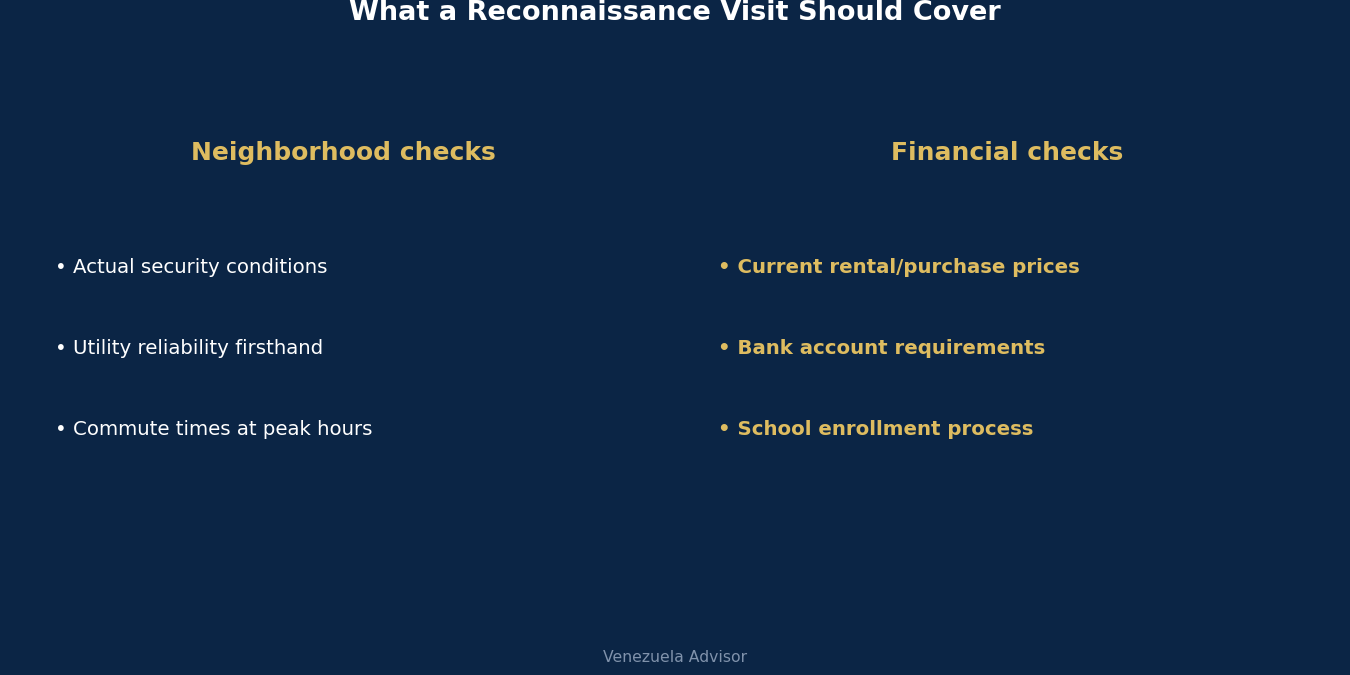
The neighborhood checks matter because family reports, however well-intentioned and loving, tend to reflect either nostalgia or outdated conditions rather than what a returning resident will actually experience day to day once they've moved in permanently. Walking a prospective neighborhood at different times, talking to current residents rather than relatives who moved away years ago, and testing utility reliability directly rather than taking someone's word for it all produce a far more reliable picture than assuming things are the same as when you left the country originally.
2. A documentation timeline that starts months out
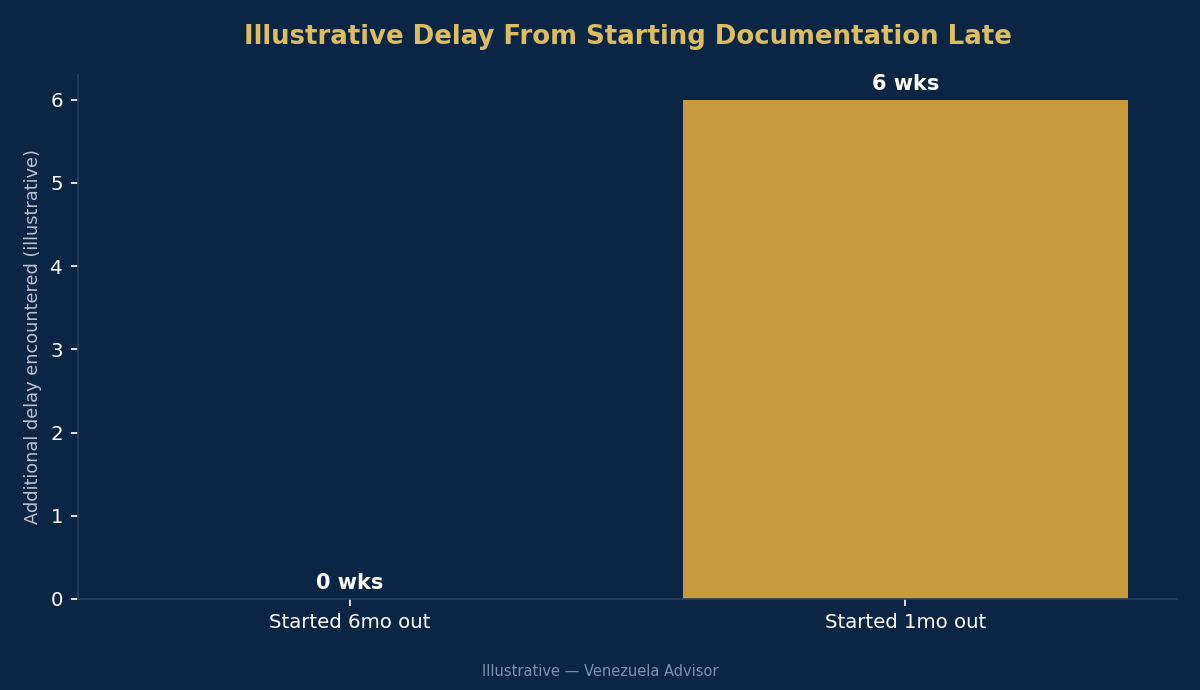
Illustrative sequence, not a rigid rule to follow blindly: starting documentation months before the actual move consistently produces a smoother transition than compressing everything into the final weeks before departure.
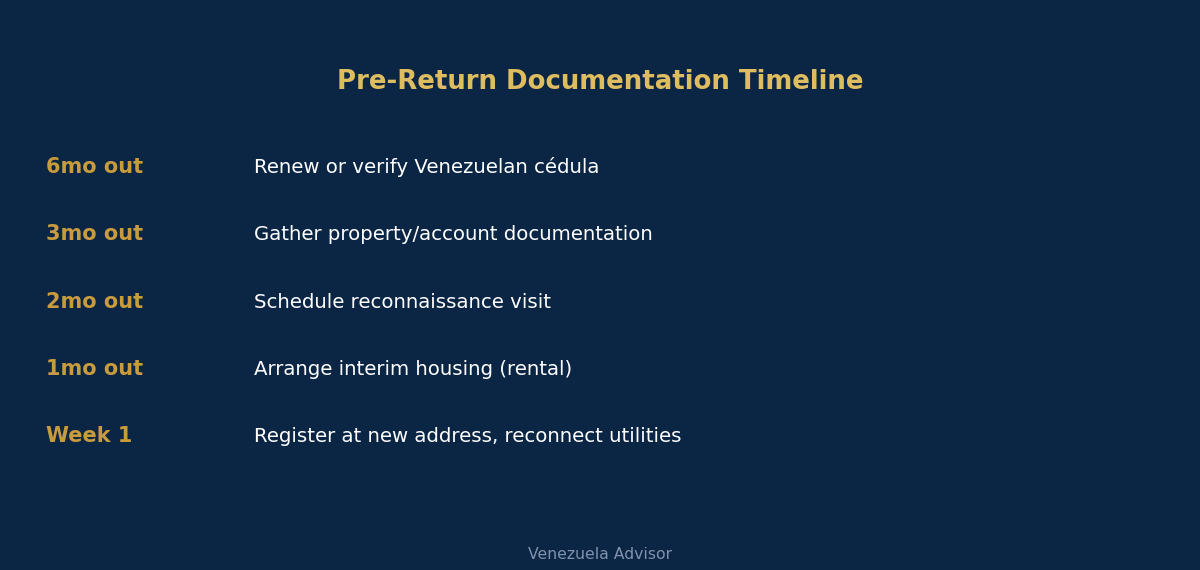
The gap between starting early and starting late isn't marginal — it compounds in ways that are hard to fully appreciate until you're living through the compressed version yourself. A renewed cédula, for instance, can take considerably longer to process than most people expect, and discovering this gap only weeks before a planned move forces a choice between delaying the entire relocation or arriving without fully current documentation, neither of which is a comfortable position to be in when you're also managing every other aspect of an international move simultaneously and under real time pressure.
3. Rent before you buy
Even for returnees who eventually plan to buy a home, renting for the first several months after return allows time to properly assess neighborhoods, evaluate actual building infrastructure, and avoid a rushed purchase decision based on outdated information from before the move.
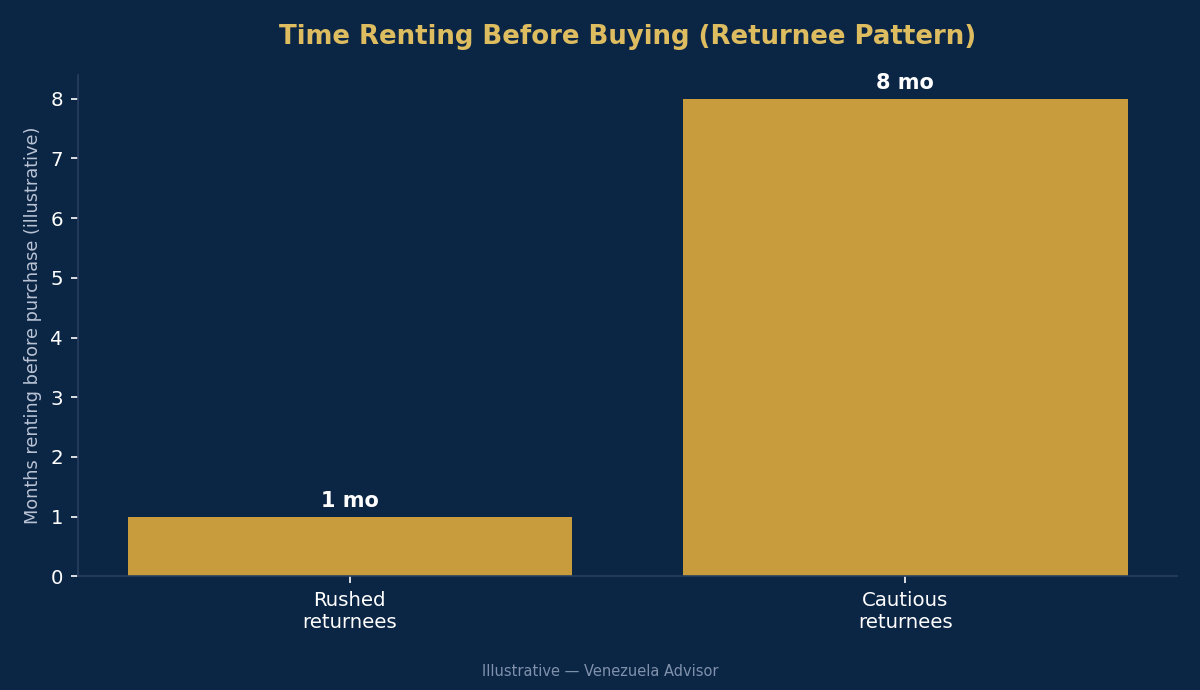
Returnees who rush directly into a purchase, motivated by the emotional pull of finally having a permanent home again after years away, sometimes discover only after closing that the building's water system is unreliable or that the neighborhood has changed in ways their reconnaissance visit didn't fully capture at the time. A rental period — even just a few months — provides a low-stakes way to confirm these details before committing the far larger capital and legal complexity of a purchase, following the same due diligence principles described in our Caracas buying guide.
4. Income sources returnees actually rely on
Illustrative distribution, not a formal survey result: some returning professionals maintain remote income working for employers abroad, offering financial stability while adapting to the local labor market, as discussed in our repatriation guide. Others pursue local employment or start a business directly, leveraging savings brought from abroad to fund the initial transition period.
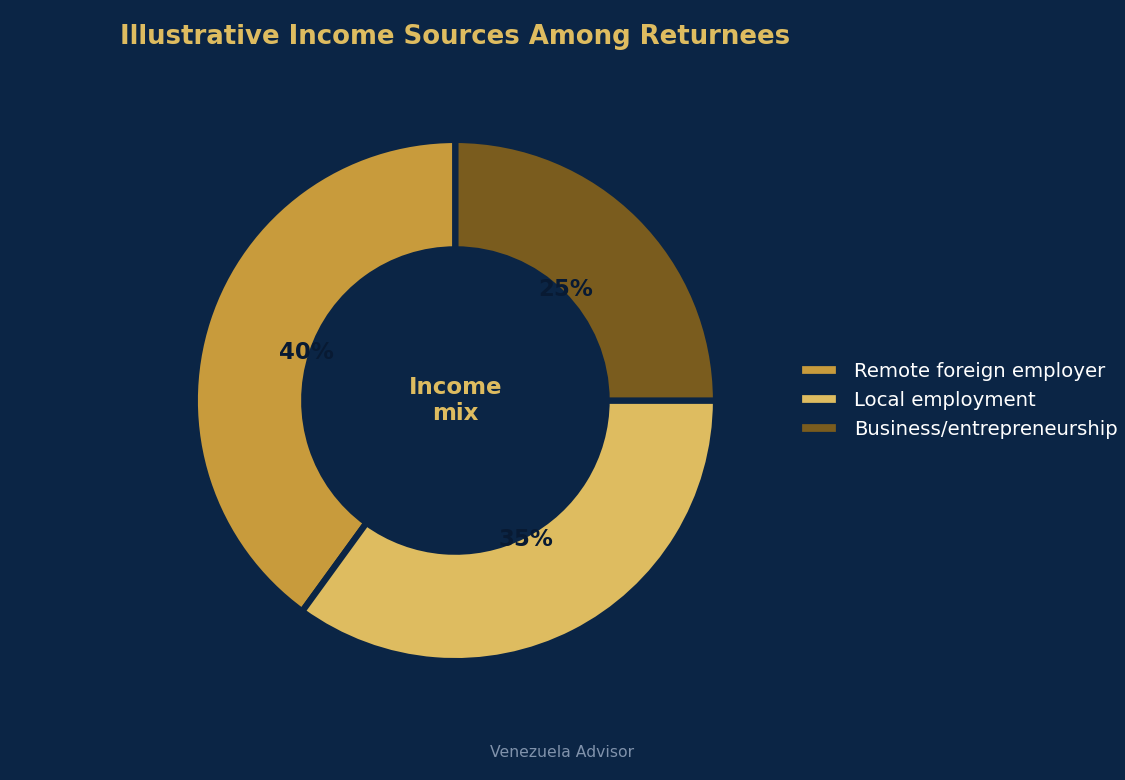
Maintaining remote employment through the transition, where possible, offers a meaningful advantage: it removes the pressure to secure local income immediately upon arrival, giving the returnee space to adapt before making major career decisions under financial duress or time pressure. Returnees without this option — because their prior role wasn't remote-compatible — face a more compressed timeline for establishing local income, which makes the savings buffer described in our financial instruments guide particularly important to have firmly in place before the move itself even begins in earnest.
5. Budgeting backup infrastructure from day one
Backup power and water storage stop being a luxury and become a practical, everyday necessity once you're actually living in Venezuela full-time on a permanent basis, not just visiting for a couple of weeks at a time.
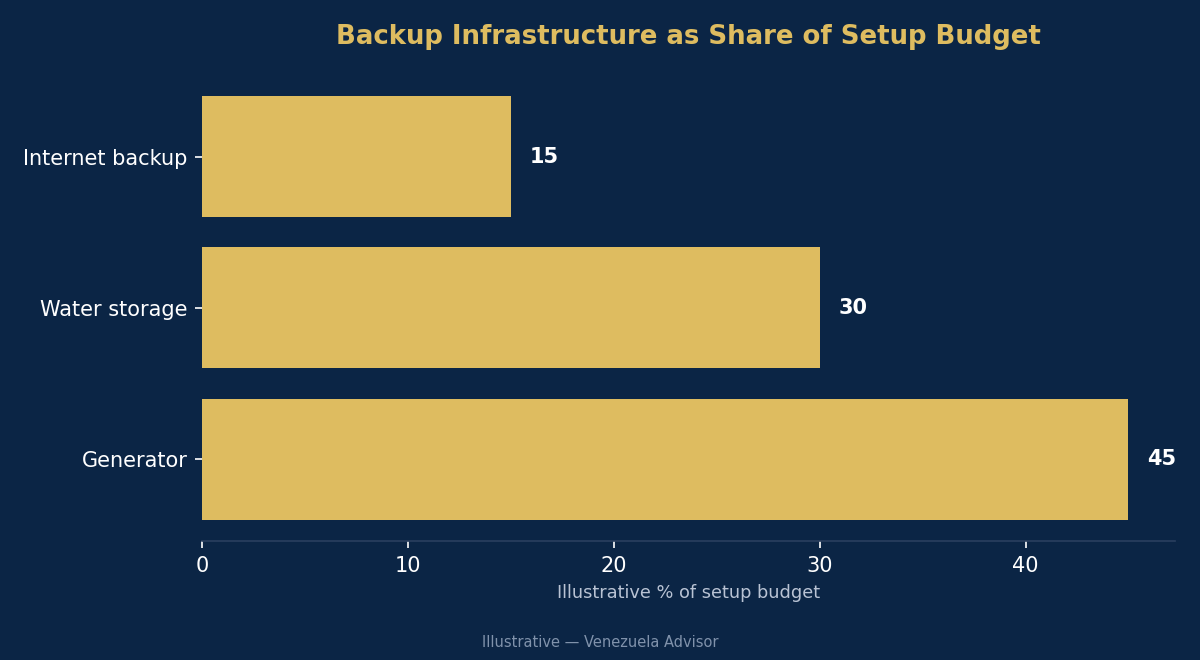
Returnees who lived abroad in countries with reliable utilities sometimes underestimate this line item specifically, having grown unaccustomed to planning around utility instability during their years away from home. Sizing a generator correctly for actual household needs, and a water tank for a genuine multi-day gap rather than a few hours, is worth the upfront engineering conversation described in our restaurant guide — the same infrastructure discipline that applies to a business applies just as directly to a returning household setting up permanent residence.
6. A realistic adaptation timeline
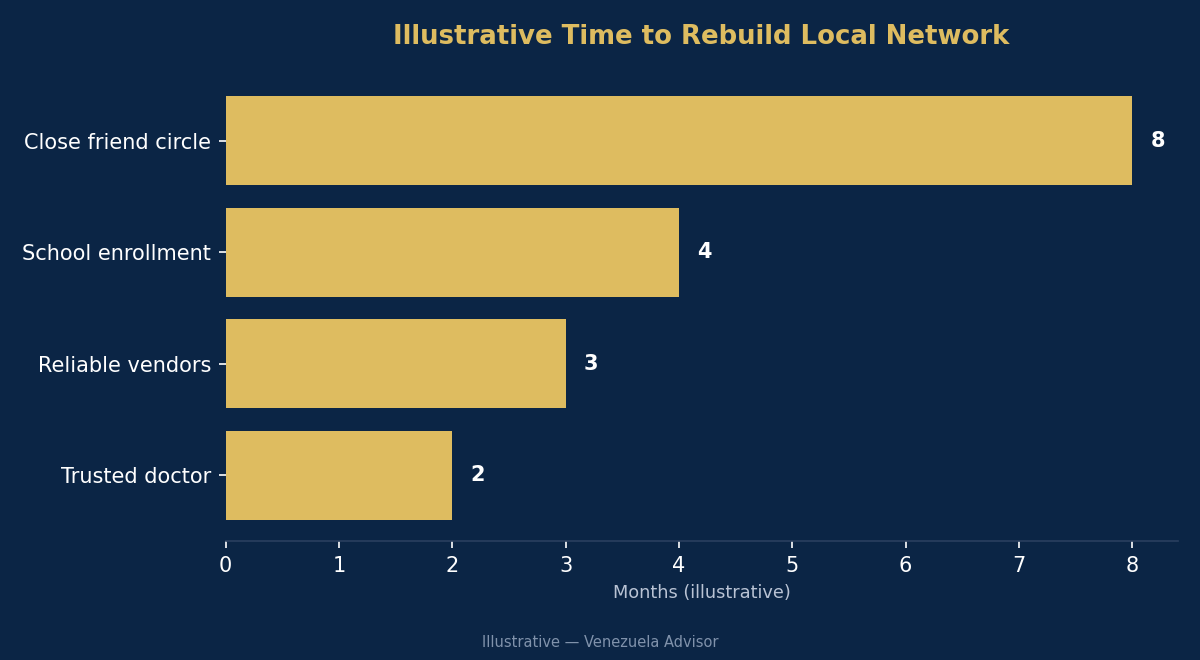
Rebuilding a local network — doctors, trusted vendors, schools if there are children — takes real time, and shouldn't be underestimated by anyone planning this transition, however emotionally ready they feel to return.
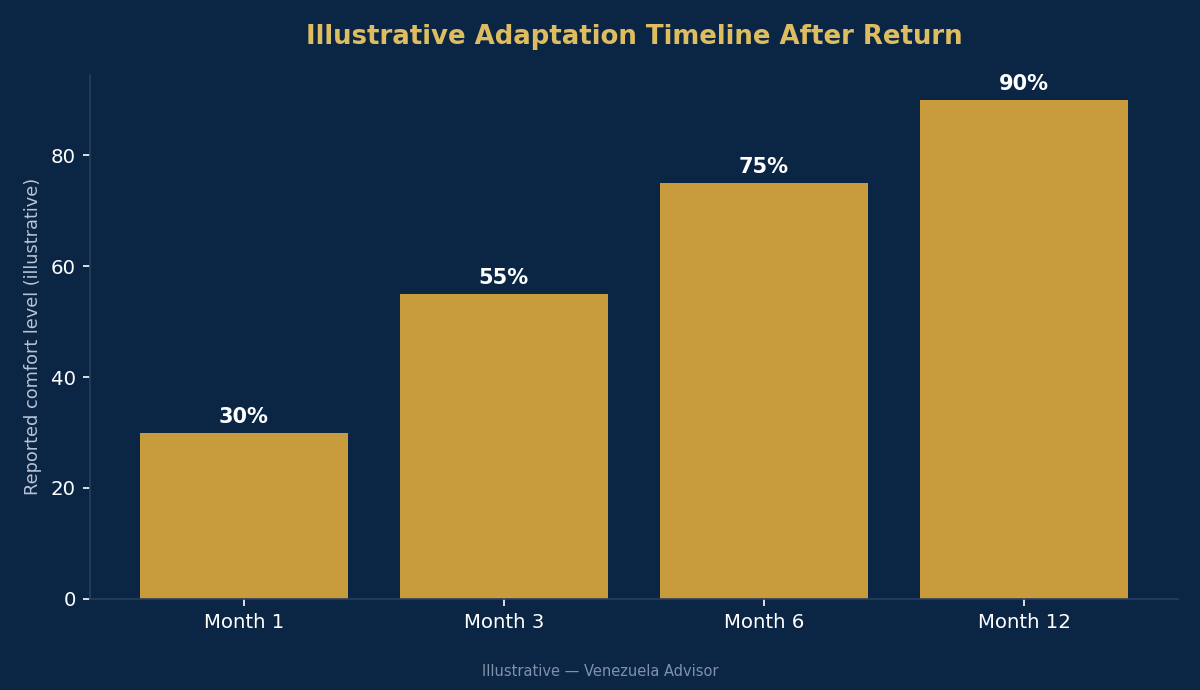
This adaptation curve isn't linear or automatic — it reflects deliberate effort to rebuild specific relationships and routines, not simply time passing on a calendar without any active effort. Returnees who actively seek out a trusted doctor, reliable vendors, and a social circle in their first months, rather than waiting for these connections to happen organically, tend to move through this curve noticeably faster than those who leave it to chance and hope things fall into place on their own.
7. Mistakes we see returnees make
Rushing into a property purchase before renting and observing the market firsthand, underestimating backup infrastructure as a core monthly expense, and setting unrealistic expectations about how quickly daily life will feel fully normal again are the three mistakes we see most consistently among people making this transition.
Underestimating the emotional dimension of returning
Beyond the practical logistics covered throughout this guide, returning after years abroad carries a genuine emotional dimension that pure planning doesn't fully address on its own. Reconnecting with family and old friends is often the strongest motivator for return, but it can also create pressure to feel settled and happy immediately, when in reality the adaptation curve described earlier applies just as much emotionally as it does practically. Giving yourself permission to still be adjusting after a few months, rather than treating any lingering difficulty as a sign the decision was wrong, protects against a premature and regrettable decision to reverse course before the adaptation process has had a fair chance to run its course fully.
Failing to maintain a financial cushion during the transition
Even returnees with a clear income plan already worked out sometimes underestimate the one-time costs of the move itself — the reconnaissance visit, moving belongings, the security deposit and furnishing for an initial rental, and the backup infrastructure investment described above, all arriving in a short window. Maintaining a financial cushion beyond the minimum calculated cost, specifically to absorb the inevitable unexpected expenses of any major relocation, prevents a stressful cash crunch during exactly the period when stability matters most for a successful adaptation to unfold naturally and without added financial pressure.
Glossary
Reconnaissance visit: a preliminary trip taken before committing to a permanent return, used to verify current conditions firsthand rather than relying entirely on secondhand information.
Adaptation curve: the gradual process of rebuilding comfort and familiarity with daily life after an extended absence from the country, home, and routines.
Financial cushion: savings held in reserve specifically to absorb unexpected costs during a major life transition, separate from the calculated baseline budget for the move itself.
Moving with children: additional considerations
Families returning with school-age children face a compressed version of the school-selection process described in our education guide, often under real time pressure if the return date doesn't align neatly with the local academic calendar and enrollment windows. Reaching out to prospective schools during the reconnaissance visit itself, rather than waiting until arrival, gives families a realistic sense of enrollment timelines and any waiting lists well before the actual move takes place and decisions become urgent.
Children's own adaptation curve often differs meaningfully from their parents' — younger children in particular can adjust to new schools and social circles faster than adults reconstructing an entire professional and social network from scratch, though this varies considerably by age and individual temperament from child to child. Acknowledging that different family members may adapt at different speeds, rather than expecting the whole family to feel settled on the same timeline, reduces friction during an already significant transition for everyone involved in the household.
Planning with reversibility in mind, without planning to fail
A small but meaningful minority of returnees eventually decide the move wasn't right for them and return abroad after a period of genuinely trying to make it work over time. This isn't a reason to avoid the decision, but it is a reason to structure the transition in a way that doesn't foreclose that option entirely — maintaining valid documentation in your country of prior residence where possible, and avoiding an all-or-nothing liquidation of assets abroad before the return has had time to prove itself over a reasonable trial period of a year or so.
This isn't about planning to fail; it's about making a major decision without unnecessary rigidity that could later trap you in a situation that isn't working out well. A returnee who's kept a reasonable exit option open makes calmer, better decisions during a difficult adjustment period than one who's foreclosed every alternative and now feels trapped regardless of how the transition is actually going day to day. This same principle of preserving optionality shows up throughout this guide series — in real estate contracts, in franchise agreements, in employment structures — and it applies just as directly to a life decision as significant and consequential as an international move like this one.
What "keeping options open" looks like in practice
Concretely, this might mean maintaining a bank account and mailing address in your country of prior residence for the first year, keeping professional licenses or memberships active rather than letting them lapse immediately after the move, and resisting the urge to sell every asset abroad the moment the return is decided upon. None of this requires hedging your commitment to the move — it simply means the decision to return doesn't have to be irreversible to be genuine, and preserving a path back doesn't undermine your intention to make the return work over the long run.
Maintaining professional continuity through the transition
Professionals with credentials or licenses tied to their country of prior residence should confirm, well before the move, whether those credentials transfer, require local validation, or need to be maintained active from abroad for future flexibility down the line and possible future relocations. This is particularly relevant for regulated professions — medicine, law, engineering — where credential recognition processes can take considerably longer than a general relocation timeline allows for if left unaddressed until after arrival in the country.
For professionals maintaining remote employment through the transition, as discussed earlier, confirming with your employer how your change in location affects tax withholding, benefits, and any location-based compensation adjustments protects against an unwelcome surprise discovered only at the next payroll cycle or annual tax filing season. This is a conversation worth having explicitly with your employer's HR department before the move, not an assumption to carry into the transition unconfirmed and hope works out fine on its own.
Key takeaways
- A reconnaissance visit before committing reduces the risk of decisions based on outdated information from before you left.
- Renting before buying provides flexibility while you get to know the current market conditions firsthand.
- Backup infrastructure should be planned as a normal part of the move, not an unforeseen expense discovered later.
- The emotional reunion with family and friends is often the driving force behind a return, but pairing it with realistic expectations about the pace of adaptation serves everyone better in the long run.
- Keep a financial cushion beyond your baseline budget to absorb the inevitable unexpected costs of a major relocation like this one.
- Structure the transition with some reversibility in mind, without treating that as a plan to fail from the outset.
If you're planning a return to Venezuela, we can help you think through documentation, housing, and the practical setup steps specific to your particular situation.