
Cost of Living in Caracas, Valencia, and Maracaibo: A Practical City-by-City Comparison (2026)

By: Venezuela Advisor — Published 2026 · Share
Venezuela's cost of living varies far more between cities — and between zones within the same city — than in countries with more homogeneous economies overall. A national average tells you very little about what it will actually cost to live in a specific municipality of Caracas versus Valencia or Maracaibo, which is exactly the gap this guide aims to close with a category-by-category, zone-aware comparison rather than a single misleading national figure.
- 1. Category-by-category comparison
- 2. What actually explains the difference between cities
- 3. What drives Caracas's cost premium specifically
- 4. Cost varies by zone within Caracas too
- 5. Matching a city to your actual situation
- 6. Mistakes we see people make when comparing cities
- Glossary
- Healthcare access as part of the true cost comparison
- Transportation realities that don't show up in headline comparisons
- A note on local salary benchmarks across the three cities
- Key takeaways
1. Category-by-category comparison
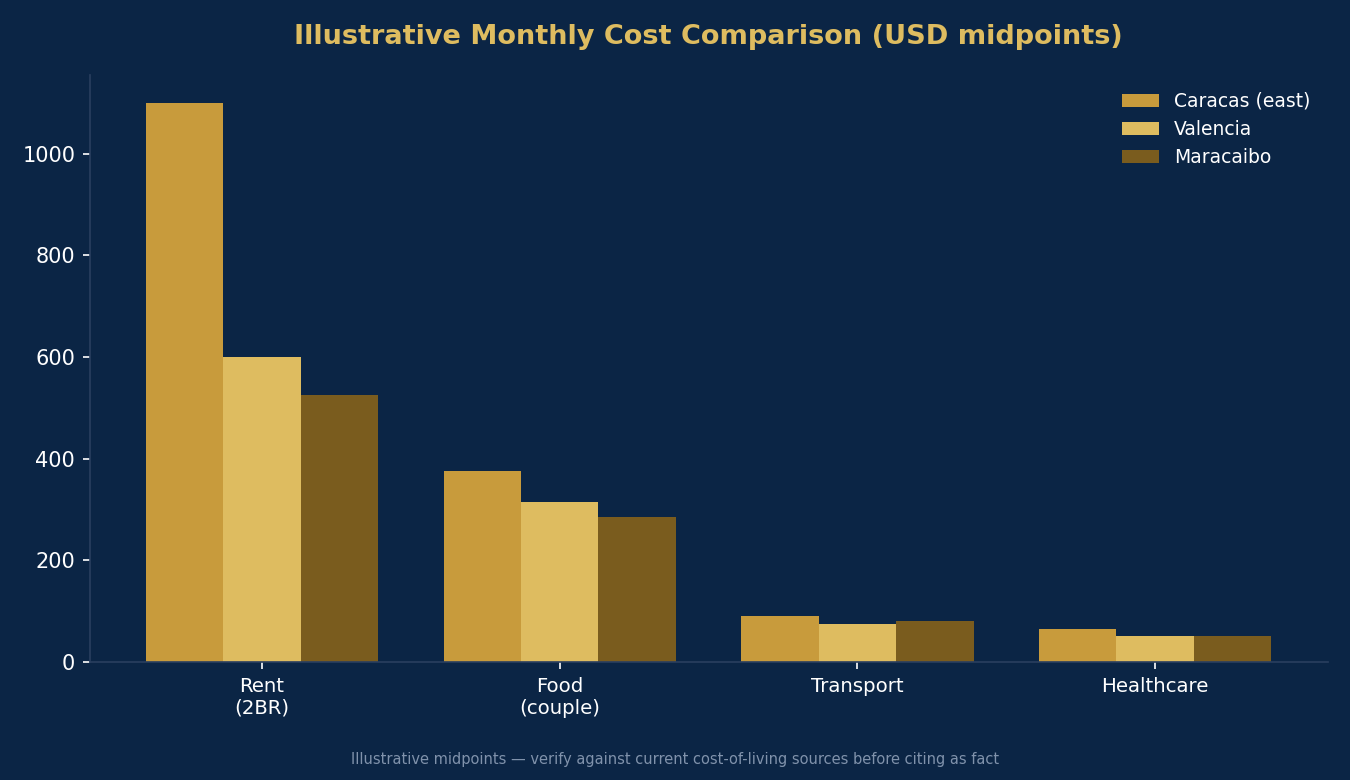
Illustrative midpoints, not precise survey data: the gap between cities is real and consistent across categories, even if exact figures shift with market conditions.
[VERIFY: these figures are illustrative midpoints based on generally known patterns and should be confirmed against current, dated cost-of-living sources and market surveys before being published as precise, citable figures.]
Rent typically shows the widest gap between the three cities, reflecting the same demand concentration that drives real estate pricing described throughout this guide series. Food and transport costs narrow the gap somewhat, since basic goods and fuel prices track more closely across cities than housing does, though even here Caracas carries a modest premium tied to the concentration of imported and premium goods available in its eastern commercial corridor specifically, rather than a uniform national markup applied evenly everywhere across the country.
2. What actually explains the difference between cities
Caracas concentrates the greatest international and corporate demand, which pushes up rents and premium services significantly. Valencia, as an industrial hub, offers more moderate costs with reasonable access to goods and services. Maracaibo combines generally lower living costs with specific electrical infrastructure challenges that anyone moving there should investigate carefully beforehand.
Valencia's cost structure reflects its role as Venezuela's industrial center: a large local workforce, established supply chains for manufactured goods, and a real estate market shaped by industrial and residential demand rather than the international corporate demand that drives Caracas pricing. This makes Valencia a genuinely different cost environment, not simply "Caracas but cheaper" — the underlying economic drivers are distinct enough that the two markets don't move in lockstep even when broader national economic conditions shift.
Why Maracaibo's electrical infrastructure deserves specific attention
Maracaibo has experienced more frequent and severe power disruptions than Caracas or Valencia in recent years, a practical reality that affects the true cost of living there beyond what a simple rent or grocery comparison ever fully captures. Anyone evaluating Maracaibo should factor in backup generator costs and water storage infrastructure as a near-mandatory expense, not an optional upgrade, when comparing total living costs against the other two cities — the same backup-infrastructure discipline described throughout our restaurant and hospitality guides applies just as directly to residential life in this specific city.
3. What drives Caracas's cost premium specifically
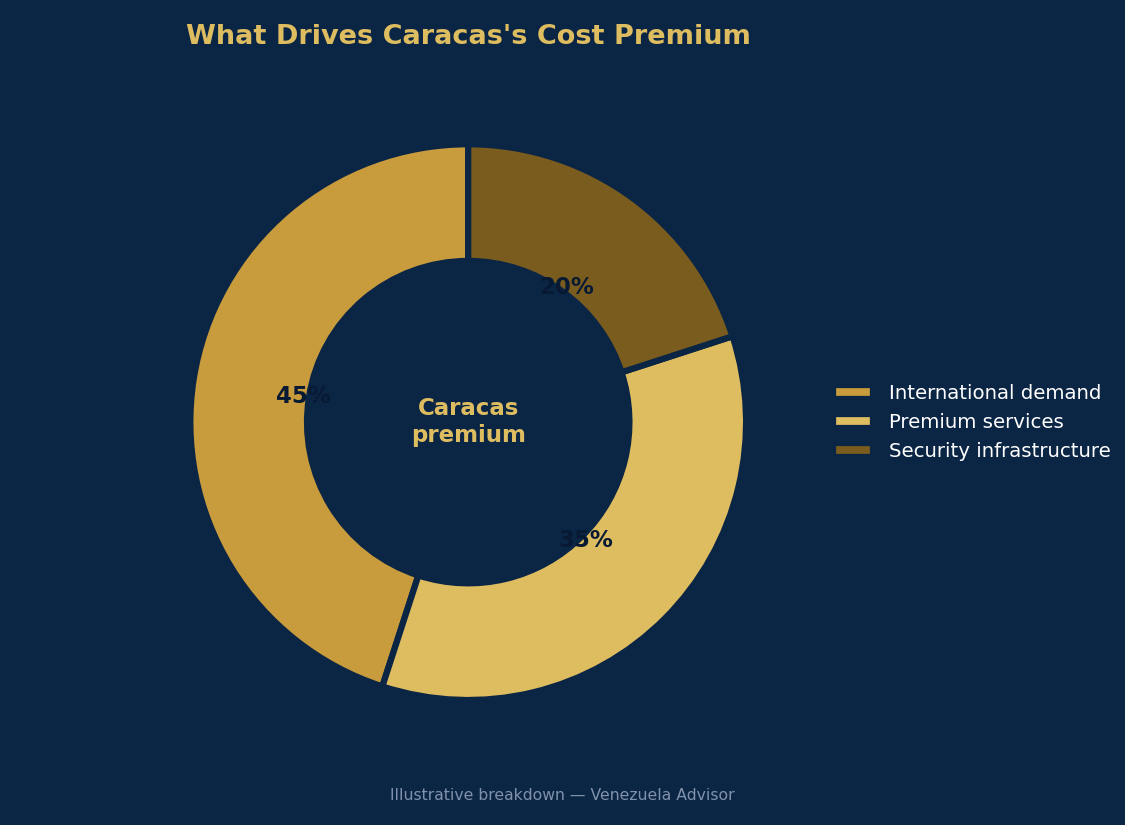
International demand — from returning diaspora, foreign professionals, and multinational operations — accounts for the largest share of the premium, followed by the concentration of premium services and the private security infrastructure that many eastern Caracas buildings and neighborhoods maintain as a baseline expectation rather than a luxury add-on.
This premium isn't evenly distributed across every service category. Rent and dining carry the most visible markup, reflecting direct competition among a wealthier, more international customer base for a limited supply of premium apartments and restaurant tables. Basic utilities and public transportation, by contrast, show a much smaller gap versus Valencia or Maracaibo, since these are priced closer to a national baseline rather than tracking the international demand that drives the premium categories specifically.
4. Cost varies by zone within Caracas too
Applying a single "Caracas cost of living" figure across the entire city obscures more than it reveals. Eastern municipalities like Chacao carry meaningfully higher costs than more affordable zones further from the primary commercial corridor, as detailed in our neighborhood guide.
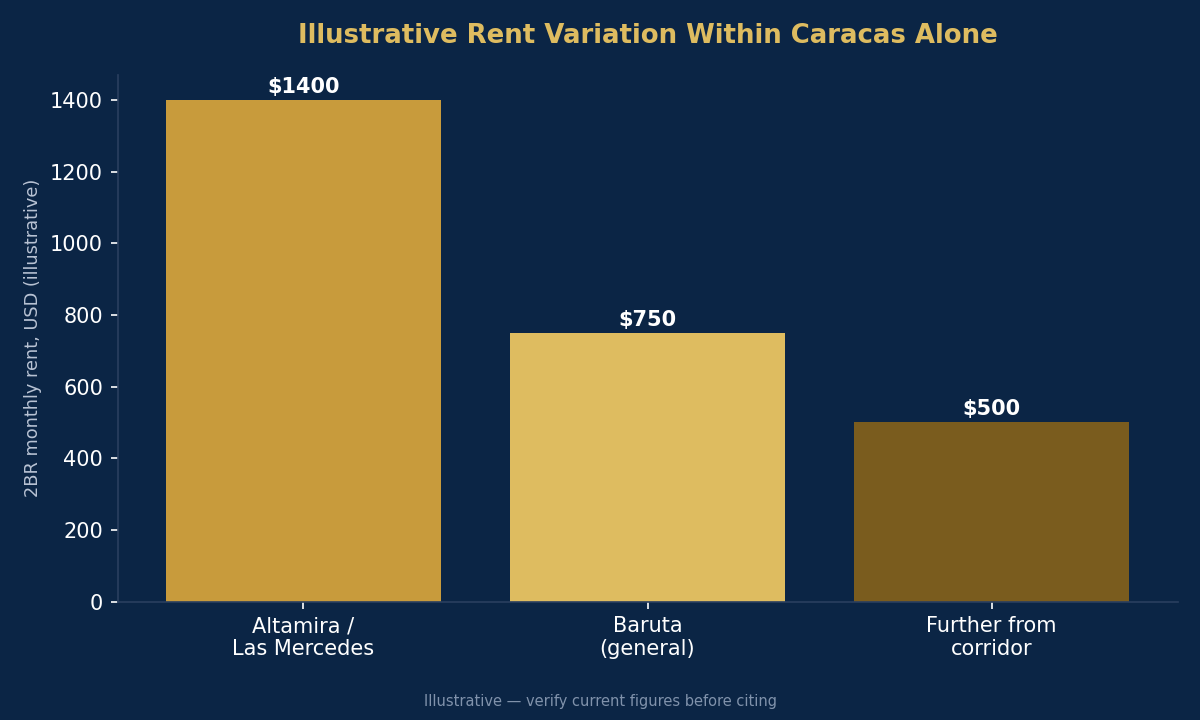
A two-bedroom apartment in Altamira or Las Mercedes can rent for two to three times what a comparable unit costs in a less central Caracas neighborhood, even though both are technically "Caracas" by any national or citywide statistic. This internal variation means that a newcomer's actual cost of living depends far more on which specific zone they choose than on the citywide average that a general cost-of-living comparison typically cites.
Why this matters more for Caracas than for the other two cities
Valencia and Maracaibo both show less dramatic internal price variation than Caracas does, largely because neither city has developed the same concentrated international demand corridor that defines eastern Caracas specifically. This makes a single citywide figure a more reasonable approximation for Valencia or Maracaibo than it is for Caracas, where the zone-level detail genuinely changes the answer — sometimes by a factor of two or three, as the chart above illustrates, rather than the modest variation a national statistic might otherwise suggest.
5. Matching a city to your actual situation
Neither city is universally "better" — the right fit depends on your income source, your priorities around infrastructure and services, and how much you value proximity to Caracas's international business environment specifically.
Someone earning income tied directly to Caracas's corporate or diplomatic sector generally needs to live within reasonable reach of that environment, making the eastern Caracas premium a practical cost of doing business rather than a purely discretionary lifestyle choice. Someone with location-independent income — remote work, a pension, investment income — has genuine freedom to choose Valencia or Maracaibo purely on cost and lifestyle preference, without the income-source constraint that ties many Caracas residents to the capital specifically, regardless of whether they'd personally prefer to live elsewhere given the choice.
Family considerations that shift the calculation
Families with school-age children often weigh private education access alongside pure cost of living, and Caracas's eastern corridor offers by far the widest selection of internationally recognized schools, a factor covered in more detail in our education guide. This educational consideration can outweigh a pure cost comparison for families prioritizing continuity with an international curriculum, even when the raw cost-of-living numbers favor Valencia or Maracaibo on paper, since school continuity and curriculum recognition carry real long-term value that's difficult to capture in a simple monthly budget comparison alone.
6. Mistakes we see people make when comparing cities
Treating a single national cost-of-living figure as meaningful, comparing Caracas prices without specifying which particular zone, and underestimating Maracaibo's specific electrical infrastructure considerations are the three mistakes we see most consistently among people evaluating a move.
Comparing salary offers without adjusting for city-specific costs
Professionals evaluating a job offer that requires relocation sometimes compare the raw salary figure across cities without adjusting for the underlying cost-of-living gap, leading to a decision that looks attractive on paper but doesn't actually improve their real purchasing power once the move is complete. Running even a rough cost-adjusted comparison — not a precise calculation, just directionally accounting for the rent and premium-service gaps described above — produces a far more honest basis for the decision than comparing nominal salary figures alone ever could.
Assuming Maracaibo's lower costs come without tradeoffs
The lower headline living costs in Maracaibo can create a false impression that it's simply a cheaper version of Caracas or Valencia with no meaningful downside. In practice, the electrical infrastructure challenges described earlier represent a real and sometimes substantial offsetting cost — in generator fuel, water storage systems, and the general inconvenience of planning daily life around potential outages — that a pure rent-and-groceries comparison misses entirely, and that only becomes visible once you actually price out the backup infrastructure a comfortable daily life there genuinely requires.
Glossary
Cost of living index: a composite measure comparing the relative cost of goods and services across locations, most useful when broken down carefully by category rather than presented as a single aggregate number.
Backup infrastructure: generators, water storage tanks, and related systems that compensate for utility instability, a significant and often underestimated practical cost consideration across all three cities.
Commercial corridor: a concentrated zone of business, dining, and retail activity that drives elevated real estate and service costs in its immediate vicinity, such as Las Mercedes or Altamira in eastern Caracas specifically.
Healthcare access as part of the true cost comparison
Private healthcare access varies meaningfully across the three cities, and this variation belongs in any honest cost-of-living comparison alongside rent and groceries.
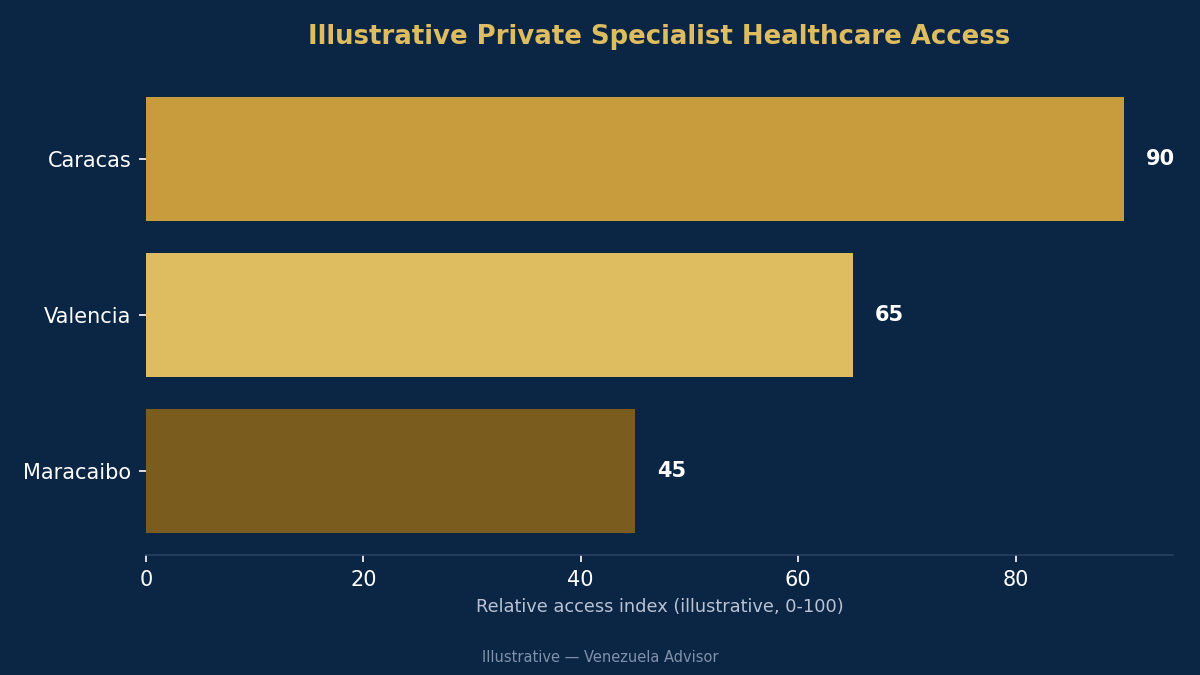
Caracas offers the widest network of private clinics and specialists by far, reflecting both its larger population and its concentration of medical professionals who've historically preferred practicing in the capital, closer to the country's most advanced medical facilities and continuing-education opportunities. Valencia offers solid private healthcare infrastructure tied to its industrial-era development, while Maracaibo's private healthcare options, while present, are comparatively more limited for highly specialized care.
For anyone with ongoing or anticipated healthcare needs specifically, this consideration can outweigh a pure cost calculation: the theoretical savings from a lower cost of living in Maracaibo may not offset the practical cost and inconvenience of traveling to Caracas for specialized treatment not available locally. Factoring in your specific healthcare needs, not just general availability, produces a more accurate total cost picture than comparing rent and groceries alone ever could on its own, particularly for anyone managing an ongoing condition that requires regular specialist attention over time.
Transportation realities that don't show up in headline comparisons
Public transportation infrastructure and private vehicle costs both vary by city in ways that a simple "transport" line item doesn't fully capture. Caracas's traffic congestion, particularly in the eastern corridor during peak hours, adds a real time cost that doesn't appear in a dollar-denominated comparison but affects daily quality of life meaningfully, sometimes turning what should be a fifteen-minute drive into an hour-long ordeal during the worst congestion windows of the day. Valencia's more compact urban layout and Maracaibo's generally lower traffic density can make daily commuting less time-intensive in practice, even when the pure dollar cost of transportation looks similar across all three cities on paper.
Vehicle maintenance costs also vary with each city's specific road conditions and climate — Maracaibo's higher average temperatures and humidity, for instance, can accelerate wear on certain vehicle components compared to Caracas's more temperate valley climate. These are smaller factors individually, but they compound into a meaningfully different day-to-day experience that a category-by-category dollar comparison alone doesn't fully convey to someone weighing a move between these cities for the first time without any prior firsthand experience of daily life in each one specifically.
Key takeaways
- Cost of living can't be averaged nationally — it varies substantially by city and by specific zone within each individual city.
- Eastern Caracas is the most expensive option but also offers the greatest access to international-standard services and infrastructure overall.
- Valencia and Maracaibo offer meaningfully lower costs, each with its own specific infrastructure considerations to evaluate carefully.
- Factor healthcare access and transportation realities into your comparison, not just rent and groceries, since both affect daily quality of life meaningfully.
- Match your city choice to your actual income source and life circumstances, not a generic cost ranking pulled from a national statistic.
If you're comparing Venezuelan cities for a move or investment, we can help you think through the specific tradeoffs that matter most for your particular situation and circumstances.
A note on local salary benchmarks across the three cities
Local salary levels, denominated in bolívares for most formal employment, generally track each city's cost structure to some degree, though not perfectly — a pattern consistent with the labor market dynamics described in our hiring guide. Caracas-based roles, particularly in the corporate and international sectors, tend to offer the highest nominal compensation, but this doesn't automatically translate into proportionally higher real purchasing power once the elevated cost of living is factored in against that higher salary figure, a distinction worth confirming carefully before accepting a relocation offer based on the headline number alone.
For anyone evaluating a job offer or business opportunity across these three cities, running the comparison in real, cost-adjusted terms — not simply comparing nominal salary figures — produces a far more useful basis for decision-making. A Valencia-based role offering a lower nominal salary than a comparable Caracas position may, once adjusted for the real cost-of-living gap described throughout this guide, actually offer comparable or even superior purchasing power once rent and premium-service costs are properly weighed against the nominal salary difference between the two offers under consideration.