
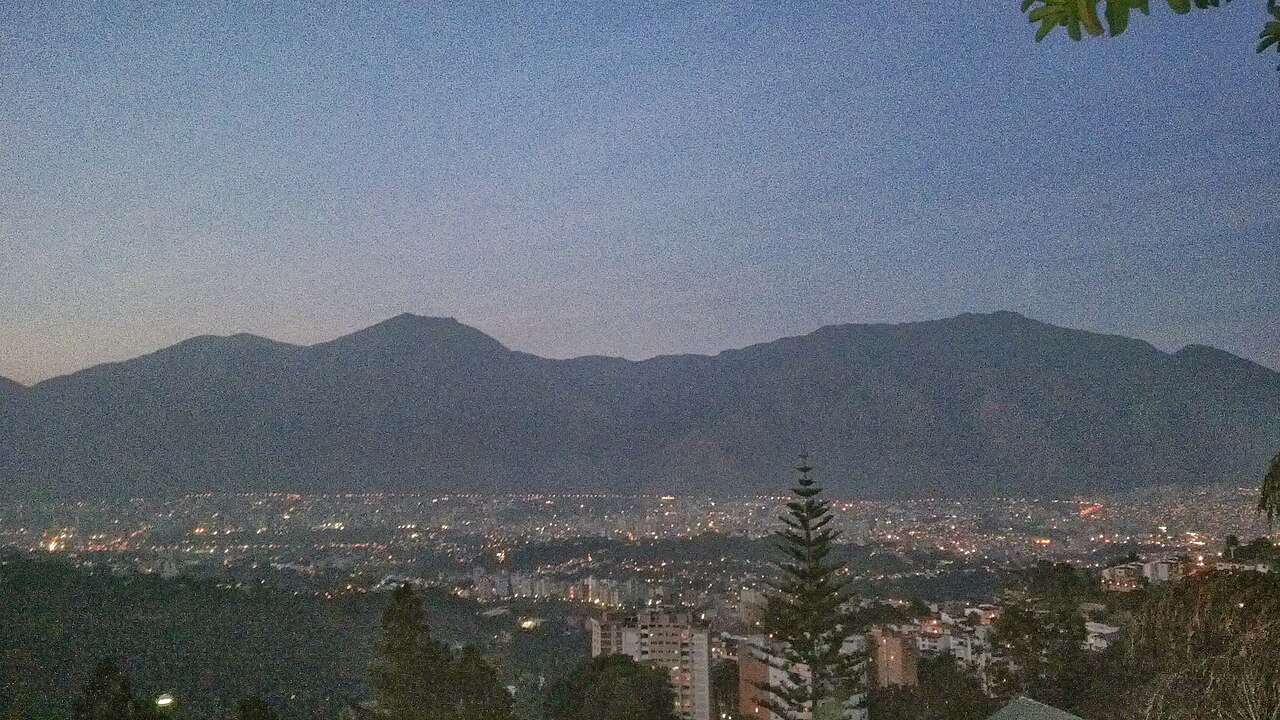
- A practical guide to buying real estate in Caracas, Venezuela.
- Why Caracas? The case for buying a property in 2026
- #1 — The political reset (Maduro, transition, boom)
- #2 — The seismic window (June 24, the reconstruction thesis)
- #3 — How the market works today (dollarization, consumer economy)
- #4: Where to buy in Caracas — Eastern municipalities
- #5: Your attorney is non-negotiable: legal process and due diligence
- #6: How do you send money to Venezuela?
- #7: The rental market and the return of the Venezuelan diaspora
- #8: Five mistakes foreign buyers make in Caracas
- Glossary of Venezuelan real estate terms
- Ready to invest in real estate in Caracas? Here's how to start.
A practical guide to buying real estate in Caracas, Venezuela.
Buying a property in Caracas can be an attractive opportunity, but it also requires knowledge, careful analysis, and a deep understanding of the potential risks. The Venezuelan real estate market has unique characteristics that set it apart from other Latin American markets, particularly regarding prices, dollar transactions, documentation, legal security, and the property-buying process.
In this guide, we'll cover 8 essential things everyone should know before buying a property in Caracas, Venezuela.
We'll start by looking at how the Caracas real estate market currently functions and the factors that influence property values. Then we'll explore the city's main neighborhoods, typical price ranges, features that can raise or lower a property's value, and opportunities that may be of particular interest to buyers and investors.
We'll also cover the legal purchase process, the documentation that must be carefully reviewed, the importance of verifying the property, payment and transfer considerations, and the key steps that must be completed before closing a transaction.
Finally, we'll discuss the most common risks and mistakes buyers may encounter, particularly those unfamiliar with Venezuela's real estate market and legal framework.
The goal isn't simply to present properties or prices, but to provide a practical, structured overview of the buying process, helping readers make better-informed decisions and approach a potential investment with due diligence.
Let's now go through the 8 essential points every buyer should understand before purchasing a property in Caracas.
Why Caracas? The case for buying a property in 2026
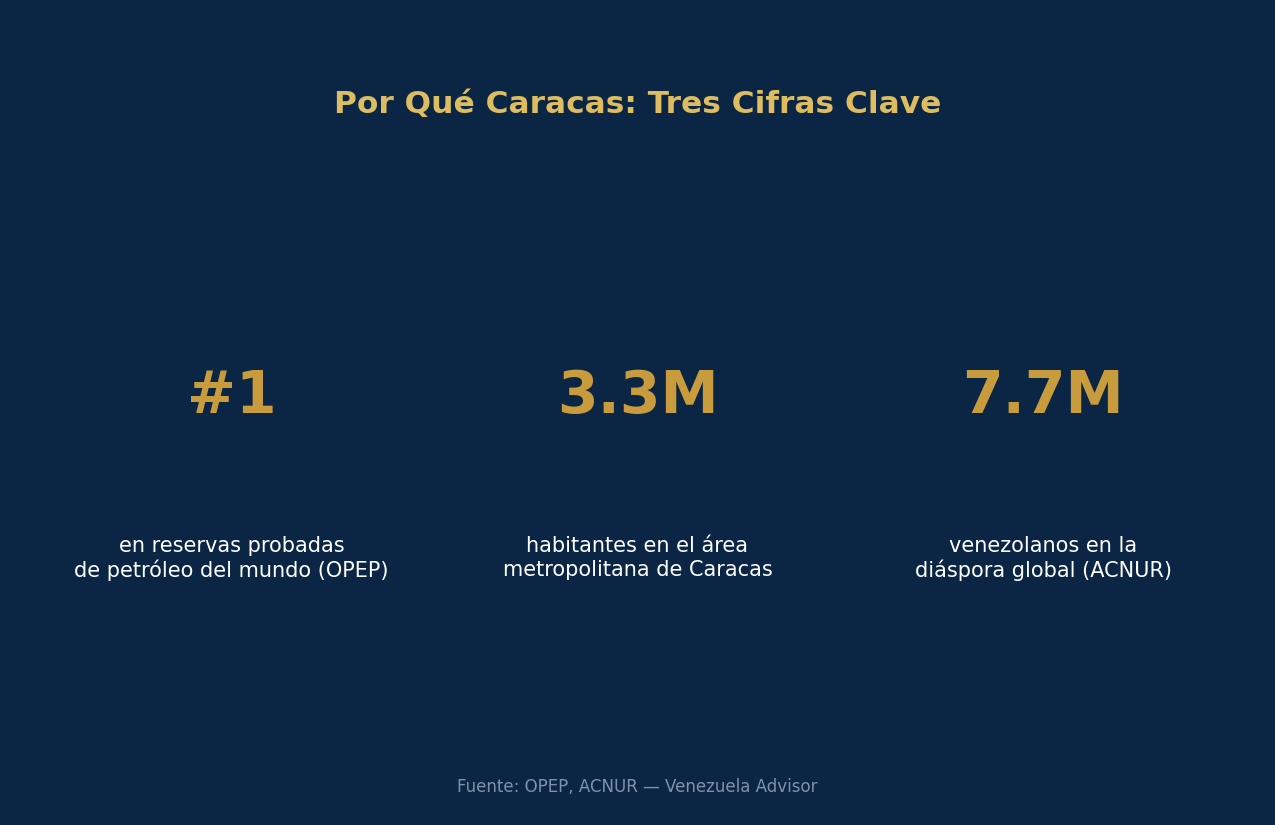
Venezuela holds the world's largest proven oil reserves — 303.8 billion barrels, according to 2023 OPEC figures — surpassing Saudi Arabia, Iran, and every other nation on earth. That geological reality hasn't changed and remains a fundamental factor justifying long-term investment in Venezuelan assets.
For real estate buyers, the question isn't simply whether the Venezuelan economy will recover, but whether they want to position themselves before or after that recovery is fully reflected in asset prices.
The gap in current property prices in Caracas is particularly striking compared to other major Latin American cities. Prime residential real estate in Bogotá sells for roughly $2,500 to $4,000 per square meter. In Panama City, long considered one of the region's safest real estate havens, prices range from $2,000 to $3,500 per square meter in the most sought-after zones.
In Caracas's most sought-after neighborhoods, like Altamira, Las Mercedes, and El Rosal, comparable properties can be found for roughly $600 to $2,500 per square meter, though most of the top-tier inventory clusters in the $900 to $1,500 range.
This is more than a modest discount. It reflects a structural price gap, the product of years of capital flight and a seller base that includes many Venezuelans living abroad who today prioritize liquidity over maximizing sale price.
According to 2023 UNHCR data, approximately 7.7 million Venezuelans were living abroad, representing one of the largest displacement crises in modern Latin American history. Many members of the Venezuelan diaspora still own properties in Caracas they no longer use and may be willing to sell at prices influenced by their need for liquidity rather than the property's intrinsic value.
The Caracas metropolitan area is home to approximately 3.3 million people and remains Venezuela's principal economic, commercial, and political center. It's not a secondary city or a purely speculative frontier market. It's the capital of a country with the world's largest proven oil reserves, where real estate can still be found at prices that would be considered extraordinarily low in many other major Latin American markets.
For buyers who understand this context and know how to manage the transaction correctly, Caracas represents a market that remains largely overlooked by international investors.
#1 — The political reset (Maduro, transition, boom)
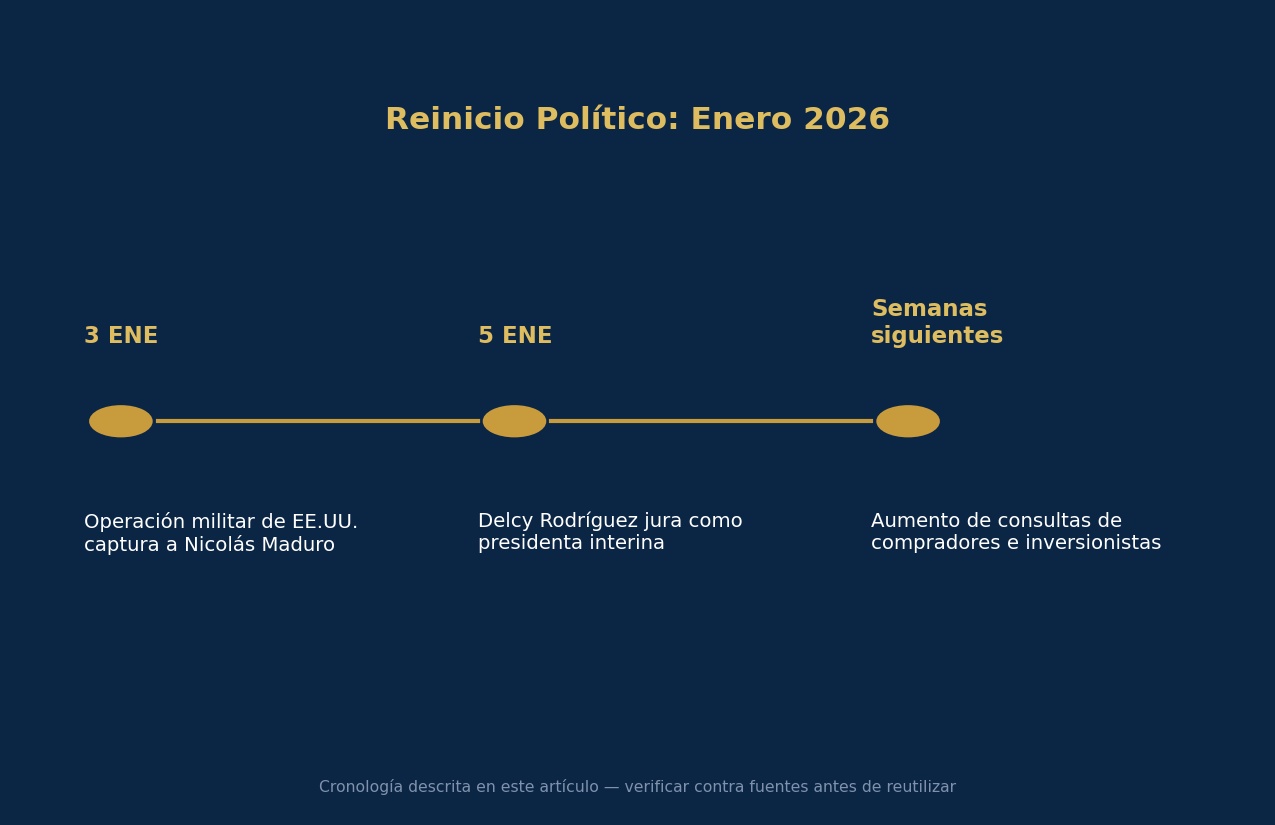
In the early hours of January 3, 2026, the United States carried out a military operation in Caracas that culminated in the capture of Nicolás Maduro and his wife, Cilia Flores. Both were extradited to the United States, where Maduro faced federal charges including narco-terrorism, drug trafficking, and weapons-related offenses. On January 5, Venezuela's vice president, Delcy Rodríguez, was sworn in as interim president. After more than a decade, the Maduro era came to an abrupt end.
The reaction in the Venezuelan real estate market was immediate. In the weeks that followed, real estate agents in Caracas and other major cities reported a significant increase in inquiries from Venezuelans living abroad and international investors. Properties across several markets began attracting renewed interest, as sellers and buyers reassessed prices in light of a possible economic and political transition.
The optimism was based on several possible structural changes. A political transition could bring the prospect of sanctions relief, greater access to international financing, a revival of mortgage lending, and increased infrastructure investment. Historically, these factors can contribute to sustained appreciation in urban real estate markets.
However, real estate professionals interviewed at the time cautioned that the initial boom was partly driven by euphoria. The broader investment thesis remained centered on the possibility that Venezuelan assets had been significantly undervalued after years of economic contraction and restricted access to international capital.
Five months later, the market experienced another major disruption. On June 24, 2026, a powerful earthquake struck northern Venezuela, followed shortly after by another major tremor. These events caused considerable damage in Caracas and other parts of the country, introducing an entirely new factor into the real estate landscape: seismic risk, structural assessments, and building condition.
For anyone considering investing in Caracas properties, understanding this sequence of events is essential. Political changes can shift investor expectations, while natural disasters can fundamentally alter risk profiles and property values. The Caracas market in 2026, therefore, requires buyers to look beyond price and carefully weigh the political, economic, legal, and physical factors affecting each potential investment.
#2 — The seismic window (June 24, the reconstruction thesis)
At 6:04 PM local time on June 24, 2026, a magnitude 7.2 earthquake struck western Venezuela with an epicenter in the municipality of Veroes, near San Felipe, in Yaracuy state. Thirty-nine seconds later, a magnitude 7.5 mainshock — classified as the dominant event — was recorded off the coast of La Guaira, west of Catia La Mar. The two earthquakes, which occurred within under a minute of each other, caused catastrophic, simultaneous damage across Caracas, La Guaira, Miranda, Carabobo, Trujillo, and Yaracuy. By August 2026, more than 6,100 deaths had been confirmed, along with approximately 61,000 hospitalizations and tens of thousands missing (Al Jazeera, CNN, Britannica, August 2026). It is the deadliest natural disaster in Venezuela's recorded history.
June 24, 2026 Earthquake: Key Data
(foreshock)
(mainshock, 39s later)
in La Guaira (Miyamoto Intl.)
in northwestern Venezuela
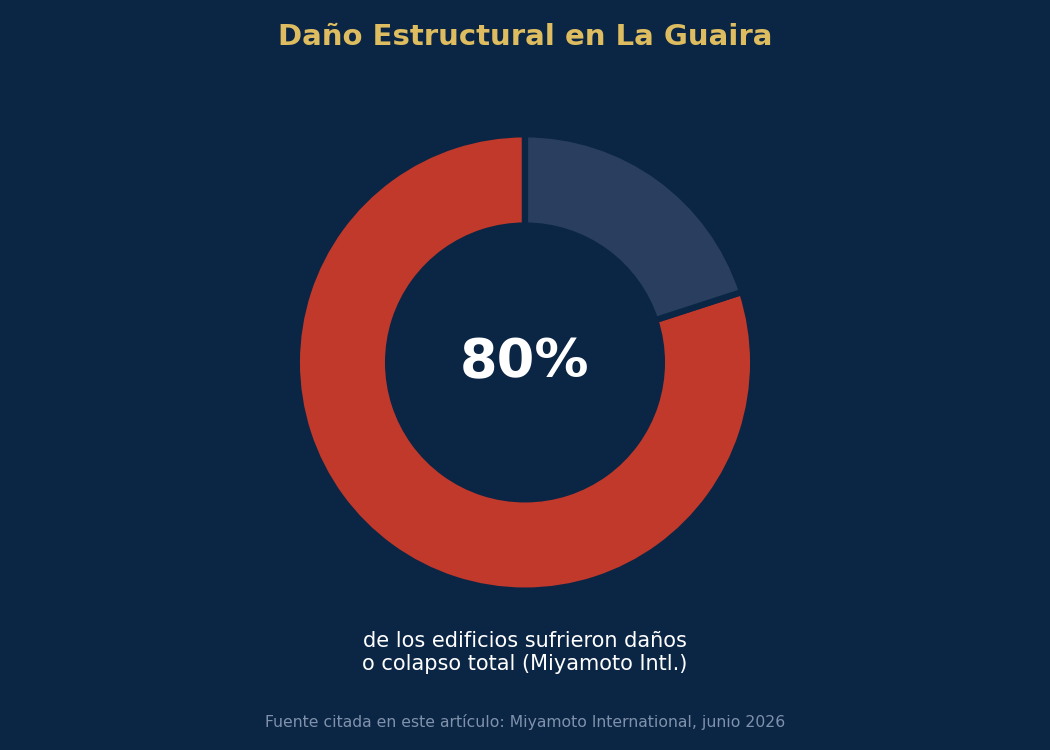
Structural damage was severe and uneven. In La Guaira, the coastal state connecting Caracas to the Caribbean and to Simón Bolívar International Airport, 80% of buildings suffered damage or total collapse, according to structural assessments by Miyamoto International (Miyamoto International Earthquake Update, June 2026). Across northwestern Venezuela, more than 250 structures were confirmed damaged or destroyed immediately after the quake, a figure that continued to rise as engineering teams completed assessments of buildings that appeared intact but had sustained structural or foundation damage. Eastern Caracas municipalities, while better built than La Guaira's older coastal buildings, suffered significant damage concentrated in buildings constructed before 1990 under pre-modern seismic codes.
The two earthquakes radically changed what buyers value in the Caracas real estate market. Before the quakes, demand concentrated mainly on luxury apartments, especially on upper floors, where price, views, and amenities were usually the key factors. After both earthquakes, priorities shifted dramatically: construction quality, structural resilience, building age, location, and perceived seismic risk have become far more important.
This shift is also reshaping demand geographically. Altamira and Los Palos Grandes, traditionally among the most coveted zones for luxury apartments, were affected by the earthquakes, leading some buyers to reconsider properties in areas where damage was less pronounced. Areas like La Lagunita, La Trinidad, Prados del Este, and parts of Baruta and El Hatillo are attracting greater attention from buyers seeking houses, sturdier construction, more open space, and a lower perceived exposure to the risks associated with tall, dense buildings.
As demand shifts toward these areas, the market is beginning to readjust in terms of pricing. Properties in locations considered less exposed to seismic damage are seeing renewed interest and, in some cases, rising value, while apartments in zones once considered the elite of the luxury market may face greater price pressure and longer selling periods.
This is how real estate markets evolve: major events reshape buyer preferences, preferences reshape demand, and demand ultimately reshapes prices. In Caracas, the two earthquakes have therefore not only affected individual buildings — they've begun to reshape the geography of real estate demand itself.
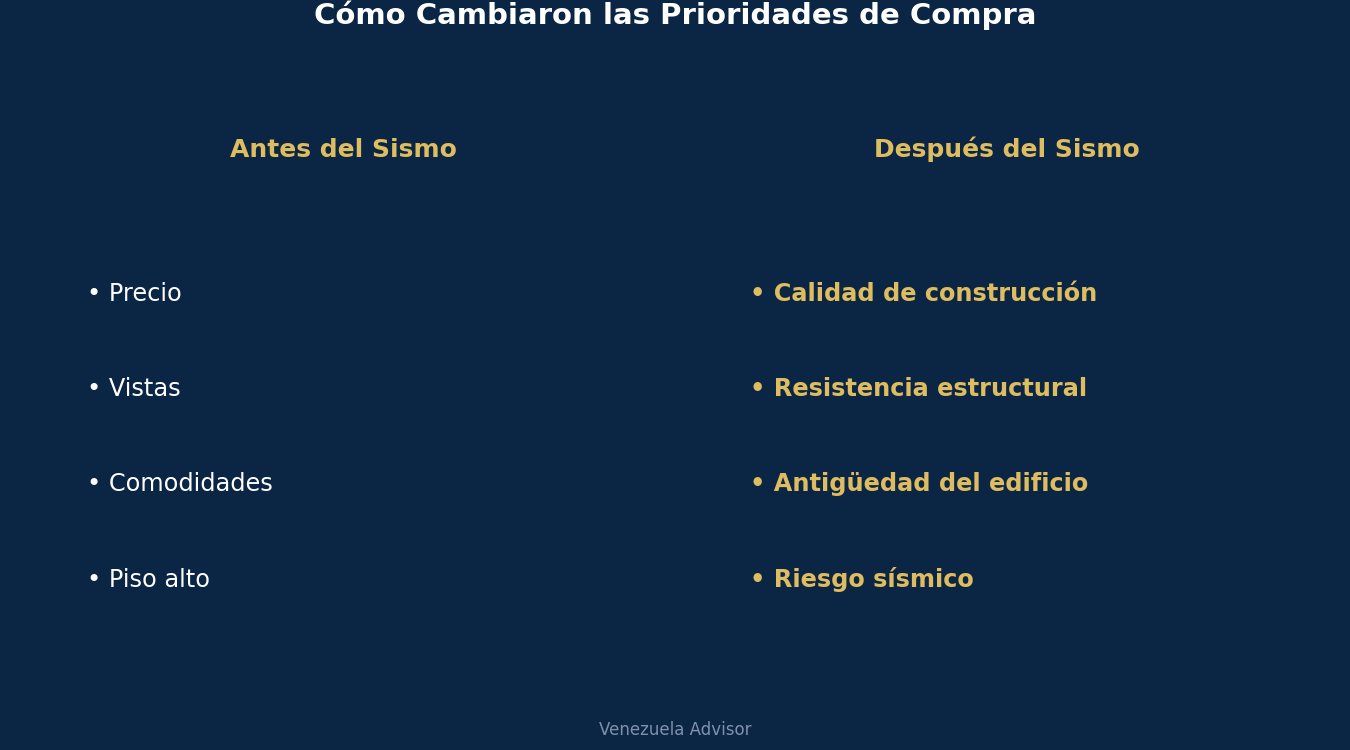
The reconstruction thesis: why does crisis become catalyst?
Every major seismic event in Latin American history has ultimately produced a sturdier, more valuable built environment in the affected city. Mexico City, after the 1985 earthquake (8.0 on the Richter scale), Santiago, after the 2010 earthquake (8.8 on the Richter scale), and Bogotá, after seismic vulnerability assessments prompted by the 1917 (6.3 Richter) and 1967 (6.4 Richter) earthquakes, all followed the same pattern: initial devastation, followed by mandatory updates to building codes, rezoning of damaged urban areas, and a construction boom lasting several years that produced a fundamentally improved city with a higher-quality, higher-value building stock.
Caracas, in 2026, following its magnitude 6.8 earthquake, is positioned to follow precisely this trajectory — and to do so with the additional momentum of a political transition that, for the first time in decades, has opened access to international financing for reconstruction, technical expertise, and development capital.
Precedents: Earthquakes That Upgraded Housing Stock
Updated building codes
Rezoning & construction boom
Seismic vulnerability review
Quality & resilience premium
Venezuela is expected to enact substantially updated seismic building codes following the June 2026 earthquakes, requiring earthquake-resistant construction standards — including base isolation, reinforced concrete shear walls, and modern foundation engineering — for all new residential and commercial developments in affected areas. Rezoning discussions are underway in both Caracas and La Guaira, with early proposals contemplating lower-density reconstruction, expanded green protection zones, and modern mixed-use developments on land where collapsed structures have created new buildable space in the city center.
Buyers entering the Caracas real estate market in the second half of 2026 aren't buying a damaged city — they're buying the beginning of a rebuilt one, at prices reflecting the post-earthquake correction, with the political and financial conditions that make a multi-year recovery not just possible, but structurally underway. The underlying fundamentals remain intact: the world's largest proven oil reserves (303.8 billion barrels, OPEC 2023), a political transition that has removed the primary barrier to international reintegration, and a diaspora of 7.7 million Venezuelans (UNHCR 2023) with the financial capacity and motivation to reinvest in their home country. The earthquake lowered the price. It didn't change the thesis.
Proven Oil Reserves (OPEC, 2023)
barrels
barrels
barrels
by proven reserves
#3 — How the market works today (dollarization, consumer economy)
To buy a property in Caracas intelligently, you first need to understand the economic trajectory that produced today's situation. Venezuela's GDP contracted by approximately 75% between 2014 and 2020, according to World Bank estimates — an unprecedented peacetime economic collapse in modern Latin American history. The country experienced a hyperinflation peak of 1,698,488% in 2018, according to IMF data, which effectively destroyed the bolívar as a store of value and dismantled the domestic mortgage system.
That collapse, catastrophic as it was, produced a paradoxical outcome for the real estate market. Without a functioning mortgage system and without confidence in the local currency, all real estate transactions shifted to cash in US dollars. This wasn't a sudden change but a gradual, then accelerated, process of dollarization that radically transformed how properties are bought and sold. By 2022, Ecoanalítica reported that approximately 67% of all retail transactions in Venezuela were conducted in US dollars. In real estate, dollar penetration was virtually total.
Caracas today looks significantly different from Caracas in 2018 or 2019. The dollarized economy has created an active consumer class, concentrated in the city's eastern municipalities. Restaurants, shopping centers, private clinics, and international franchise brands have returned to the most sought-after districts. This notable economic recovery forms the local backdrop for a rental market that now generates dollar returns genuinely competitive with the region's best markets.
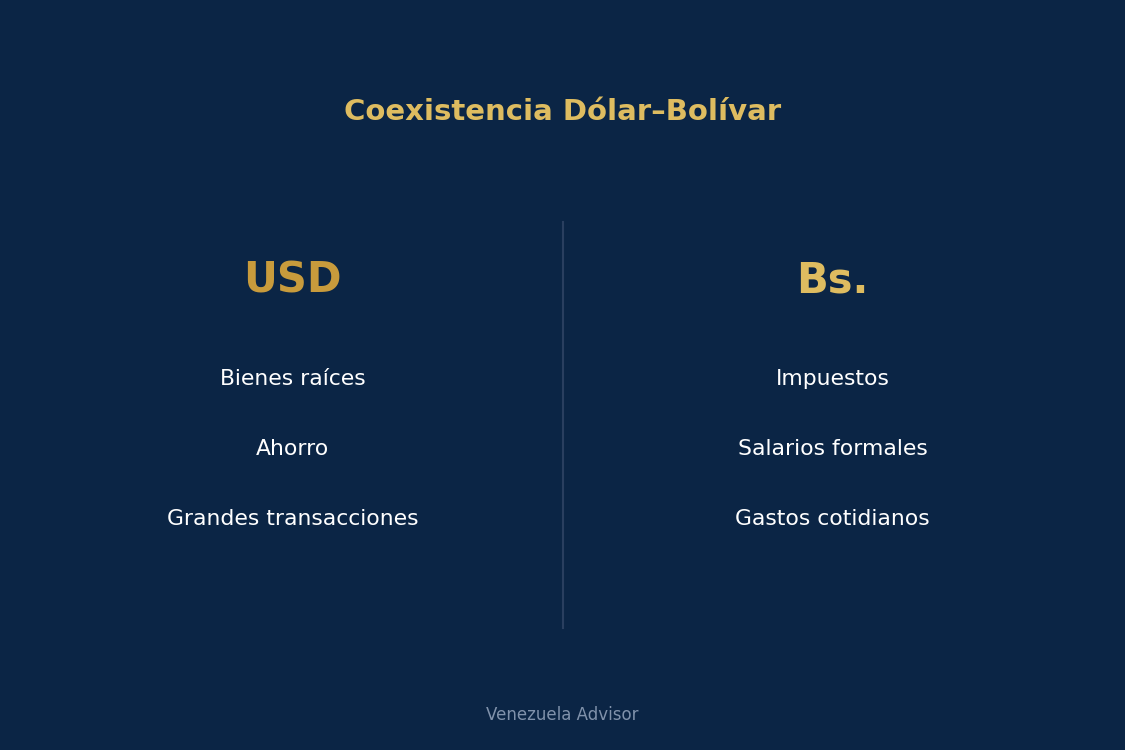
The death and rebirth of the bolívar-denominated market
For decades, the Venezuelan real estate market was priced in bolívares, financed through Venezuelan banks at subsidized rates, and regulated through a complex web of controls that made foreign participation nearly impossible. During the early years of the Chávez government, and later under Nicolás Maduro, the bolívar was defended through strict currency controls and official exchange rates, while the widening gap between the currency's official and real value gave rise to a parallel dollar market. Economic deterioration, hyperinflation, and international sanctions eventually forced the government to acknowledge the economic reality it had tried to control for years. Between 2015 and 2020, much of that economic apparatus stopped functioning, and Venezuela gradually moved toward a de facto, increasingly pragmatic dollarized economy.
The result was a simpler, faster, and in many ways more transparent real estate market: a predominantly dollar-based, cash-oriented system where buyers and sellers negotiate directly in US dollars, transactions typically close in weeks rather than months, and property prices are determined primarily by supply and demand rather than official exchange rates. Today, the US dollar and the Venezuelan bolívar coexist in relative harmony, each playing a practical role in the economy. The dollar has become the preferred currency for real estate, large transactions, savings, and much private-sector activity, while the bolívar remains the country's official currency and continues to be widely used for everyday expenses, taxes, wages, and other local payments.
This transformation has created a market that, structurally speaking, is more accessible to foreign buyers than at any other point in modern Venezuelan history. Foreign buyers generally don't face traditional currency controls when negotiating a purchase price, there's no blanket prohibition on foreign property ownership, and transactions don't require local mortgage financing or other domestic financial structures. A foreign buyer working with the right legal and professional team can therefore complete a real estate transaction in Caracas through a process comparable to a cash purchase in other major Latin American cities. The important caveat is that Venezuela's due diligence process has specific legal, ownership, registration, and documentation requirements unique to the country that must be met precisely. For investors who understand and properly manage these requirements, the shift from a tightly controlled, bolívar-based market to today's pragmatic dollar-bolívar coexistence has fundamentally changed the accessibility and mechanics of buying property in Venezuela.
Economic Collapse: GDP & Hyperinflation
from 2013 peak (est.)
(IMF, 2018)
for real estate today
reopening interest
#4: Where to buy in Caracas — Eastern municipalities
Greater Caracas is divided into several municipalities, but not all are equally relevant to the foreign investment thesis. The eastern part of the city — anchored by Chacao, Baruta, El Hatillo, and Sucre — is where the dollarized economy is concentrated, infrastructure is generally more functional, and property prices have shown the greatest stability in US dollar terms. This is where foreign buyers should focus their search, and where this guide's analysis is concentrated. Among these municipalities, Chacao represents Caracas's financial and commercial core, home to some of Venezuela's most valuable real estate. Its neighborhoods — Altamira, La Castellana, Los Palos Grandes, and El Rosal — together function as the city's financial district, diplomatic corridor, and luxury residential center, with property prices reflecting superior security infrastructure, well-maintained buildings, and access to top-tier services.
Altamira, in particular, has maintained its status as the preferred address for foreign diplomats, multinational executives, and Venezuela's most financially stable families. Its iconic Plaza Francia sits at the center of a residential district defined by tree-lined avenues, established architecture, and a strong private security presence, giving it a distinctive character compared to surrounding neighborhoods. Buyers seeking one of Caracas's most sought-after and internationally recognized addresses consistently identify Altamira as one of the best options. Baruta, by contrast, offers a different value proposition. Neighborhoods like Las Mercedes, La Trinidad, and Caurimare generally offer lower property prices than Chacao while providing appealing quality-of-life features, including more green space and lower residential density in certain areas. Las Mercedes has also become Caracas's leading dining and entertainment district, making Baruta particularly attractive to investors seeking rental income rather than simply capital appreciation in a prestige location.
El Hatillo represents the upscale suburban alternative. Situated at a higher elevation than Caracas's main valley, the municipality offers a distinct urban environment characterized by lower density, larger properties, colonial architecture, and a village-like atmosphere. It tends to attract buyers looking for houses rather than apartments, along with professionals, artists, and high-income Venezuelan families who prioritize space and setting over central location. Prices per square meter are generally comparable to Baruta's, though luxury homes on larger lots can command significantly higher prices. Together, Chacao, Baruta, and El Hatillo represent three distinct investment profiles in eastern Caracas: Chacao for liquidity and prime urban location, Baruta for lifestyle and rental potential, and El Hatillo for space, exclusivity, and upscale suburban living.
Greater Caracas: Key Municipalities
eastern core
& western districts
& southern corridor
residential zones
Property prices by neighborhood: what can your money buy?
Prices in the Caracas real estate market aren't uniform, and the gap between the most and least expensive neighborhoods is wider than in most comparable cities. Understanding the market's price structure is essential before starting a property search, both to set a realistic budget and to recognize good opportunities.
Price per m² in Caracas by Neighborhood
- Altamira / La Castellana — higher end of the covered range
- Las Mercedes / El Rosal — strong commercial-residential demand
- Los Palos Grandes / Chacao — established premium corridor
- Country Club / Valle Arriba — larger homes, lower density
- Other covered barrios — wider spread; always verify comps
In the most exclusive districts of Altamira and La Castellana, well-maintained apartments in established buildings typically sell for $1,500 to $2,500 per square meter. Renovated units in landmark buildings — those with reliable water supply, working elevators, and active management — can exceed $2,500 per square meter for exceptional properties. These are addresses that would sell for $4,000 to $6,000 per square meter in Bogotá or Santiago, and that price gap remains the central argument for the Caracas market.
Price per m² in Caracas by Neighborhood
- Altamira / La Castellana — higher end of the covered range
- Las Mercedes / El Rosal — strong commercial-residential demand
- Los Palos Grandes / Chacao — established premium corridor
- Country Club / Valle Arriba — larger homes, lower density
- Other covered barrios — wider spread; always verify comps
Las Mercedes and El Rosal, which function as Caracas's leading commercial and dining corridors, typically see prices between $1,200 and $2,000 per square meter for residential property. The commercial real estate market in these areas is more complex and beyond the scope of this residential guide, but investors interested in ground-floor commercial space or mixed-use properties should note that dollar rental prices in Las Mercedes have recovered to levels not seen since the early 2010s.
Moving away from the eastern commercial core, the municipalities of Baruta, Caurimare, and La Trinidad offer good-quality housing at prices ranging from $700 to $1,400 per square meter. These areas are highly attractive — drawing Caracas's professional class — and the lower prices reflect geographic location and commute time from the city center rather than any significant quality deficiency. For buyers who prioritize space and construction quality over a prestigious address, these zones offer the market's best value.
In the market's most affordable segment — older buildings in areas with fewer amenities, properties requiring substantial renovation, or apartments in buildings with infrastructure issues — prices can drop to between $400 and $700 per square meter. These properties require thorough investigation of building management, structural condition, and utility supply before any purchase commitment.
#5: Your attorney is non-negotiable: legal process and due diligence
In today's Venezuelan real estate market, having qualified legal counsel isn't a luxury — it's one of the most important safeguards in any real estate transaction. Foreign buyers shouldn't rely solely on a real estate agent, a standard contract, or a seller's promises. The Venezuelan system requires careful verification of ownership, registration, liens and other encumbrances, municipal obligations, and the seller's authority to transfer the property. Because property rights are intrinsically tied to the Public Property Registry, an independent attorney must verify the ownership history and obtain current registry documentation before any significant deposit or payment is made.
A competent Venezuelan real estate attorney should lead the legal due diligence process, reviewing the full title chain and verifying the lien certificate, registry records, cadastral information, property tax status, condominium obligations, and any restrictions affecting the property. The attorney should also draft or review the Option to Purchase or Promise of Sale, negotiate clauses protecting the buyer's deposit and closing rights, and coordinate the documentation required for transfer and final registration. For foreign buyers, the attorney should additionally confirm identification, RIF, and documentation requirements, and ensure the payment structure is correctly reflected in the transaction documents. Practical closing details can vary by municipality, registry office, and the parties' specific circumstances, which is what makes current local experience particularly valuable.
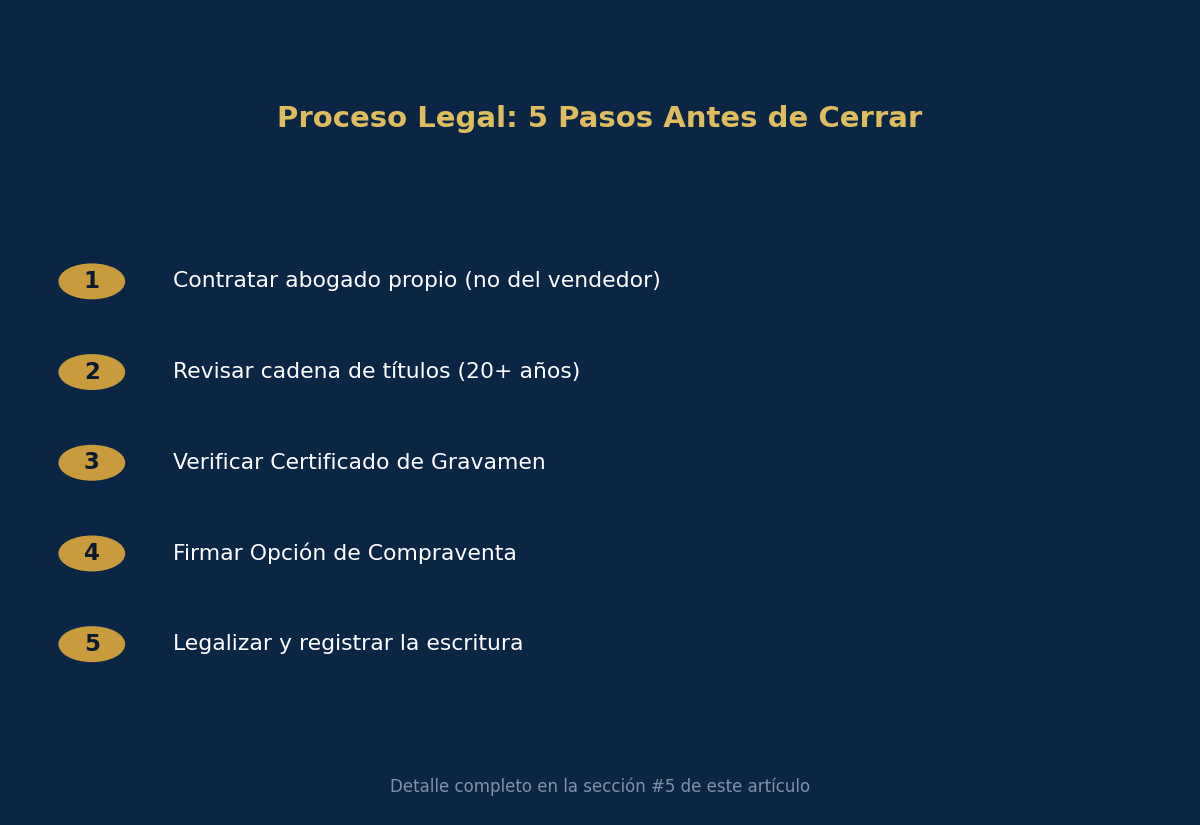
Attorney fees should be evaluated as part of the transaction's risk-management cost, rather than simply as an added expense. Published market guidelines typically place legal fees in the range of 1% to 3% of the transaction value, though the actual amount can vary substantially depending on the property, municipality, complexity of the title review, and scope of services. More important than choosing the cheapest attorney is selecting a Venezuelan attorney with recent, demonstrable experience in real estate transactions and in the specific jurisdiction where the property is located. Ideally, the attorney should be engaged before signing an option or paying a substantial deposit, so that legal due diligence informs the purchase decision rather than simply documenting a transaction that's already been agreed to.
Due diligence, contracts, and closing: protecting your real estate investment
Buying a property in Venezuela requires more than finding the right property at a fair price. The most important step is making sure the property, the seller, and the transaction are all legally in order before you commit your money. Venezuela has a specific chain of custody for documents, and an experienced local attorney must verify every crucial document before you sign anything or make a substantial deposit.
Verify the property's document chain
The process begins with the Property Document, or deed, for the current owner and every previous owner in the chain of title. Your attorney should review the records at the corresponding Real Estate Registry and confirm that every transfer was properly executed and recorded. Gaps in the chain, undeclared inheritances, or poorly documented prior transfers can create serious problems down the line.
The review should also include the Lien Certificate, which identifies mortgages, liens, judicial embargoes, and other encumbrances affecting the property. Your attorney should verify this information directly with the registry, along with the corresponding municipal and condominium solvency certificates confirming that taxes, community fees, and other obligations are current.
Protect your deposit before signing
The Option to Purchase sets out the purchase price, deposit, closing timeline, and consequences if either party fails to perform. It should also include clear conditions requiring satisfactory title documentation, a clean Lien Certificate, and current solvency certificates before the transaction is finalized.
Don't rush to pay a substantial deposit just because you've found the property you want. A preliminary legal review can identify title issues before your money is at risk. The goal is simple: find the problem before you commit your capital, not after.
Notarization and property registration
Once a transaction is ready to close, the final deed is formalized before the corresponding Venezuelan notary. However, notarization isn't the final step. The transaction must also be recorded at the relevant Real Estate Registry, which formalizes the buyer's ownership and protects against competing claims.
Your attorney should follow the transaction through to registration and confirm the property has been correctly recorded in the buyer's name. This final step is essential to securing legal ownership of the property acquired through the transaction.
Taxes, fees, and closing costs
The purchase price is only part of the total investment. Buyers should budget for applicable SENIAT taxes, municipal charges, notary and registration fees, attorney fees, and other administrative costs. Exact amounts depend on the property, the municipality, the transaction structure, and the regulations in force at the time of closing.
Real estate commissions should also be clearly defined before the transaction begins. In Caracas, commission arrangements can vary by property and agency structure, so the buyer should understand who pays the commission and what services are included.
Why professional due diligence matters
For a foreign buyer, handling the documentation for a Venezuelan property without local expert help can create unnecessary risk. A qualified Venezuelan real estate attorney doesn't just prepare paperwork — they verify the property before you invest your capital, identify issues a buyer might miss, negotiate contractual protections, coordinate closing, and ensure the transaction is properly registered.
The real estate agent and the attorney play different but complementary roles. The agent brings market knowledge and helps with property selection and negotiation, while the attorney protects the legal side of the investment. For an international buyer, having both professionals involved from the start can turn a complex purchase into a structured, properly protected investment.
#6: How do you send money to Venezuela?
Getting funds into Venezuela is one of the first things a foreign buyer needs to resolve before purchasing a property. While the US dollar is widely used as the reference currency for real estate transactions, Venezuela's financial system still presents practical limitations for international buyers. The key isn't simply finding a way to transfer money — it's establishing in advance how funds will be received, transferred to the seller, and properly documented throughout the transaction.
Banking services and international transfers
An international dollar wire transfer can be one of the simplest options, but the feasibility of sending funds directly to a Venezuelan bank account depends on the buyer's circumstances and the receiving institution's compliance policies and requirements. Foreign buyers should never assume that arriving in Venezuela with a foreign passport will automatically let them open a local bank account. Banks may require additional identification, immigration documentation, proof of income or source of funds, and other information to meet legal requirements.
For this reason, banking strategy should be defined before signing a purchase contract or making a significant deposit. The buyer should know exactly where funds will be received, what documentation the bank or other intermediary will require, and how the source of the money will be substantiated.
How to Send Money to Venezuela
- Define the channel before signing the purchase option (Opción de Compraventa)
- Bank wire / correspondent banking — formal, documented, slower
- Licensed money transmitters — often used for smaller amounts
- Stablecoins (where legal) — speed and FX efficiency; compliance still required
- Document the source of funds — essential for clean closing and RIF processes
Immigration status and financial access
A buyer planning to settle long-term in Venezuela should also review their immigration status. Depending on the purpose of the stay and the activities to be carried out in the country, obtaining a Venezuelan visa or another immigration status may be appropriate. The applicable category depends on each person's circumstances, and professional immigration advice can help determine the correct procedure and documentation.
It's important to distinguish two things: buying a property and obtaining banking services are different processes. Owning real estate in Venezuela doesn't automatically grant a foreigner the right to open a Venezuelan bank account or access the local financial system.
Brokerage firms, financial intermediaries, and digital assets
Venezuela's constantly evolving financial landscape also includes brokerage houses and other regulated financial intermediaries that may offer alternatives for certain investors. These structures should be evaluated individually, based on the regulations and services available at the time of the transaction.
Stablecoins and other digital assets, particularly dollar-pegged instruments like USDT, are also part of the Venezuelan financial landscape and can appear in commercial transactions. However, any real estate transaction involving digital assets requires rigorous legal, financial, and compliance review. The buyer must be able to clearly demonstrate the origin, transfer, and final destination of the funds.
Keep a complete paper trail
Regardless of whether funds enter Venezuela via bank transfer, financial intermediary, or another legally permitted mechanism, documenting the origin and movement of funds is essential. Buyers should keep bank statements, transfer confirmations, proof of the source of funds, payment receipts, and documentation linking those funds to the property purchase.
This documentation provides an important layer of protection and may also be relevant to the legal formalization and registration of the transaction.
Plan financing before you buy
Your financing and payment strategy should be defined before signing the Option to Purchase or making a significant deposit. Waiting until closing to discover that funds can't be transferred or received through the intended channel can cause major delays and, in some cases, jeopardize the transaction.
For foreign buyers, the most effective approach is to coordinate the process from the start: determine the available method for transferring funds, verify banking or financial requirements, establish the buyer's immigration situation where applicable, document the source of the money, and only then proceed with the property purchase.
A Venezuelan attorney experienced in real estate and immigration can help coordinate the legal and documentary aspects of the process, while an experienced local real estate agent brings market knowledge, helps with property selection, and supports negotiation. These roles complement each other, and having both professionals involved from the start can make the purchase significantly safer and more efficient.
#7: The rental market and the return of the Venezuelan diaspora
Caracas's rental market in 2026 offers attractive income potential for investors, supported by relatively low US-dollar property prices, dollar-denominated rents, and growing demand from both the local professional class and Venezuelans returning from abroad. In the most important eastern municipalities, gross rental yields can be particularly attractive compared to many established Latin American markets, though actual returns vary significantly by property, location, condition, and operating costs.
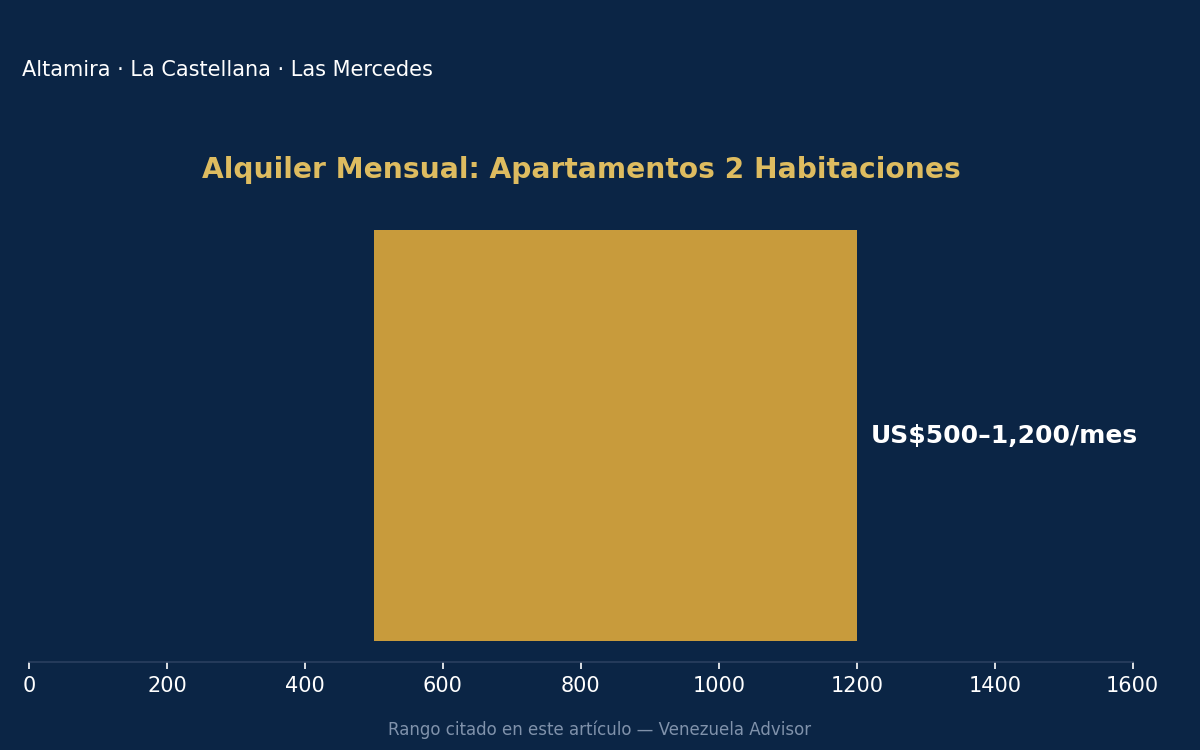
Rental demand is especially strong in areas like Altamira, La Castellana, and Las Mercedes, where well-maintained apartments attract professionals, returning Venezuelans, and international residents. Two-bedroom properties in these areas can generate rents between $500 and $1,200 a month, depending on size, furnishing, construction quality, and location. Diaspora return represents an important driver of demand, since many Venezuelans abroad maintain family and professional ties to Caracas and increasingly consider extended or permanent stays.
Short-term rentals can offer additional income potential in areas like Las Mercedes, Altamira, and El Hatillo, especially among business travelers, international professionals, and returning diaspora. However, this strategy requires more active management and greater attention to building infrastructure, including reliable water, electricity, and internet. For investors, the opportunity isn't simply about buying cheap — it's about selecting the right property in the right location, with the features that best match the strongest rental demand.
#8: Five mistakes foreign buyers make in Caracas
Mistake one: Skipping a full title chain review
The most common serious mistake is proceeding to the Option to Purchase — or even notarization — without completing a thorough review of at least 20 years of property history. Venezuela's registry system has gone through periods of dysfunction, and improperly recorded transfers, undeclared inheritances, and title defects from the bolívar era are more common than most buyers expect. No property is priced attractively enough to justify accepting an incomplete title review. The one or two weeks needed to do this review properly are always well spent.
Mistake two: Trusting the attorney "the seller already has ready"
Some foreign buyers try to save money by using the seller's attorney instead of hiring their own independent legal counsel. This is a fundamental mistake. The seller's attorney owes a fiduciary duty to the seller, not to you, and while most attorneys are professional and won't try to deceive the buyer, their advice will always be shaped by their client's interests. Hire your own attorney, pay them separately, and treat their advice as the definitive guide for your transaction.
Mistake three: Paying deposits without documentation
In the Caracas market, there have been cases where buyers made informal deposits — sometimes in cash, without a signed Option to Purchase — based on verbal promises or preliminary negotiations. These situations inevitably lead to disputes when the formal terms of the transaction are later negotiated. Never pay any amount to a seller or their representative without a signed Option to Purchase reviewed by an attorney. This document protects you — use it.
Mistake four: Underestimating infrastructure due diligence
Beyond legal documentation, properties in Caracas require a practical assessment of infrastructure — something foreign buyers often overlook. Venezuelan utilities — water, electricity, and natural gas — have experienced considerable instability in recent years, and backup infrastructure and management capacity vary widely by building. A property with a non-functioning water storage system, an unreliable backup generator, or a management company that can't collect condominium fees will offer a very different ownership experience than one with properly functioning services. Visit the property at different times of day, talk to current residents, and have your attorney check in with the building's management before committing.
Mistake five: Miscalculating total cost
Buyers who plan their transactions based solely on the initial sale price — without accounting for taxes, attorney fees, notary costs, registration fees, and potential renovation expenses — sometimes find themselves short of capital at critical moments in the transaction. Calculate your total acquisition cost — including a 10% to 15% reserve for renovations, furnishing, and unforeseen expenses — before starting your property search. Arriving at closing with insufficient funds isn't just embarrassing; in a market where sellers have other options, it can cost you the property entirely.
5 Common Mistakes Foreign Buyers Make in Caracas
- 1. Skipping a full title-chain review (20+ years)
- 2. Relying on the seller’s attorney instead of your own
- 3. Paying deposits without a signed purchase option (Opción de Compraventa)
- 4. Ignoring structural / seismic condition after June 2026
- 5. Underestimating closing costs and registry timelines
Glossary of Venezuelan real estate terms
Acta de Entrega: the delivery certificate documenting the transfer of the property from seller to buyer, typically signed on the day of final possession and confirming the property's condition at that time.
Arras: the earnest-money deposit paid by the buyer under the Option to Purchase. Under Venezuelan law, confirmatory arras obligate both parties to complete the transaction, with the seller subject to a double-refund penalty in the event of breach.
Certificado de Gravamen (Lien Certificate): the lien certificate issued by the Real Estate Registry confirming the property is free of mortgages, embargoes, and other liens. Essential for every transaction.
Condominio: the homeowners' association or building management entity responsible for managing common areas, collecting maintenance fees, and maintaining building services. Condominium solvency is required before a property can be transferred.
Documento de Propiedad (Property Document): the recorded title document proving ownership. The complete chain of these documents, traced back through each successive owner, forms the title chain that must be reviewed during due diligence.
Notaría Pública: the notary office where deeds of sale are formalized and legalized. The notary is a public official who verifies identities, authenticates signatures, and retains the original deed.
Opción de Compraventa (Option to Purchase): the purchase-option contract binding buyer and seller to complete the transaction under specific terms and timelines. The Venezuelan equivalent of a purchase agreement.
Registro Inmobiliario (Real Estate Registry): the public property registry where all real estate transactions must be recorded to be fully valid against third parties. Registration, following notarization, is the final, indispensable step in any purchase of property in Venezuela.
SENIAT: Venezuela's national tax authority (Servicio Nacional Integrado de Administración Aduanera y Tributaria), responsible for collecting taxes on property transfers and other transaction-related charges.
Solvencia Municipal: a certificate issued by the corresponding municipality confirming that all municipal taxes on the property in question are current. Required before transfer.
Ready to invest in real estate in Caracas? Here's how to start.
The Caracas real estate market offers a genuinely attractive opportunity for informed foreign investors: quality properties at competitive prices, transactions conducted mostly in dollars, and strong potential in the rental market. The opportunity is real, but seizing it requires local knowledge and a clear understanding of how the Venezuelan market operates.
A successful purchase should start with two key professionals: an experienced local real estate agent who can help you identify the right properties, evaluate pricing, negotiate effectively, and understand each area's characteristics; and a qualified Venezuelan real estate attorney who can review documentation, conduct due diligence, and protect your interests throughout the transaction.
If you're considering investing in Caracas, we're ready to guide you through the process. Our goal is to help you understand the market, find the right property, and connect you with the local professionals you need to move forward with greater confidence and security. The opportunity is real, and you don't have to navigate it alone.