
Repatriating Capital to Reinvest in Venezuela: A Practical Guide for the Diaspora (2026)

By: Venezuela Advisor — Published 2026 · Share
This guide builds directly on our financial instruments guide and remittances guide, focusing specifically on the moment when accumulated savings abroad are ready to move into a Venezuelan investment — the practical mechanics that separate a plan on paper from capital that's actually deployed and working.
- 1. Why repatriate capital now, rather than wait
- 2. A realistic repatriation timeline, not an optimistic one
- 3. The documentation standard that protects you
- 4. Repatriate and reinvest vs. hold abroad
- 5. Tax considerations on both sides
- 6. Mistakes we see in this process
- Glossary
- Choosing the right transfer channel for a large, one-time repatriation
- Coordinating repatriation across multiple family members
- Key takeaways
1. Why repatriate capital now, rather than wait
The entry-price argument developed throughout this guide series — low prices per square meter relative to regional capitals, described in our neighborhood guide — doesn't hold indefinitely as the broader market continues to stabilize. Capital that sits abroad waiting for "more certainty" risks missing the exact pricing window that makes the investment case compelling in the first place.
This isn't a pressure tactic — it's simply how emerging-market repricing tends to work. As more buyers recognize a pricing gap, the gap itself narrows, and the investors who moved earliest capture the largest share of that narrowing. Waiting for zero uncertainty typically means waiting until the pricing advantage that justified the risk in the first place has already been substantially arbitraged away by other, earlier-moving investors who were willing to act with the information available at the time, rather than waiting for a certainty that rarely arrives on a convenient schedule.
2. A realistic repatriation timeline
Illustrative timeline, not a guarantee: documentation preparation, bank compliance review, the transfer itself, and deployment into the actual investment each take real time, and treating the whole process as instantaneous sets an unrealistic expectation that tends to create friction with sellers or attorneys operating on a timeline you never actually confirmed was achievable.
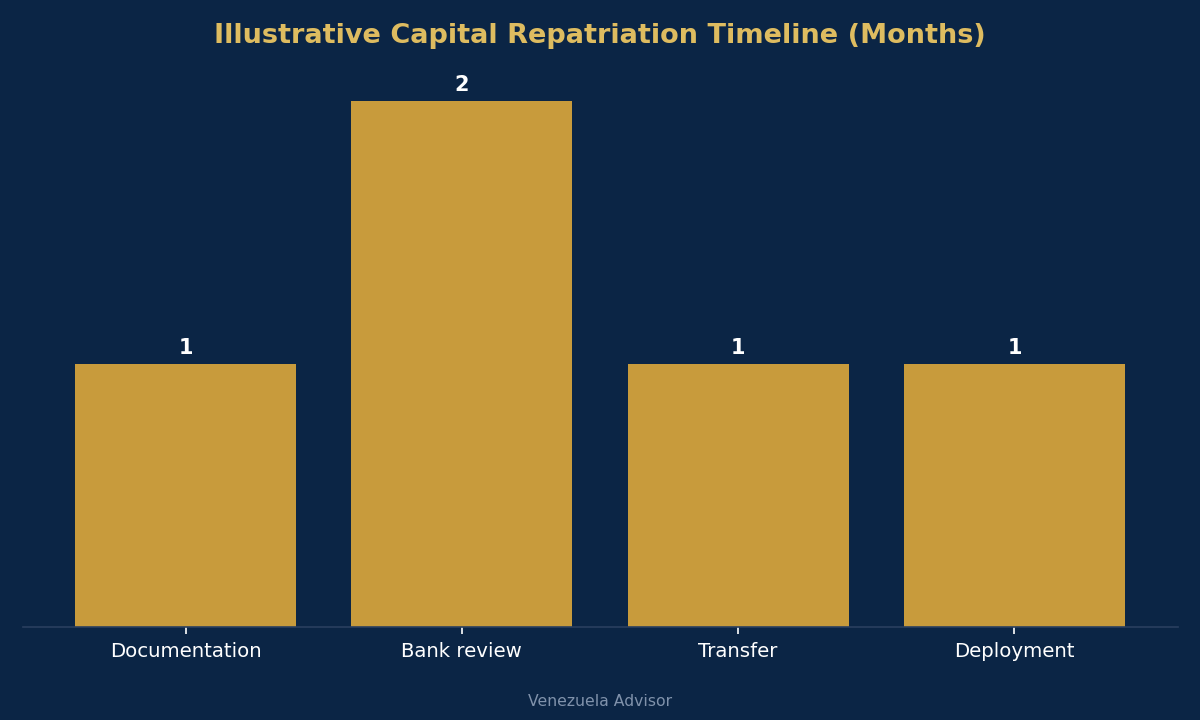
Documentation preparation is usually the most compressible step if you start it early — gathering pay stubs, prior tax returns, and account statements takes little time if you already have them organized, but can stretch for weeks if you're reconstructing years of financial history from scratch. Bank compliance review, by contrast, runs on the receiving institution's own timeline and isn't something you can meaningfully accelerate once the funds and documentation are submitted — building this into your planning as a fixed, non-negotiable window rather than an optimistic best case avoids the frustration of an unmet self-imposed deadline, particularly if you're coordinating the transfer against a specific property closing date.
3. The documentation standard that protects you
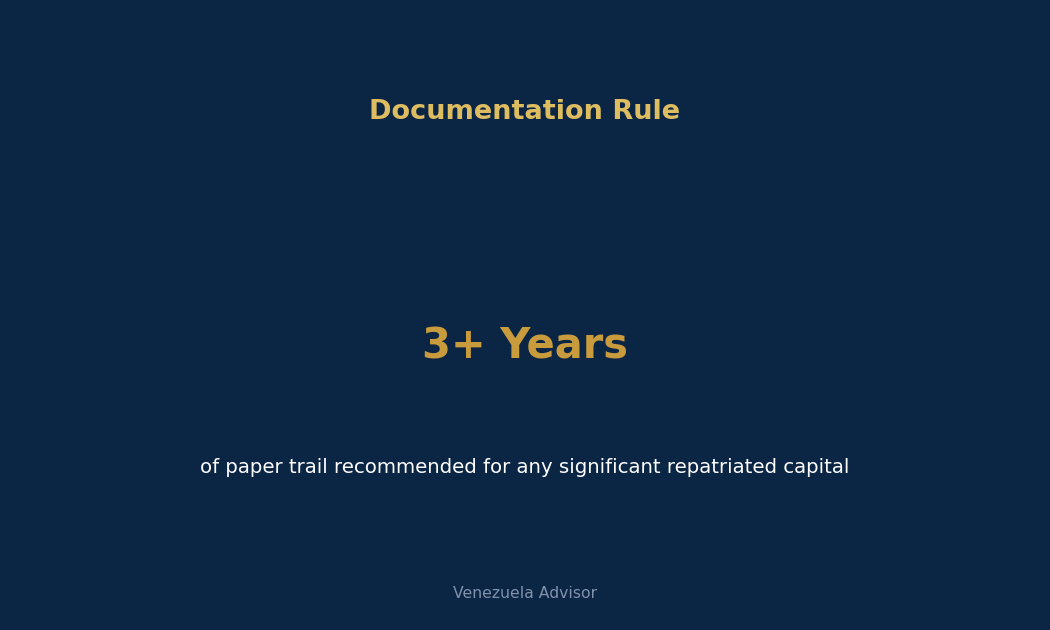
A multi-year paper trail — pay stubs, tax returns, prior account statements — showing exactly how the capital was earned and accumulated abroad is what actually protects you during both the transfer itself and any eventual property closing, as described in our Caracas buying guide. This documentation serves two distinct audiences — the receiving bank's compliance team and, later, your Venezuelan attorney — and preparing it once, thoroughly, serves both purposes rather than requiring separate documentation efforts for each.
Why "three years" isn't an arbitrary number
A single pay stub or account statement shows a snapshot; a multi-year history shows a pattern consistent with how the capital was actually accumulated over time. Banks and, eventually, your Venezuelan attorney during a property closing are both looking for the same thing: a coherent story that a single document can't tell on its own. Three years is a practical minimum that captures enough history to establish that pattern without requiring you to reconstruct records from further back than most people realistically retain, though a longer history never hurts if you happen to have it readily available.
Organizing documentation before, not during, the process
Assembling this paper trail into a single, organized file — chronologically ordered, clearly labeled — before initiating any transfer saves real time once the process begins. Compliance reviewers and attorneys both move faster through a well-organized submission than through a pile of documents they need to sort and interpret themselves, and a poorly organized submission can itself trigger additional scrutiny that a clean one wouldn't have. Treating this organizational step as a genuine part of the repatriation process, not just a formality, is one of the highest-leverage, lowest-cost actions available to anyone planning a significant transfer.
4. Repatriate and reinvest vs. hold abroad
Neither option is universally correct — the right choice depends on your timeline, your existing exposure to Venezuela, and how much documentation friction you're prepared to manage now versus later.
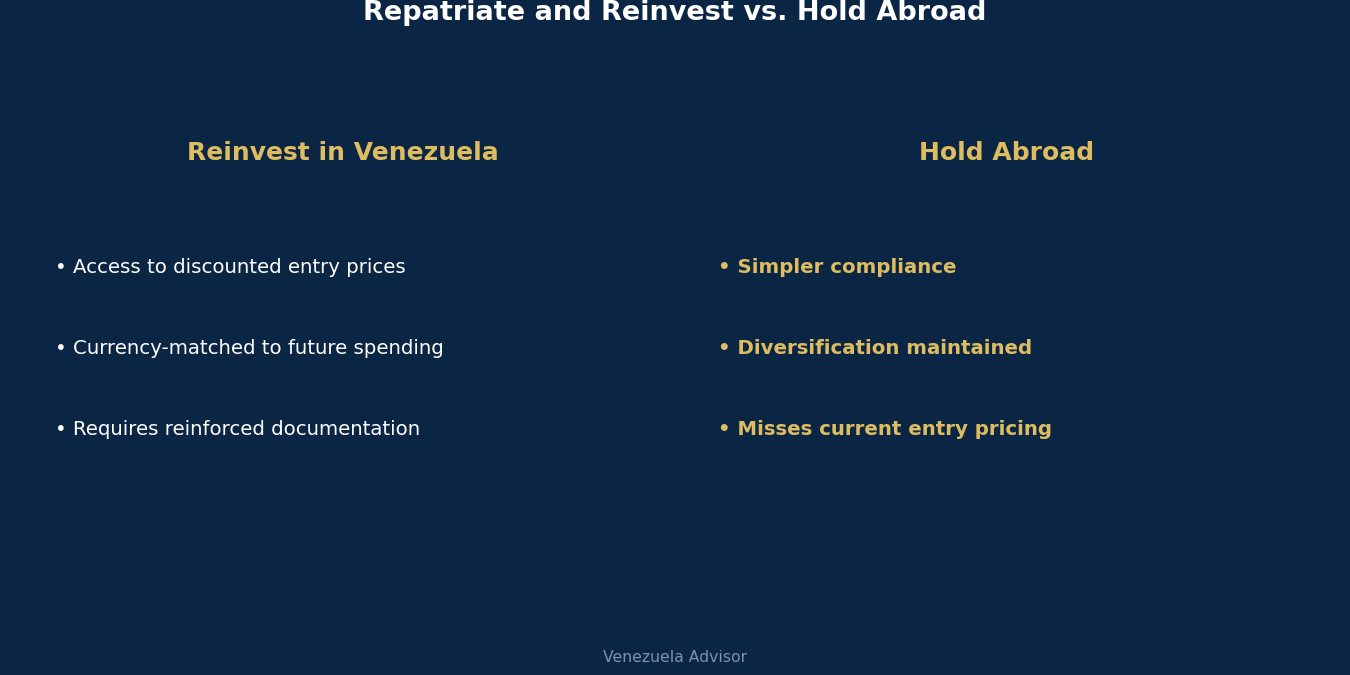
An investor already holding significant Venezuelan real estate exposure through family property, as discussed in our remittances guide, may reasonably choose to hold additional capital abroad to maintain the diversification described in our financial instruments guide. An investor with little current Venezuela exposure and a genuine long-term interest in the market may find that the documentation friction of repatriating now is worth accepting to capture today's entry pricing before it moves further. There's no universally correct answer here — the goal of this section is simply to make sure you're choosing deliberately, rather than defaulting to whichever option required the least immediate effort.
5. Tax considerations on both sides
Repatriating capital can trigger reporting obligations in your country of residence that have nothing to do with Venezuela specifically, a point we cover in more detail in our financial instruments guide. Confirming these obligations with a qualified accountant before the transfer, not after, avoids an unwelcome surprise at tax season, and the cost of that consultation is trivial compared to the cost of an unexpected tax liability discovered months later.
On the Venezuelan side, funds entering the country for a real estate purchase should be structured with the closing costs and tax framework described in our closing costs guide already in mind, rather than treating the repatriation and the eventual purchase as two entirely separate financial events. Coordinating both sides of this process — your home-country accountant and your Venezuelan attorney — from the start produces a cleaner outcome than handling them sequentially and hoping they align, since a change on one side (a different closing timeline, an adjusted transfer amount) frequently has direct implications for the other that only a coordinated view catches early.
6. Mistakes we see in this process
Waiting for a documentation gap to resolve itself rather than addressing it proactively, treating the repatriation timeline as instantaneous when planning a property closing date, and failing to confirm home-country reporting obligations before transferring are the three mistakes we see most consistently across the transfers we've been involved with.
Assuming a bank will explain what's missing
Some clients assume that if their documentation is incomplete, the receiving bank will simply tell them what's missing and the process will pause cleanly until it's resolved. In practice, compliance reviews sometimes conclude with a declined or delayed transfer with limited explanation, leaving the sender to guess what additional documentation might resolve the issue. Front-loading documentation — providing more than the stated minimum, organized clearly — reduces the odds of hitting this ambiguous outcome in the first place, and is far less frustrating than trying to reverse-engineer a bank's specific concerns after a transfer has already been delayed or declined.
Locking in a closing date before funds are confirmed available
Coordinating a property closing date with a seller before your repatriated funds have actually cleared and are available for use creates unnecessary risk on both sides of the transaction. Confirming funds are fully available and accessible before committing to a specific closing date — even if it means a slightly longer negotiation with the seller — avoids the scenario where a delayed transfer jeopardizes an otherwise-agreed transaction, and puts you in a stronger negotiating position generally, since a buyer who can demonstrate funds are already in place is a more credible counterparty than one still waiting on a transfer to clear.
Treating this as a one-time event rather than an ongoing capability
Investors who plan to make more than one Venezuela-related transfer over time benefit from building a repeatable process — a documented relationship with a specific bank or channel, an established rhythm with their accountant and attorney — rather than treating each repatriation as a one-off project reinvented from scratch. This investment in process pays off increasingly as the number of transactions grows, since the second and third repatriations become meaningfully faster and less stressful once the channel, documentation format, and professional relationships are already established from the first one.
Glossary
Repatriation: the process of moving capital held abroad back into the country of origin for investment or other use.
Paper trail: the documented history of how funds were earned, held, and transferred, used to demonstrate legitimate origin.
Compliance review: a bank's internal process of verifying a transaction meets regulatory and anti-money-laundering requirements before processing it.
Source of funds: the documented, verifiable origin of money being transferred, distinct from source of wealth, which refers more broadly to how the sender accumulated their overall net worth over time.
Choosing the right transfer channel for a large, one-time repatriation
A large, one-time repatriation for a specific real estate purchase deserves a different channel evaluation than the smaller, recurring transfers described in our remittances guide. Fee structures that work well for frequent, modest transfers don't necessarily offer the best terms for a single large transaction, and some channels impose transaction-size limits that make them unsuitable regardless of their fee structure, a detail that only becomes apparent once you actually request a quote for the full amount you intend to move.
For a significant repatriation, it's worth requesting a specific quote for your exact transfer amount from more than one channel, rather than assuming your regular remittance provider automatically offers the best terms for a transaction of this size. The savings from comparing channels on a large transfer can meaningfully offset the cost of the additional time spent comparing them.
Bank wire vs. specialized transfer services
Traditional bank wires offer the most straightforward compliance path for a large, well-documented transfer, since banks are already equipped to handle the kind of source-of-funds documentation a significant repatriation requires. Specialized transfer services sometimes offer more competitive exchange rates or lower fees, but may have lower transaction limits or less mature processes for handling the compliance documentation a large transfer typically requires. Confirming which category a specific provider falls into, before committing to a channel, avoids discovering a transaction-size limit only after you've already started the process. For genuinely large transfers, splitting the transaction across more than one channel is sometimes necessary simply to stay within each provider's individual limits — a detail worth confirming well in advance rather than discovering mid-transfer.
Key takeaways
- Entry-price advantages described throughout this guide series don't hold indefinitely — waiting indefinitely for certainty has a real opportunity cost.
- Budget real time for documentation, compliance review, transfer, and deployment — not an instantaneous process.
- A multi-year paper trail is the single most protective step you can take before repatriating significant capital.
- Confirm home-country tax reporting obligations before transferring, not after.
- Compare transfer channels specifically for your transaction size — the best channel for frequent small transfers isn't necessarily the best for a large one-time repatriation.
- Don't commit to a property closing date before repatriated funds are confirmed available and accessible.
If you're planning to repatriate capital to invest in Venezuela, we can help you think through documentation and timeline planning specific to your situation, and coordinate with the local attorney who will ultimately handle your property closing directly.
Coordinating repatriation across multiple family members
Some repatriations involve pooled capital from several family members — siblings jointly funding a parent's return, or a family group jointly purchasing a property. This adds a layer of coordination beyond the documentation and compliance questions already covered: each contributor's funds typically need their own source-of-funds documentation, even when the capital is being pooled toward a single purchase.
Establishing clear agreement in advance on how the pooled capital translates into ownership shares — and documenting that agreement in writing before funds move, not after — prevents the kind of ambiguity that can strain family relationships later, even when everyone involved started with entirely good intentions. This is a smaller-scale version of the ownership clarity we recommend in our family business guide: separating the financial mechanics from the relationship dynamics protects both.
A simple written memorandum — who contributed what, what ownership percentage that corresponds to, how decisions about the resulting property will be made — costs little to prepare and removes ambiguity before it has a chance to become a dispute. Families who skip this step because "we trust each other" often find that the trust itself is exactly what's tested if circumstances change unexpectedly, whether through a disagreement about the property's use or a life event affecting one contributor differently than the others.