
Passports, Visas, and Documents: A Complete Practical Venezuelan Paperwork Guide (2026)

By: Venezuela Advisor — Published 2026 · Share
Documentation issues are one of the most common sources of delay for anyone moving, as noted throughout our diaspora return guide. This guide focuses specifically on the passport, visa, and civil registry documents that most often need attention before a move, a purchase, or a new business venture in the country.
- 1. A realistic document renewal timeline to follow
- 2. Core documents most people genuinely need
- 3. The cédula de identidad specifically
- 4. Civil registry documents and certified translations
- 5. Considerations for foreign nationals specifically
- 6. Mistakes we see people make
- Glossary
- Power of attorney as a practical tool for remote situations
- Documentation specific to business activities
- Documentation considerations specific to children
- Key takeaways
1. A realistic document renewal timeline
Illustrative sequence, not a rigid rule: starting document verification months before any planned move or trip consistently produces fewer complications than compressing everything into the final weeks.
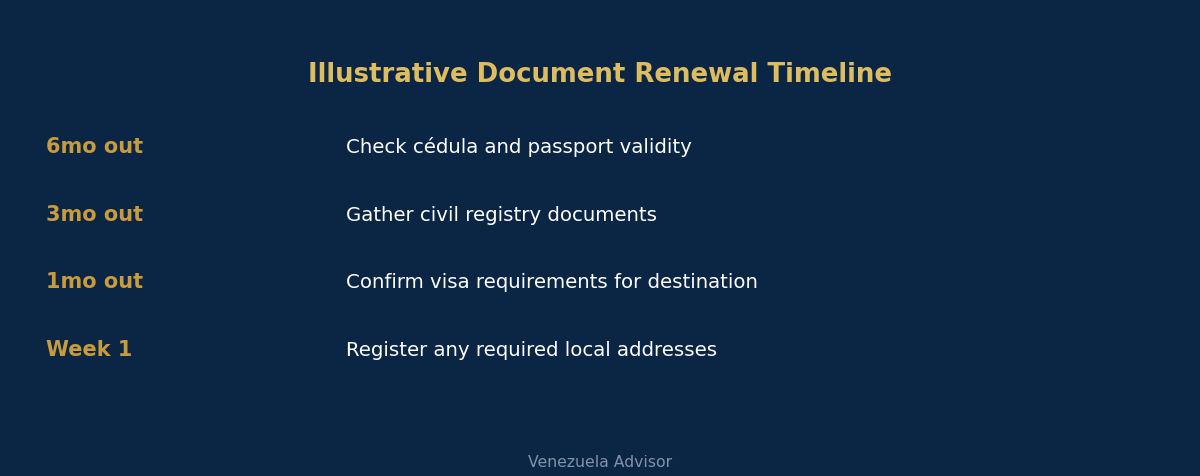
The gap between starting early and starting late compounds in ways that are easy to underestimate until actually living through the compressed version. A cédula renewal or a civil registry document request can take considerably longer to process than expected, and discovering this only weeks before a deadline forces uncomfortable choices between delaying other plans or proceeding without fully current documentation.
2. Core documents most people need
Illustrative checklist, not a complete legal list: certain documents come up repeatedly across the moves, purchases, and business activities described throughout this guide series.
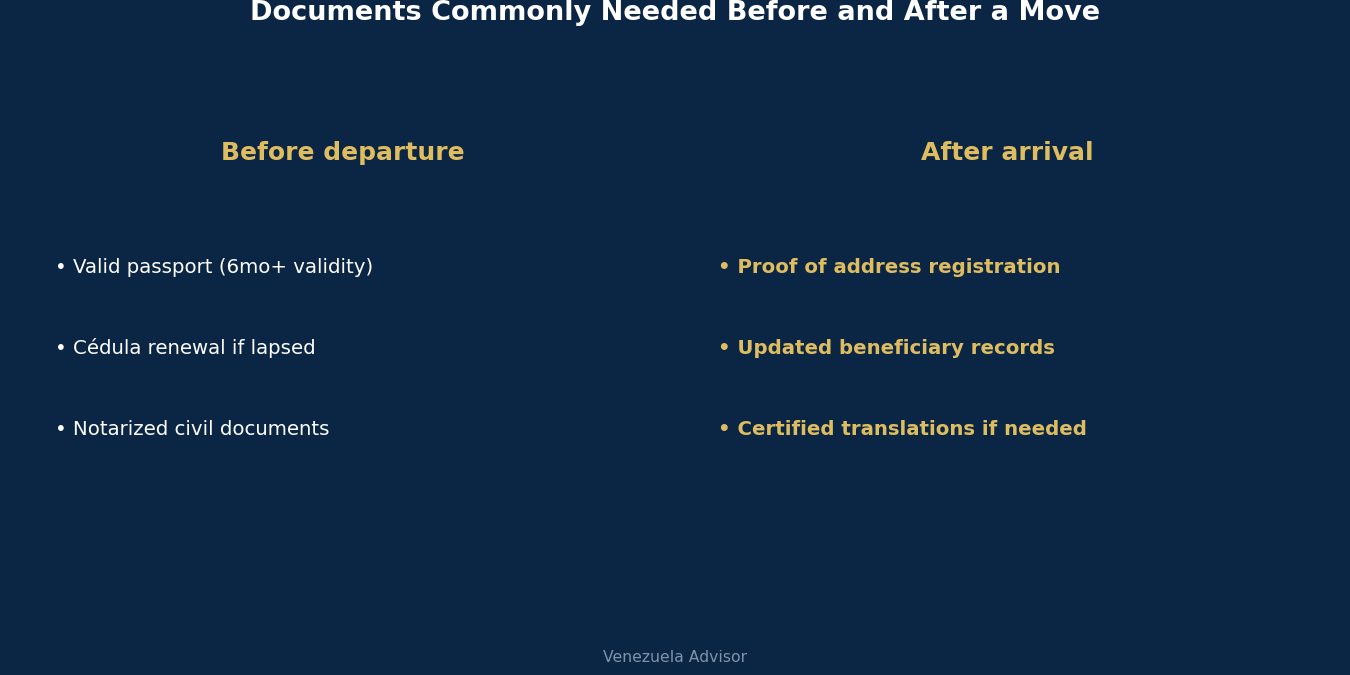
A valid passport with meaningful remaining validity — typically at least six months beyond any planned travel — comes up as a requirement across nearly every scenario covered in this guide series, from property purchases requiring identification to school enrollment requiring proof of identity for children. Confirming passport validity months before any planned move, rather than assuming a passport expiring in a few months is still adequate, avoids a genuinely disruptive last-minute renewal process.
3. The cédula specifically
The cédula de identidad remains the core identification document for most transactions within Venezuela, and its renewal timeline deserves particular attention given the processing delays described in our return guide.
Why the cédula matters beyond simple identification
Beyond everyday identification, the cédula is typically required for property transactions, bank account operations, and enrollment in schools or formal employment — essentially every significant transaction described throughout this guide series requires it in some form before it can proceed. A returnee or foreign resident planning to engage in any of these activities should treat cédula status as a foundational document to resolve early, rather than an afterthought handled only once genuinely needed for a specific transaction that's already underway and difficult to pause.
Renewal versus first-time issuance
The process and timeline differ meaningfully between renewing an existing, lapsed cédula and applying for one for the first time, particularly for children born abroad to Venezuelan parents who may need to establish this documentation from scratch rather than simply updating an existing record. Confirming which category applies to your specific situation before beginning the process avoids wasted time pursuing the wrong procedure entirely, since the required supporting documents and processing steps can differ substantially between the two paths even though the end result looks similar on paper.
4. Civil registry documents and certified translations
Birth certificates, marriage certificates, and similar civil registry documents often require both apostille certification and certified translation for use abroad, a process worth starting well before any deadline that depends on them.
What apostille certification actually accomplishes
An apostille is an internationally recognized certification confirming that a document is authentic and was issued by the stated authority, allowing it to be accepted in another country party to the same international convention without additional layers of embassy legalization or further authentication steps. Without this certification, a foreign authority may simply refuse to accept an otherwise valid Venezuelan document, regardless of how genuinely authentic it actually is — making the apostille a practical necessity, not a bureaucratic formality that can be safely skipped or postponed until later.
Certified translation as a separate, additional step
Even a properly apostilled document typically still requires certified translation into the destination country's official language, a distinct step from the apostille process itself that some people mistakenly assume is already covered by the certification alone. Confirming both requirements — apostille and certified translation — early, and identifying a qualified certified translator well before any deadline, prevents a document that's otherwise ready from being rejected purely on a translation technicality at the worst possible moment in an otherwise straightforward process.
Documents that most commonly need this treatment
Birth certificates for children enrolling in foreign schools, marriage certificates for spousal visa applications, and academic transcripts for credential recognition abroad — the same credential recognition process described in our education guide — are the documents most frequently requiring this combined treatment across the situations covered throughout this guide series. Identifying which of your own documents fall into this category early, rather than discovering the requirement only when a specific transaction is already underway and time-sensitive, avoids a genuinely disruptive delay at an inconvenient moment for the whole family.
5. Considerations for foreign nationals specifically
Foreign nationals considering a move, purchase, or business activity in Venezuela should confirm current visa and residency requirements directly with official sources, since these requirements have changed multiple times in recent years and specific current rules should never be assumed from outdated general information.
[VERIFY: current visa categories and requirements for foreign nationals should be confirmed directly with official Venezuelan consular sources before publishing as fact.]
Why property ownership and visa status are separate questions
A foreign national's ability to purchase property in Venezuela is generally a separate legal question from their visa or residency status, and conflating the two leads to unnecessary confusion for prospective buyers evaluating a purchase from abroad. Confirming both questions independently with qualified local legal counsel — property ownership rules described throughout our real estate guides, and visa or residency rules separately — produces a clearer, more accurate picture than assuming one status automatically implies or restricts the other in ways it actually doesn't.
Long-term residency versus tourist entry
The documentation and process for a short tourist visit differs substantially from what's required for longer-term residency intended to support living, working, or running a business in the country described throughout this guide series, and confusing the two categories leads to significant complications down the line. Foreign nationals planning anything beyond a short visit should research the specific residency category that matches their actual intended activity — investor, retiree, employee of a local company — rather than assuming a single generic "visa" covers every scenario equally well.
6. Mistakes we see people make
Starting document renewal only weeks before a deadline, assuming a translation doesn't need formal certification when it does, and failing to confirm current visa requirements directly with official sources are the three mistakes we see most consistently.
Assuming old documents remain valid indefinitely
Some documents, once issued, are assumed to remain valid indefinitely, when in practice certain civil registry documents have a limited period during which receiving institutions will accept them as sufficiently current — often just a few months from issuance for certain transactions and requirements. Confirming the specific validity window a receiving institution actually requires, rather than assuming any properly issued document remains acceptable indefinitely regardless of age, avoids submitting an otherwise valid document that gets rejected purely for being technically too old at the time of submission.
Underestimating the value of keeping organized digital copies
Maintaining organized digital copies of key documents — passport, cédula, civil registry documents, property records — provides a practical backup against loss and also speeds up future transactions that require referencing these documents repeatedly over time, echoing the same documentation discipline recommended in our safety guide. A simple, consistently organized folder structure, backed up in more than one location, saves considerable time and stress compared to searching for a specific document each time it's needed for a new transaction that comes up unexpectedly.
Not accounting for processing delays in personal timelines
People planning a specific move date, property closing, or school enrollment deadline sometimes build their personal timeline around the assumption that document processing will proceed at the fastest possible pace, without building in reasonable buffer time for the delays that commonly occur in practice across nearly every process described in this guide. Building deliberate buffer time into any timeline that depends on document processing, rather than assuming best-case processing speed will apply to their specific situation, produces a far less stressful experience than discovering a delay only once it's already jeopardizing another commitment that can't easily be postponed.
Glossary
Cédula de identidad: the core Venezuelan national identification document, required for most local transactions and everyday civil life.
Apostille: an international certification confirming a document's authenticity for use in another country that is party to the relevant international convention.
Certified translation: a translation accompanied by a formal declaration of accuracy from a qualified, recognized translator, distinct from a general or informal translation done by anyone.
Civil registry: the official government system recording births, marriages, and deaths, from which certified copies of related documents can be requested when needed.
Power of attorney as a practical tool for remote situations
For anyone unable to be physically present in Venezuela for a specific transaction — a property sale, a legal proceeding, a business matter described throughout this guide series — a properly executed power of attorney allows a trusted representative to act on their behalf without requiring the principal's own physical presence at every step. Setting this up well before it's actually needed, rather than scrambling to arrange one once a transaction is already time-sensitive, provides genuine flexibility for anyone managing affairs in Venezuela from abroad, a situation increasingly common given the diaspora dynamics described throughout this guide series and the growing number of remote transactions this makes possible.
A power of attorney intended for use in Venezuela but executed abroad typically requires the same apostille and certified translation treatment described earlier in this guide, and confirming this requirement with a Venezuelan notary or attorney before finalizing the document abroad avoids discovering a critical gap only once the document is actually needed for its intended purpose and there's no time left to correct it properly.
Key takeaways
- Starting document verification months ahead avoids the most common and costly delays across every process described in this guide.
- The cédula remains central to most transactions and deserves early attention specifically, before it's urgently needed.
- Civil registry documents for use abroad typically need both apostille and certified translation to be accepted.
- Foreign nationals should always confirm current visa requirements directly with official sources, never secondhand accounts.
- A power of attorney, set up in advance, offers genuine flexibility for anyone managing affairs remotely from abroad.
- Building buffer time into any timeline that depends on document processing reduces unnecessary stress considerably.
If you're planning a move or transaction in Venezuela, we can help you think through which documents need attention first for your specific situation and timeline, so nothing catches you by surprise later.
Documentation specific to business activities
Beyond personal documents, anyone starting a company as described in our business formation guide or engaging in import/export activity described in our trade guide faces an additional layer of corporate and commercial documentation beyond the personal documents covered throughout the rest of this article and this entire guide series. Registro Mercantil filings, RIF tax identification, and municipal operating licenses each carry their own renewal timelines and requirements that deserve the same proactive, early-start discipline recommended for personal documentation throughout every section of this guide.
Foreign entrepreneurs in particular should confirm which of their home-country corporate documents require the same apostille and certified translation treatment described earlier in this guide when used to support a Venezuelan business registration, since incorporation documents from abroad are rarely accepted without this additional certification layer completed in advance. Coordinating this requirement with local legal counsel before beginning the registration process avoids a delay that could otherwise push back an entire business launch timeline by weeks or months, undermining momentum built up during the earlier planning stages of the venture.
Documentation considerations specific to children
Children moving between countries, whether as part of a family return described in our diaspora guide or a temporary relocation for work, often require their own specific set of documents — birth certificates, both parents' consent for international travel in certain circumstances, and school transfer records — that parents sometimes overlook while focused on their own paperwork and the many other logistics of a major move. Confirming these child-specific requirements early, particularly any consent documentation required when only one parent is traveling with a child, avoids a genuinely stressful situation at an international border or during school enrollment that could otherwise have been anticipated well in advance.
For children born abroad to Venezuelan parents, establishing Venezuelan citizenship documentation and a first-time cédula may require a distinct process from renewal, as noted earlier in this guide, and researching this specific pathway well before it's needed prevents an unwelcome surprise during what should otherwise be a straightforward and celebratory family transition rather than a source of unexpected bureaucratic stress.