
Beach and Nature Escapes Within Comfortable Reach of Caracas (2026)
By: Venezuela Advisor — Published 2026 · Share
Building on the day-trip overview in our culture and leisure guide, this guide goes deeper into Venezuela's coastal and nature destinations, matched to what kind of trip you're actually looking for and how much time and planning flexibility you genuinely have available.
- 1. Travel time from Caracas to each coastal destination
- 2. Matching the destination to your actual trip goal
- 3. Los Roques in more depth
- 4. Chichiriviche in more depth
- 5. The central coast beaches
- 6. Mistakes we see visitors make
- Glossary
- Combining destinations into a longer trip
- Visiting protected areas responsibly
- What to actually pack differently for each destination
- The value of local guides and operators
- Key takeaways
1. Travel time from Caracas to each destination
Illustrative travel times, not confirmed schedules: these three destinations offer genuinely different tradeoffs between travel effort and experience.
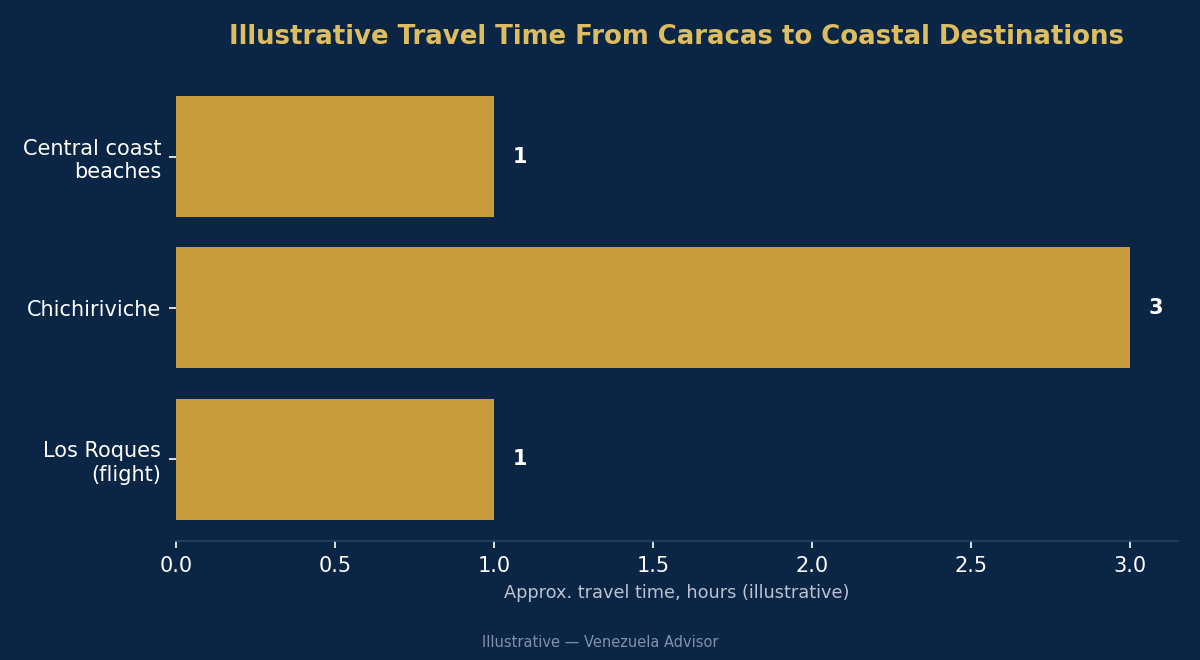
This travel time gap matters more than it might initially appear, since it directly shapes how spontaneous a trip can realistically be. A central coast beach can accommodate a same-day decision to head out for an afternoon, while Los Roques requires the kind of advance flight booking and planning that fits better into a scheduled getaway than a last-minute escape from the city.
2. Matching the destination to your trip goal
The right choice depends less on which destination is "best" in the abstract and more on what you're actually looking for from the trip.
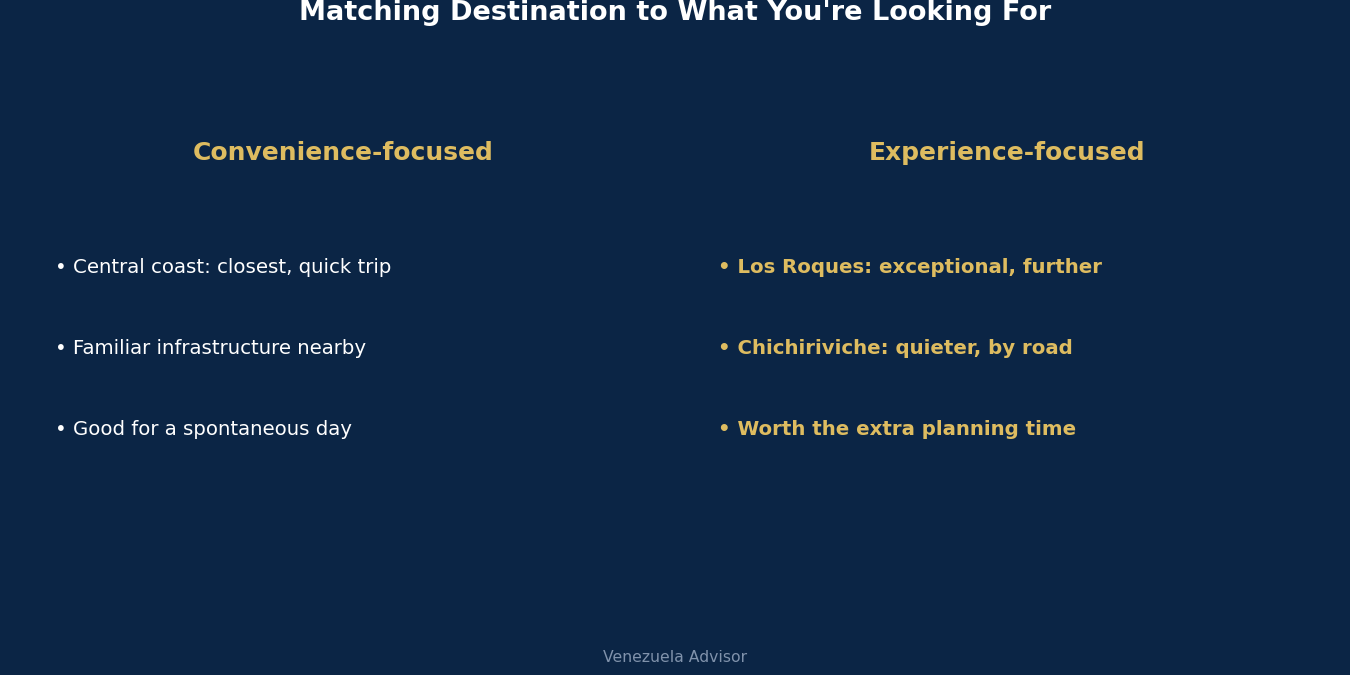
Visitors who default to whichever destination has the strongest general reputation, without considering which category actually fits their available time and priorities, sometimes end up disappointed — not because the destination itself falls short, but because it was mismatched to what they actually wanted from the trip in the first place. Being honest about whether a trip is meant to be a quick, convenient escape or a genuinely planned experience-focused getaway clarifies the right choice considerably.
3. Los Roques in more depth
As described in our coastal investment guide, Los Roques' status as a protected national park shapes both its exceptional natural condition and the more limited, higher-cost nature of visiting it, a tradeoff worth understanding clearly before planning a trip there.
What the national park designation actually means for visitors
Unlike a destination with unrestricted commercial development, Los Roques' protected status has preserved its reef systems and water clarity in a way that's increasingly rare across the wider Caribbean region, but it also means accommodation options remain deliberately limited rather than expanding to meet demand the way an unprotected destination typically would over time. This scarcity is precisely why advance booking matters more here than for the other destinations described in this guide — waiting until the last minute often means settling for whatever remains rather than the specific experience originally planned and hoped for.
Getting there and what to expect
Access is by short flight from Caracas rather than by road, and confirming current flight schedules and availability directly before finalizing any other trip plans avoids building an itinerary around a connection that may not actually be available as assumed when the time comes. Once there, the experience centers overwhelmingly on the water itself — snorkeling, diving, and simply being on some of the clearest water in the region — rather than the kind of built infrastructure and amenities travelers might expect from a more developed destination elsewhere in the Caribbean.
4. Chichiriviche in more depth
Chichiriviche's road access from Caracas makes it a genuinely practical option for travelers who want a coastal experience without flight logistics, trading some of Los Roques' exclusivity for considerably easier planning.
What makes Chichiriviche a distinct experience from Los Roques
Rather than treating Chichiriviche as a lesser substitute for Los Roques, it's worth understanding as a genuinely different kind of destination — quieter, less internationally known, and reachable without the advance planning flight logistics require of visitors with less flexible schedules. Visitors expecting a scaled-down version of Los Roques' specific reef and water clarity sometimes come away disappointed, whereas those who arrive with accurate expectations for what Chichiriviche actually offers tend to have a considerably better and more genuinely enjoyable experience overall.
Nearby national park access
Chichiriviche also serves as a gateway to its own nearby national park area, offering additional nature access beyond the town's beaches themselves for visitors willing to explore slightly further afield and make the most of the surrounding natural landscape. Checking current access conditions and any required permits directly before a visit, rather than assuming unrestricted access, respects both the area's protected status and the visitor's own trip planning, avoiding a wasted trip to an area that turns out to require advance arrangements not initially anticipated.
5. The central coast beaches
The closest option to Caracas, the central coast beaches work best for a spontaneous day trip rather than a planned getaway, with quality varying meaningfully by specific beach.
Why quality varies so much along a relatively short stretch of coast
Infrastructure, water quality, and general upkeep differ noticeably between specific beaches along this stretch, sometimes over a distance of just a few kilometers, reflecting differences in local management and investment rather than any consistent pattern across the whole coast or region. Asking current residents for their specific, current recommendations — rather than assuming any beach along this general stretch offers an equivalent experience — consistently produces a better outcome than picking based on proximity or general reputation alone.
Practical considerations for a central coast day trip
Weekend crowds can meaningfully affect the experience at the most popular and accessible beaches along this stretch, and visiting on a weekday when possible, or arriving early on a weekend, generally produces a more relaxed experience than a midday weekend arrival when crowds have already built up considerably. Basic amenities vary by specific beach as well, and confirming what's actually available — parking, food options, restroom facilities — before departure avoids an unwelcome surprise upon arrival that could have easily been anticipated with a quick check beforehand.
6. Mistakes we see visitors make
Underestimating Los Roques' booking lead time, assuming Chichiriviche and central coast beaches offer an equivalent experience, and not confirming current flight or road conditions before departure are the three mistakes we see most consistently among first-time visitors to these destinations.
Booking Los Roques too close to the intended travel date
Given the limited accommodation described earlier in this guide, visitors who wait until shortly before their intended travel dates to book Los Roques frequently find their preferred options already unavailable, particularly during peak periods when demand from both domestic and international visitors is at its highest. Starting this planning process well in advance — genuinely weeks or months ahead for anything beyond off-peak travel — protects against having to settle for a considerably less appealing option than originally intended for what should be a memorable trip.
Not accounting for weather-related schedule changes
Flight schedules to Los Roques and road conditions to the other destinations described in this guide can be affected by weather in ways that catch visitors off guard if they haven't built any flexibility into their travel plans from the outset of the trip. Building at least a small buffer into any trip involving these destinations, rather than scheduling travel with no margin for a possible delay, reduces the stress of an otherwise unavoidable weather-related disruption that could easily be absorbed with slightly more flexible planning from the beginning.
Glossary
National park status: a legal protection designation that restricts development and requires special consideration for any commercial or construction activity.
Central coast: the stretch of Venezuelan coastline closest to Caracas, accessible by a relatively short drive.
Peak period: holidays and high-demand travel windows during which accommodation and flight availability at popular destinations becomes considerably more limited than usual.
Combining destinations into a longer trip
For visitors with more flexible time, combining a central coast stop with a longer Los Roques or Chichiriviche visit offers a way to experience the genuinely different character of multiple destinations within a single broader trip, rather than choosing just one and wondering about the others. Sequencing the more convenient, closer destination first and the more involved one second tends to work better logistically than the reverse, since it front-loads the simpler planning and leaves more complex logistics for when travelers have already settled into trip mode and adjusted to being away from their regular routine.
This kind of combined itinerary works particularly well for visitors from abroad making the trip specifically to explore Venezuela's coast, rather than residents fitting in a shorter, more spontaneous getaway — the additional planning and time investment makes more sense when spread across a longer visit that justifies the extra logistics involved, rather than squeezed into a single compressed weekend that doesn't allow enough time to properly enjoy any one destination.
Visiting protected areas responsibly
Both Los Roques and the Chichiriviche-area national park described in this guide depend on visitors respecting their protected status for their continued exceptional condition, and this isn't merely a suggestion but a genuine practical consideration for preserving what makes these destinations worth visiting in the first place for generations of future travelers. Following posted guidelines around reef contact, waste disposal, and designated areas protects the same natural qualities that draw visitors there to begin with, and that make these destinations meaningfully different from less-protected alternatives elsewhere in the region.
Choosing tour operators and accommodations with genuine environmental practices, rather than assuming all options are equivalent on this front, supports the long-term preservation of these destinations in a way that individual visitor behavior alone can't fully achieve on its own. This is a reasonable question to ask directly when booking, and operators with genuine practices are typically glad to discuss them specifically rather than offering only vague reassurances that don't hold up to closer questioning.
Health and travel insurance considerations
Any trip to a more remote destination like Los Roques or the Chichiriviche national park area benefits from the same travel insurance and health preparation discussed in our healthcare guide, since medical access at these destinations is considerably more limited than in Caracas itself. Confirming what coverage actually applies during travel to these specific areas, rather than assuming a standard policy covers every location equally, is worth checking directly with your provider before departure rather than discovering a gap only if something actually goes wrong.
Key takeaways
- Los Roques, Chichiriviche, and the central coast each serve a genuinely different kind of trip and traveler.
- Travel effort and experience quality trade off differently across the three destinations described throughout this guide.
- Matching the destination to your actual trip goal produces better results than picking by reputation alone every time.
- Confirming current conditions directly before departure avoids the most common visitor frustrations at any of these destinations.
- Combining destinations into a longer trip works well for visitors with more flexible time and planning capacity to spare.
- Respecting protected-area guidelines helps preserve what makes these destinations worth visiting at all for future travelers.
If you're exploring Venezuela's coast as part of a broader investment or relocation decision, we can help you think through these destinations in that context specifically, connecting them to the property and lifestyle considerations covered throughout this guide series and your own particular goals.
What to actually pack differently for each destination
Los Roques' remote, limited-infrastructure setting means packing more self-sufficiently than a central coast day trip requires — sun protection, water, and any specific gear can't simply be purchased locally if forgotten, unlike a beach with nearby shops just a short drive from Caracas and its many amenities. Confirming what's actually available for purchase at the specific accommodation or area before departure, rather than assuming central-coast-level convenience will be available, avoids an uncomfortable gap once already on site and far from any easy resupply option.
Chichiriviche and the central coast, by contrast, generally offer enough local infrastructure that forgetting a minor item isn't a significant problem, though visitors heading to the nearby national park area described earlier in this guide should still pack with the same self-sufficiency mindset recommended for any protected natural area, regardless of how close it sits to more developed infrastructure nearby that might otherwise create a false sense of convenience.
The value of local guides and operators
Across all three destinations described in this guide, working with an established local guide or tour operator — rather than attempting to navigate logistics entirely independently — often produces a meaningfully better experience, particularly for first-time visitors unfamiliar with the specific conditions and considerations of each location and its particular quirks. Local operators bring current knowledge of conditions, access points, and seasonal factors that general online research alone doesn't reliably capture, especially for a destination as dynamic as Venezuela's coast.
This is particularly true for Los Roques, where local guides' knowledge of specific reef conditions and less-visited areas within the archipelago adds genuine value beyond what a visitor could discover independently during a single trip of limited duration. Researching and booking a reputable operator in advance, as part of the same early-planning discipline recommended throughout this guide, tends to produce a more rewarding overall experience than arranging logistics informally upon arrival and hoping things work out well on the ground.