
Wellbeing and Lifestyle for Expats Settling in Venezuela (2026)

By: Venezuela Advisor — Published 2026 · Share
Beyond the practical logistics covered throughout this guide series — documentation, housing, healthcare, safety — genuine wellbeing during a major relocation depends on factors that deserve their own dedicated attention, which this guide addresses directly.
- 1. What new residents actually prioritize for wellbeing
- 2. A realistic wellbeing adjustment timeline
- 3. Building a supportive daily routine
- 4. Social connection as a wellbeing factor, not a luxury
- 5. Managing expectations honestly
- 6. Mistakes we see newcomers make
- Glossary
- When to seek professional support specifically
- Financial stability as a wellbeing foundation
- Taking a long-term view of the transition
- Work-life balance during the transition period
- Wellbeing considerations specific to the whole family
- Key takeaways
1. What new residents actually prioritize for wellbeing
Illustrative mix, not a formal survey: social connection, physical routine, and healthcare access consistently emerge as the factors new residents identify as mattering most to how settled they feel.
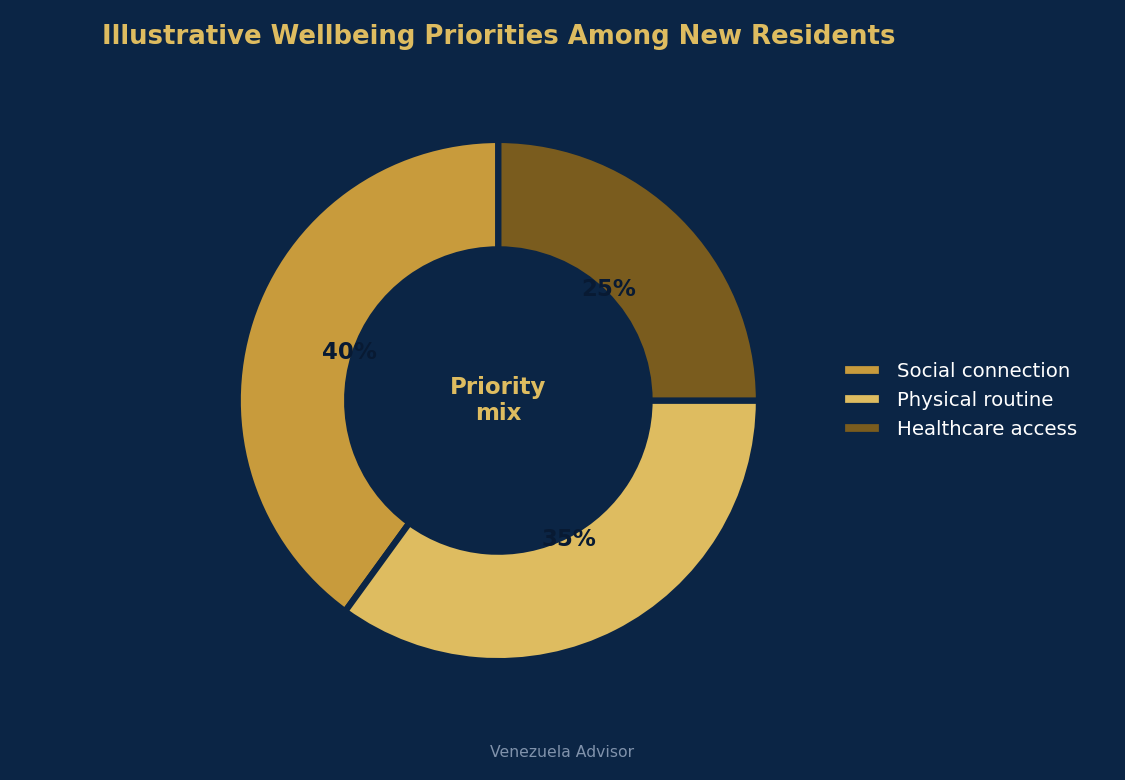
This ranking makes intuitive sense once considered directly: practical logistics like housing and paperwork, however demanding in the moment, tend to resolve themselves within weeks or months, while genuine social connection and daily routine take longer to rebuild and matter more for sustained wellbeing over the following year. Newcomers who focus disproportionately on logistics while neglecting these slower-building factors often find themselves practically settled but still genuinely unhappy months into their transition.
2. A realistic wellbeing adjustment timeline
Illustrative progression, not a guarantee: reported wellbeing among new residents tends to improve steadily over the first year, following a pattern consistent with the adaptation curve described in our return guide.
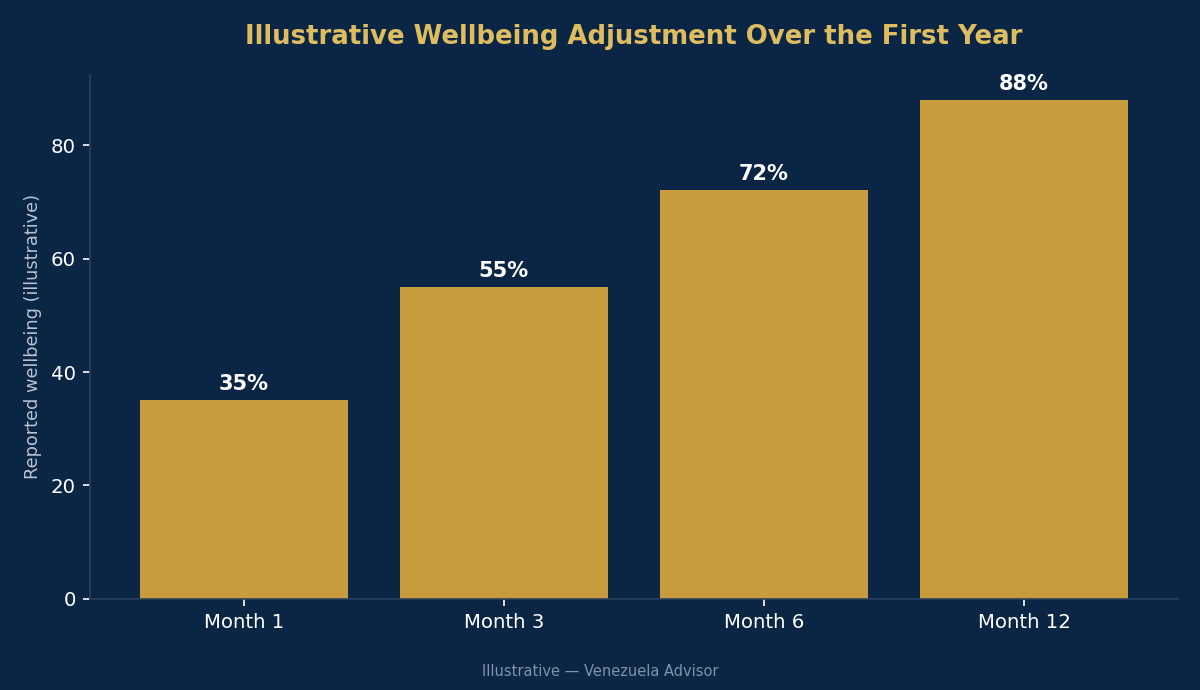
This curve isn't automatic — it reflects the cumulative effect of the practical steps described throughout this guide series, from rebuilding a social network to establishing healthcare access and a stable daily routine. Residents who actively pursue these steps rather than waiting passively for time alone to resolve their adjustment tend to move through this curve meaningfully faster than the illustrative pace shown here.
3. Building a supportive daily routine
A predictable daily structure — regular exercise, consistent sleep patterns, familiar routines rebuilt deliberately rather than left to chance — provides genuine stability during a period when nearly everything else in life feels unfamiliar and new.
Why routine matters more during a major transition
Psychological research on major life transitions consistently identifies routine and structure as protective factors against the stress that naturally accompanies significant change, and a move to a new country qualifies as exactly this kind of significant change regardless of how excited or prepared someone feels going in. Deliberately rebuilding small, familiar routines — a morning coffee ritual, a regular exercise time, a consistent bedtime — gives the nervous system a sense of stability even while larger circumstances remain genuinely unfamiliar and in flux.
Physical activity as a specific, actionable priority
Given Caracas's genuine outdoor advantages described in our culture and leisure guide, physical activity offers newcomers a particularly accessible way to build both routine and the beginnings of social connection simultaneously, through the same recurring activities recommended throughout that guide. Prioritizing this specifically during the busiest early weeks of a move, rather than treating it as something to resume "once things settle down," produces better outcomes precisely because things rarely settle down on a predictable schedule during a major transition.
4. Social connection as a wellbeing factor, not a luxury
The recurring activities and community-building approaches described in our culture and leisure guide aren't just pleasant additions to daily life — they represent one of the most consistently identified factors supporting genuine wellbeing during a major transition.
Why isolation compounds other adjustment challenges
A newcomer dealing with unfamiliar bureaucracy, a new home, and an unfamiliar city simultaneously already faces genuine stress, and social isolation on top of these practical challenges tends to compound their difficulty rather than existing as a separate, unrelated issue. Having even a small number of genuine social connections to talk through frustrations with, celebrate small wins alongside, or simply share a meal with regularly makes every other practical challenge described throughout this guide series measurably easier to navigate.
Quality over quantity in early relationships
Newcomers sometimes feel pressure to build a large social circle quickly, when in practice even one or two genuine, reliable connections provide more wellbeing benefit than a large number of superficial acquaintances met in passing. Investing real time and follow-through into a smaller number of promising early connections, rather than spreading effort thin across many surface-level interactions, tends to produce a more genuinely supportive network over the following months.
5. Managing expectations honestly
Expecting to feel completely settled within the first few weeks sets up most newcomers for unnecessary disappointment; the adjustment curve described earlier in this guide is normal, not a sign that the decision to move was wrong.
Distinguishing normal adjustment from a genuine problem
Nearly everyone experiences some version of the adjustment curve described in this guide, and mistaking normal, temporary difficulty for evidence that the move itself was a mistake can lead to a premature, regrettable decision to reverse course before the process has had a fair chance to complete. Giving the process the realistic timeline suggested throughout this guide — meaningfully longer than a few weeks — before drawing firm conclusions about whether the move is working protects against this kind of reactive decision-making during an emotionally difficult early period.
Some degree of homesickness, frustration, and fatigue during the first months of a major relocation is a normal, expected part of the process rather than evidence that something has gone wrong or that the move itself was a mistake. That said, persistent low mood, loss of interest in previously enjoyable activities, or significant difficulty functioning day to day that doesn't improve over time deserve attention from a qualified professional rather than being dismissed as ordinary adjustment — a distinction worth taking seriously rather than assuming everything difficult is simply part of the normal process.
6. Mistakes we see newcomers make
Expecting an unrealistically fast adjustment timeline, neglecting physical routine during the busiest weeks of a move, and treating social connection as secondary to practical logistics are the three mistakes we see most consistently.
Postponing routine until logistics feel fully resolved
Newcomers sometimes tell themselves they'll resume exercise, hobbies, or other routine-building activities "once things settle down," not realizing that logistics rarely resolve on a clean, predictable schedule during a major transition. Building at least a minimal version of a supportive routine from the very first week, even amid ongoing logistical demands, produces better wellbeing outcomes than waiting for an ideal moment that may not arrive for months.
Comparing an early, difficult phase to an idealized memory of home
It's natural, but often unhelpful, to compare a genuinely difficult early adjustment period in Venezuela against an idealized, selectively remembered version of life before the move — one that conveniently omits its own frustrations and difficulties. Recognizing this comparison for what it is, rather than treating it as objective evidence that the move was a mistake, helps newcomers evaluate their situation more fairly and accurately during a naturally vulnerable period.
Glossary
Adjustment curve: the gradual process of rebuilding comfort and familiarity with daily life after a major relocation.
Wellbeing: a person's overall state of comfort, health, and life satisfaction, distinct from the absence of specific problems alone.
When to seek professional support specifically
Beyond the normal adjustment difficulties described throughout this guide, some newcomers benefit from professional support during a major transition, and recognizing when this crosses from "normal adjustment" into something warranting direct attention matters for genuine wellbeing. The healthcare guide in this series covers accessing mental health professionals specifically, and treating this resource as a normal part of a well-supported transition, rather than a last resort, reflects the same proactive approach recommended throughout this entire guide series.
Seeking professional support early, at the first sign that adjustment difficulty is more persistent or severe than the normal pattern described in this guide, tends to produce better outcomes than waiting until a difficulty has compounded significantly. This is true regardless of whether someone has ever sought this kind of support before — a major international relocation is exactly the kind of significant life transition where professional support can add real value.
Financial stability as a wellbeing foundation
The financial cushion and buffer-time planning recommended throughout our diaspora return and documentation guides aren't purely practical concerns — they have a direct, measurable relationship to psychological wellbeing during a major transition. Financial stress compounds every other adjustment challenge described in this guide, and newcomers who've built in a genuine financial cushion beyond their minimum calculated budget report meaningfully lower stress during the early months than those operating with no margin for unexpected costs.
This connection between financial planning and wellbeing works in the other direction too: the stability that comes from feeling genuinely settled reduces the likelihood of financially reactive decisions — a rushed property purchase, an unnecessary expense driven by discomfort rather than genuine need — that could otherwise undermine the same financial foundation a newcomer worked to establish before the move. Treating financial and emotional wellbeing as connected, rather than entirely separate concerns, produces more consistent decision-making throughout the transition as a whole.
Taking a long-term view of the transition
The wellbeing curve described throughout this guide, while generally trending upward over the first year, rarely follows a perfectly smooth trajectory — most newcomers experience meaningful ups and downs along the way rather than steady, linear improvement from one week to the next. Recognizing this variability as normal, rather than treating any single difficult week as evidence the overall trajectory has reversed, helps newcomers maintain perspective during an inherently uneven process.
Ultimately, the same practical, verification-first approach recommended throughout this entire guide series — for housing, documentation, healthcare, and safety — applies just as directly to wellbeing itself: treating it as something to actively plan for and invest in, rather than something that either happens automatically or doesn't happen at all. Newcomers who approach their own wellbeing with this same deliberate attention tend to build a more genuinely satisfying life in Venezuela than those who leave it entirely to chance.
Beyond the normal adjustment difficulties described throughout this guide, some newcomers benefit from professional support during a major transition, and recognizing when this crosses from "normal adjustment" into something warranting direct attention matters for genuine wellbeing. The healthcare guide in this series covers accessing mental health professionals specifically, and treating this resource as a normal part of a well-supported transition, rather than a last resort, reflects the same proactive approach recommended throughout this entire guide series.
Seeking professional support early, at the first sign that adjustment difficulty is more persistent or severe than the normal pattern described in this guide, tends to produce better outcomes than waiting until a difficulty has compounded significantly. This is true regardless of whether someone has ever sought this kind of support before — a major international relocation is exactly the kind of significant life transition where professional support can add real value.
Work-life balance during the transition period
Professionals maintaining remote employment through a move, as described in our diaspora return guide, sometimes find the boundary between settling-in tasks and work responsibilities becomes blurred during the transition period, with neither receiving full attention as a result. Deliberately protecting specific blocks of time for settling-in activities — apartment setup, document processing, exploring the new city — rather than treating them as something to squeeze into work's remaining margins, produces a smoother transition on both fronts simultaneously.
For those starting local employment rather than maintaining remote work, the adjustment to a new workplace culture and professional environment adds another layer to the broader adjustment curve described throughout this guide, and treating this as its own distinct challenge — separate from the personal and logistical adjustment happening simultaneously — helps newcomers extend appropriate patience to themselves across multiple fronts at once rather than expecting complete mastery of everything all at once.
Key takeaways
- Social connection, routine, and healthcare access consistently rank as top wellbeing priorities for new residents.
- Wellbeing typically improves steadily over the first year rather than settling immediately.
- A predictable daily routine provides genuine stability during an otherwise unfamiliar transition.
- Managing expectations about adjustment pace prevents unnecessary discouragement early on.
- Professional support, sought early, is a normal and valuable part of a well-supported transition.
- Protecting dedicated time for settling-in tasks, separate from work, produces a smoother adjustment overall.
If you're planning a move to Venezuela, we can help you think through what would genuinely support your wellbeing during the transition, based on your specific situation and circumstances.
Wellbeing considerations specific to the whole family
Families moving together face a layered version of the adjustment process described throughout this guide, where each family member may move through the wellbeing curve at a different pace, requiring patience and communication rather than an expectation that everyone will adjust in lockstep together. A spouse who left behind an established career, in particular, sometimes faces a more complex adjustment than a partner who arrives with an existing work role and built-in daily structure, and acknowledging this difference openly within the family — rather than assuming equal adjustment difficulty across the board — supports a healthier overall family transition.
Children's wellbeing during this process, as touched on in our education and culture guides, benefits from the same combination of routine, social connection, and managed expectations described throughout this article, adapted to their specific age and temperament. Checking in regularly and specifically with each family member individually, rather than assuming the family's overall wellbeing reflects every member's actual internal experience equally, helps surface adjustment difficulties early, while they're still relatively easy to address directly.