
Private and International Education in Venezuela: A Complete City-by-City Guide (2026)

By: Venezuela Advisor — Published 2026 · Share · Updated for the 2026-2027 academic year
For families weighing a move covered throughout this guide series — whether returning from abroad or relocating temporarily for work — school quality and continuity are often the deciding factor, sometimes more than housing cost itself. This guide walks through where good options actually exist, what to verify before committing, and how costs and strategies vary across Venezuela's three most relevant cities for this kind of decision.
- 1. Where private school density actually concentrates today
- 2. Curriculum types actually available to families
- 3. What to verify carefully before enrolling any child
- 4. Tuition ranges by tier and what drives them
- 5. Higher education strategy families actually use
- 6. Differences by city that actually matter
- 7. Mistakes we consistently see families make
- Glossary of relevant education terms
- Considerations for children with learning differences or special needs specifically
- Language immersion as a truly distinct consideration from curriculum choice
- Extracurricular programs and their genuine role in the total decision
- Key takeaways and how to start your search
1. Where private school density actually concentrates
Illustrative index, not a formal enrollment count: private school options concentrate heavily in eastern Caracas, with Valencia offering solid mid-tier density and Margarita considerably more limited options.
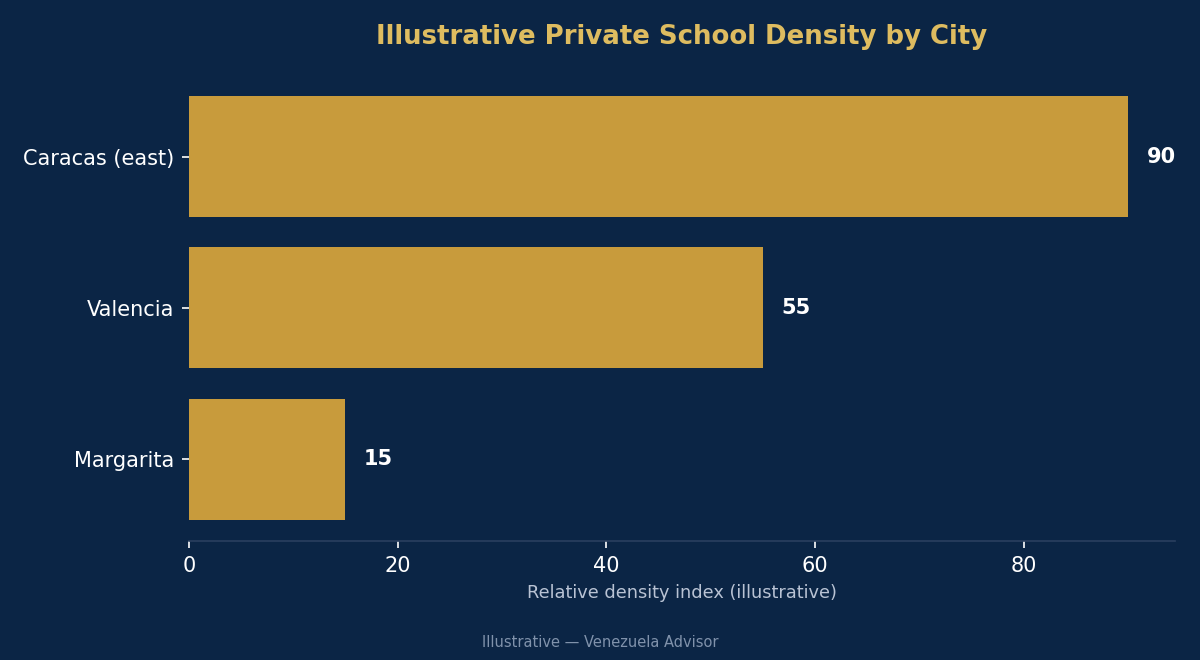
[VERIFY: specific institution names and current enrollment figures should be confirmed directly with each school before publishing as fact.]
This concentration mirrors the broader demand patterns described throughout this guide series — the same eastern Caracas corridor that hosts the highest concentration of dollarized commerce and international business also hosts the highest concentration of schools serving that same international and upper-income population base. Families relocating specifically for school access, rather than treating it as one factor among several, should weight this concentration heavily in their city and neighborhood decision from the very start of their search.
2. Curriculum types available
Illustrative mix, not a precise count: options generally split between Venezuelan national curriculum, bilingual programs blending national and foreign content, and full international curricula like the IB or American systems.
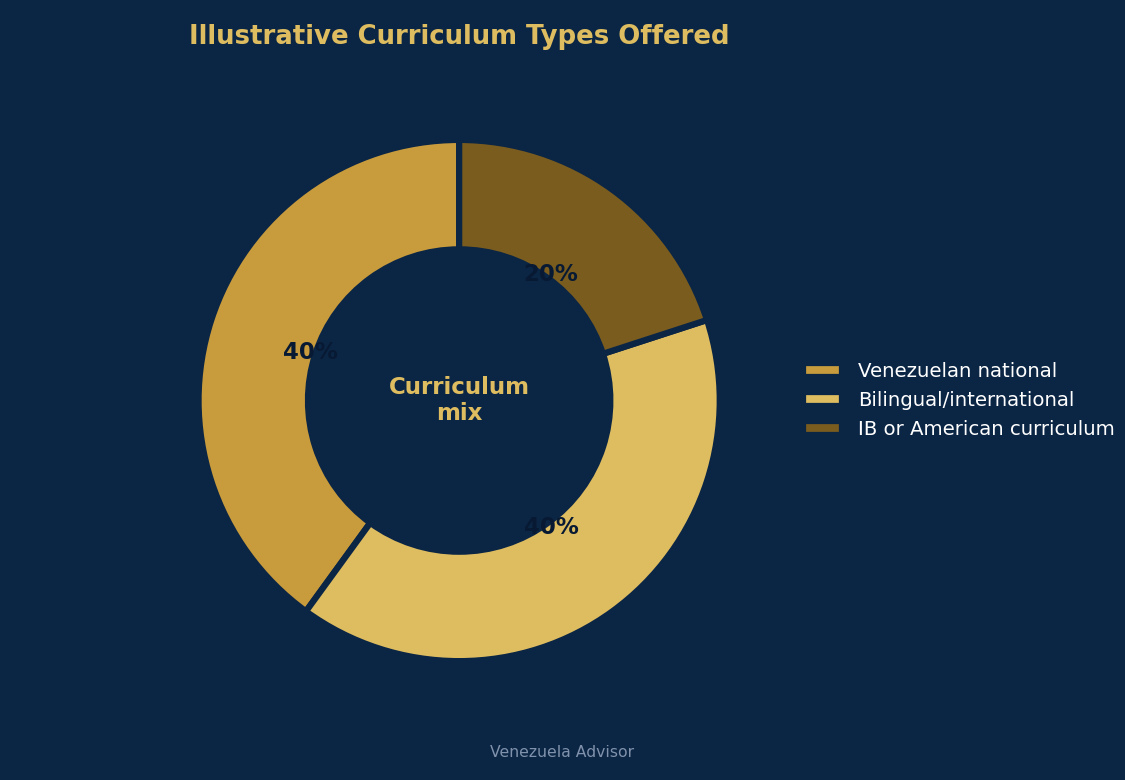
The choice between these tiers isn't purely about prestige — it has real practical consequences for a family's future mobility and options down the line. A student who completes a fully national curriculum may face a more complex credential recognition process if the family later relocates abroad, while a student in an internationally recognized program carries credentials that transfer more smoothly across borders and education systems. Families with a genuine expectation of future international movement, whether for further study or relocation, should weight this transferability heavily when choosing between otherwise comparable schools.
3. What to verify before enrolling
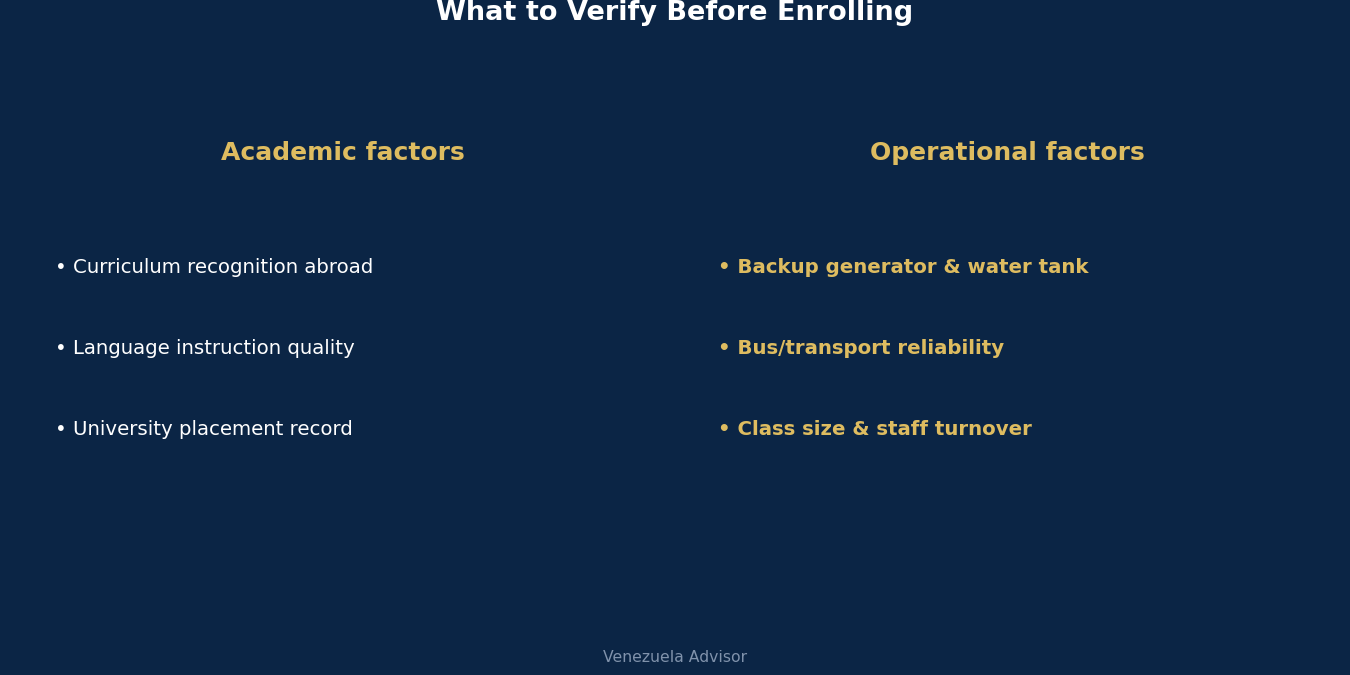
Backup generator and water infrastructure matter for schools just as much as for the businesses and households covered throughout this guide series — a school without reliable backup power loses instructional days that a comparable institution with proper infrastructure simply doesn't, and repeated disruptions compound into a genuine academic disadvantage over a full school year.
Why university placement records deserve direct verification
A school's marketing materials about university placement outcomes should be verified against actual, named examples rather than accepted at face value without question. Asking a prospective school for specific recent graduates' university placements, and where possible confirming these independently, provides a far more reliable signal than a general claim about "excellent university placement" that isn't backed by verifiable specifics a family can actually check.
Class size and staff turnover as leading indicators
Consistently high staff turnover at a school often signals underlying management or compensation issues that eventually affect educational quality, even if current academic outcomes still look reasonable on paper for the moment. Asking directly about teacher retention rates, and being wary of a school reluctant to discuss this openly, surfaces a concern before it manifests as a decline in your own child's classroom experience further down the line.
4. Tuition ranges by tier
Illustrative ranges, not confirmed pricing: costs vary substantially by curriculum tier, with top international programs commanding a significant premium over national private options.
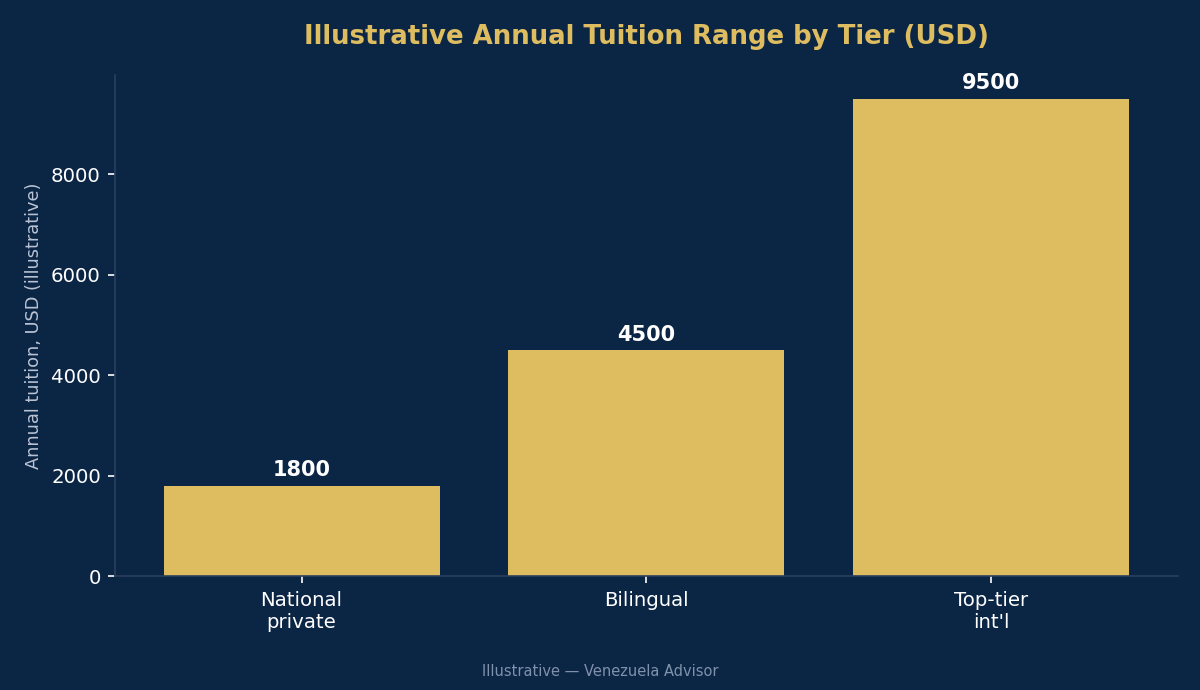
This tuition gap compounds meaningfully across multiple children and multiple years, making it worth budgeting explicitly as a long-term line item rather than a one-time enrollment decision made in isolation. Families should also confirm whether tuition is quoted and payable in dollars or bolívares, since this affects both budgeting predictability and how the cost compares to the dollar-denominated living expenses described throughout our cost of living guide.
5. Higher education strategy
Illustrative pattern, not survey data: many Venezuelan families combine a local undergraduate degree with postgraduate study abroad, balancing cost against international credential recognition.
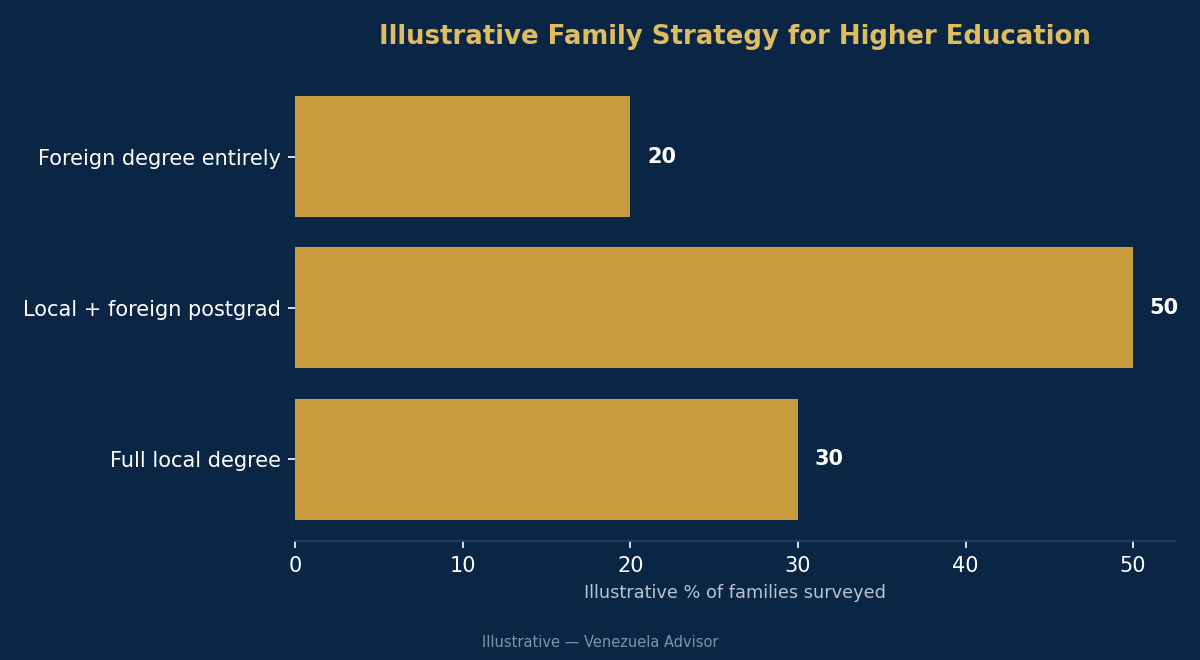
This staged approach reflects a practical calculation: Venezuelan undergraduate education, at its strongest institutions, remains considerably more affordable than starting a foreign degree from year one, while a foreign postgraduate credential can still open the same international doors a family might be seeking for their child's long-term career prospects. Families planning this path should research which local undergraduate institutions have strong track records of graduates gaining admission to competitive foreign postgraduate programs, rather than assuming any local degree provides equivalent positioning for that eventual transition.
6. Differences by city
Caracas concentrates the greatest variety of high-level private schools, especially in the eastern municipalities where dollarized demand is strongest. Valencia offers consolidated private options oriented partly toward families connected to the city's industrial sector. Isla de Margarita's more limited offering is relevant mainly for families relocating for lifestyle or tourism reasons, who should plan around this constraint well in advance rather than discovering it only after arrival.
What Caracas's concentration means practically for families
Beyond simply having more schools, Caracas's concentration means genuine competition among institutions for both students and quality teaching staff, which in practice drives continuous investment in facilities and curriculum in a way a market with fewer competing options doesn't experience to the same degree. This dynamic benefits families willing to shop carefully among several strong options, though it also means the very top schools maintain waiting lists that require early application, sometimes years in advance of actual enrollment for the most competitive grade levels and programs.
Valencia's industrial-sector orientation
Valencia's strongest private schools often maintain particular strength in STEM-oriented curricula and partnerships reflecting the city's manufacturing and industrial base, which can be a genuine advantage for families whose own professional orientation aligns with those fields specifically. Families relocating to Valencia specifically for industrial-sector employment often find this alignment convenient, since it mirrors the same professional community their own work connects them to locally, both for the child's education and the family's broader social network.
Margarita's tradeoff between limited choice and community
The smaller number of schools in Margarita means less selection, but it also tends to produce a tighter-knit school community where families and staff know each other well over time — an advantage some families genuinely prefer over a larger, more anonymous institution, even when the larger option offers more formal program variety on paper and a longer list of extracurricular activities to choose from.
7. Mistakes we see families make
Assuming a school's reputation alone guarantees backup infrastructure reliability, underestimating enrollment waiting lists at top-tier schools, and failing to confirm curriculum recognition for an eventual return abroad are the three mistakes we see most consistently among families going through this process for the first time.
Confusing prestige with operational reliability
A school's academic reputation and its day-to-day operational reliability are related but genuinely distinct qualities, and a family focused entirely on academic rankings sometimes discovers only after enrollment that the prestigious institution they chose struggles with the same infrastructure issues as less renowned alternatives. Visiting a school in person, ideally during a period of actual utility instability rather than only on a curated tour day, provides a more honest picture than reputation alone.
Underestimating application timelines at the most sought-after schools
Families who begin the school search only shortly before a planned move frequently discover that the most sought-after institutions in eastern Caracas have waiting lists extending a year or more, particularly for the most popular grade levels and academic tracks. Starting the school search during the reconnaissance visit described in our return guide, well before the actual move, gives families realistic options rather than forcing a compromise choice made under significant time pressure.
Not planning for curriculum continuity if the family later leaves again
Even families with no current plans to leave Venezuela again should consider curriculum continuity as a form of insurance against future uncertainty they can't fully predict today. A student enrolled in an internationally recognized curriculum retains more flexibility if family circumstances change unexpectedly than one whose credentials require additional validation steps to be recognized abroad — a distinction that costs nothing to consider at enrollment but can matter considerably years later when circumstances shift.
Glossary
IB curriculum: the International Baccalaureate, a globally recognized curriculum offered by a subset of private schools, valued for its portability across countries and university systems.
Bilingual program: a curriculum blending Venezuelan national content with instruction in a foreign language, typically English, at varying levels of intensity depending on the specific institution and grade level involved.
Credential recognition: the process by which an educational credential earned in one country is formally validated as equivalent in another, relevant for students who move between education systems at any point in their schooling, whether during primary years or later.
Considerations for children with learning differences or special needs
Specialized educational support for children with learning differences or other special needs varies considerably across Venezuelan private schools, and this variation deserves particular attention from families with a child who has an identified need before enrolling anywhere. Not every school with an otherwise strong general reputation maintains the specialized staff or resources a specific learning difference requires, and assuming otherwise based on general prestige can leave a family without adequate support after enrollment has already begun.
Families in this situation benefit from requesting specific, detailed information about a school's special education resources — trained staff, individualized learning plans, physical accessibility where relevant — rather than accepting a general assurance that the school "supports all learners." Direct conversations with the school's specific special education coordinator, where one exists, provide far more useful information than a general admissions conversation alone ever could.
Language immersion as a distinct consideration from curriculum
Curriculum type and language of instruction are related but distinct choices worth evaluating separately from each other. A school can offer a fully Venezuelan national curriculum while still providing strong English immersion, just as a bilingual program's actual level of English immersion can vary considerably between institutions that both claim the "bilingual" label without much standardization behind it. Asking specifically what percentage of instructional time occurs in each language, rather than accepting the bilingual label at face value, produces a clearer picture of what a child will actually experience day to day in the classroom.
Some schools reserve their strongest language immersion for younger grades, tapering off as students advance, while others intensify it over time — a distinction that matters considerably depending on the age of the child being enrolled and the family's specific language goals for that child. Requesting a grade-by-grade breakdown of language allocation, rather than a single overall percentage, surfaces this kind of detail that a general marketing conversation often glosses over.
Extracurricular programs and their role in the total decision
Beyond academics, extracurricular offerings — sports, arts, music, robotics and similar programs — factor meaningfully into many families' school decisions, particularly for children with an established interest or talent in a specific area before the move. Schools vary considerably in which extracurricular programs they maintain at a genuinely competitive level versus offering only nominally, and this distinction is worth investigating directly rather than assuming a school's general prestige extends equally to every program it lists in its marketing materials.
For families relocating specifically to support a child's development in a particular area — competitive swimming, classical music, a specific sport, competitive academics — researching which schools maintain genuine strength in that specific area, including facilities and coaching quality, deserves the same direct verification approach recommended for academic and infrastructure factors throughout this guide. A school's general reputation doesn't reliably predict the strength of any single specific program within it, and assuming otherwise can lead to real disappointment after enrollment.
Key takeaways
- Private school density varies enormously by city — Caracas offers by far the widest selection.
- Curriculum recognition abroad matters for families anticipating future international mobility and possible relocation.
- Backup infrastructure is as relevant for schools as for any other institution covered throughout this guide series.
- Many families combine a local undergraduate degree with international postgraduate study to balance cost against credential recognition.
- Verify special education resources directly with a named coordinator rather than accepting general assurances at face value.
- Confirm actual grade-by-grade language-immersion levels rather than relying on the "bilingual" label alone to guide your decision.
If you're evaluating schools for a move to Venezuela, we can help you think through curriculum and city fit for your family's specific situation and long-term plans.