
International Franchises Entering Venezuela: Is It Worth It? A Practical Evaluation Guide (2026)

By: Venezuela Advisor — Published 2026 · Share
The recovery of dollarized consumption in zones like Las Mercedes and El Rosal has made certain international brands look again at Venezuela after years of absence. This guide covers what a prospective franchisee — local or foreign — should evaluate before signing. We wrote it specifically for the entrepreneur who has already identified a brand of interest and needs a structured framework for evaluating whether the specific opportunity, not just the general market recovery, makes financial sense. The framework below applies whether you're negotiating directly with an international franchisor or evaluating an opportunity presented by an existing regional master franchisee.
- 1. Why franchises are looking at Venezuela again
- 2. What a franchise contract typically includes
- Local franchisee vs. master franchise: two very different bets
- 3. Considerations specific to the Venezuelan market
- 4. Where dollarized demand actually concentrates
- 5. Questions to ask before you sign
- Planning your exit before you plan your opening
- Common mistakes we see franchise evaluators make
- Glossary
- Key takeaways
1. Why franchises are looking at Venezuela again
The dollarized consumer base concentrated in Caracas's eastern corridor, described throughout our neighborhood guide, has recovered enough purchasing power to sustain restaurant chains, gyms, and retail concepts that would have been unthinkable during the peak of the economic crisis. That said, this recovery is still fragile enough that any franchise decision should be treated as a genuine bet on continued stability, not a foregone conclusion.
This recovery is real but narrow — it's concentrated in a handful of zones and a specific income bracket, not a broad national consumer recovery. Any franchise evaluation should be built on that narrower reality rather than extrapolating from national population figures, which would dramatically overstate the addressable market for a premium-positioned international brand.
What franchise brands typically look for before entering a market
Beyond raw consumer spending power, franchisors generally evaluate currency stability for repatriating profits, the availability of qualified local operating partners, and the regulatory predictability of the specific sector they operate in. Venezuela's dollarized transaction environment, described in our dollarization guide, addresses the first concern more directly than it would have just a few years ago, which is part of what's changed the calculus for brands that previously ruled the country out entirely. None of this means every brand's calculus has changed at the same pace — the more risk-averse franchisors are still watching from a distance, and it's worth understanding where any specific brand you're evaluating actually sits on that spectrum.
2. What a franchise contract typically includes
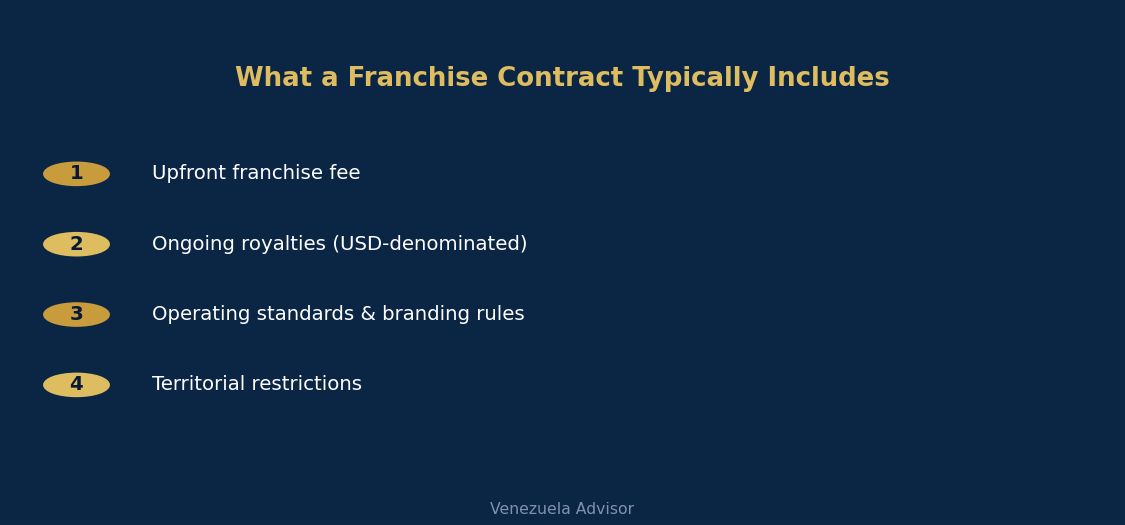
Beyond the standard elements listed below, pay particular attention to how the contract handles force majeure and market-disruption scenarios — clauses that matter more in Venezuela's context than they would in a more predictable market, and that many standard franchise templates handle poorly by default. A well-negotiated force majeure clause specifies what qualifies as a triggering event, how obligations pause or adjust during it, and what happens if disruption extends beyond a defined threshold — details that a generic template borrowed from a more stable market often leaves dangerously vague.
- An upfront franchise fee for the right to operate under the brand.
- Ongoing royalties, typically denominated in dollars.
- Operating standards and branding requirements the franchisee must follow strictly.
- Territorial restrictions defining where the franchisee can operate.
Local franchisee vs. master franchise: two very different bets
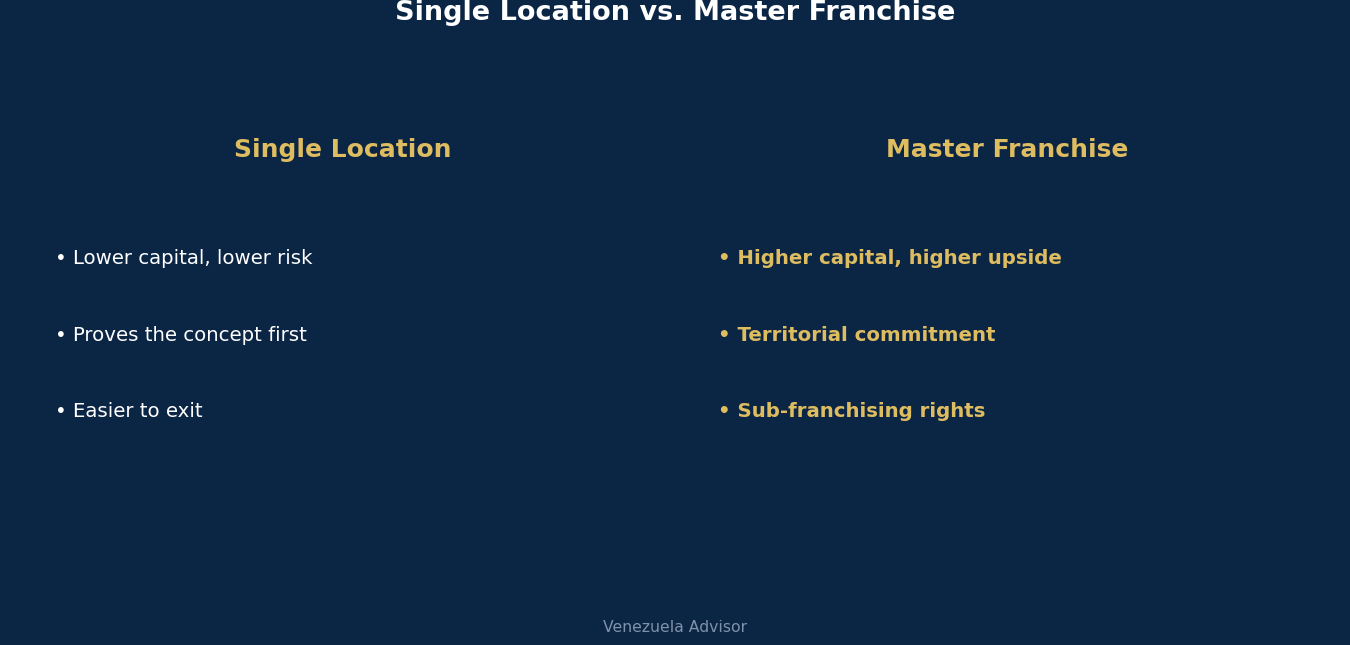
A standard single-location franchisee agreement and a master franchise agreement — where you acquire rights to develop multiple locations, potentially sub-franchising to others — carry very different capital requirements and risk profiles. A master franchise demands significantly more upfront capital and operational sophistication, but can generate returns a single-unit franchisee never reaches. For a first-time franchisee in the Venezuelan market specifically, starting with a single location to prove the concept before committing to a master agreement is generally the more prudent path, even if the brand offers master rights at an attractive price.
Franchisors sometimes push master agreements on prospective partners precisely because it shifts more of the market-development risk onto the franchisee while locking in the franchisor's territorial commitment. A master agreement can be an excellent opportunity for the right partner, but it should be evaluated on its own risk-adjusted merits, not accepted simply because it was the option presented first or most attractively priced per location. If a franchisor pushes hard for a master agreement before you've operated even a single successful location, treat that pressure itself as information worth weighing carefully.
3. Considerations specific to the Venezuelan market
These three factors consistently separate franchise evaluations that hold up under scrutiny from ones that fall apart once the financial model meets reality. Getting each of them right on paper, before any capital moves, is what separates a franchise that survives its first difficult quarter from one that doesn't.
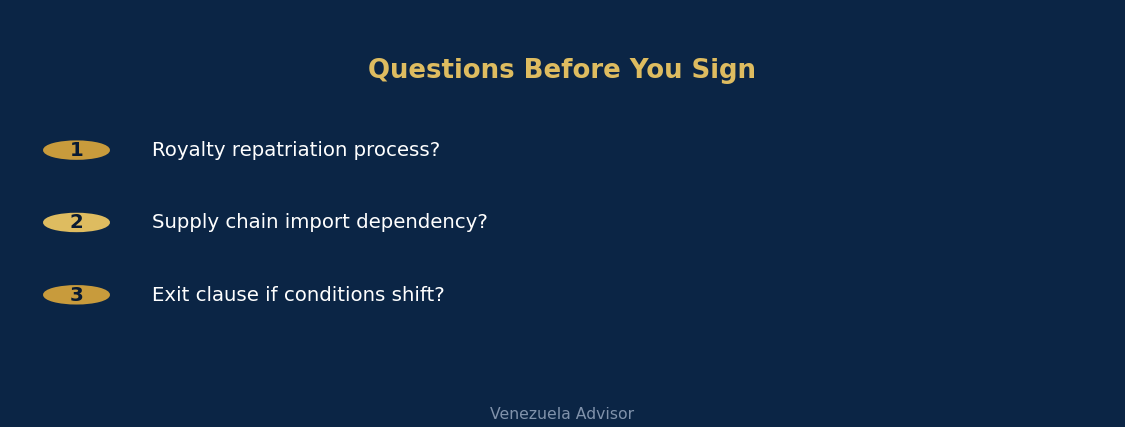
- Royalty repatriation: confirm in advance how dollar royalty payments will actually be transferred to the international franchisor and what documentation the bank will require to process it smoothly.
- Supply chain: many franchises require specific imported inputs; evaluate import costs and timelines, as detailed in our import/export guide, before finalizing your financial projections, since supply disruptions hit franchise operations especially hard given their strict brand-standard requirements.
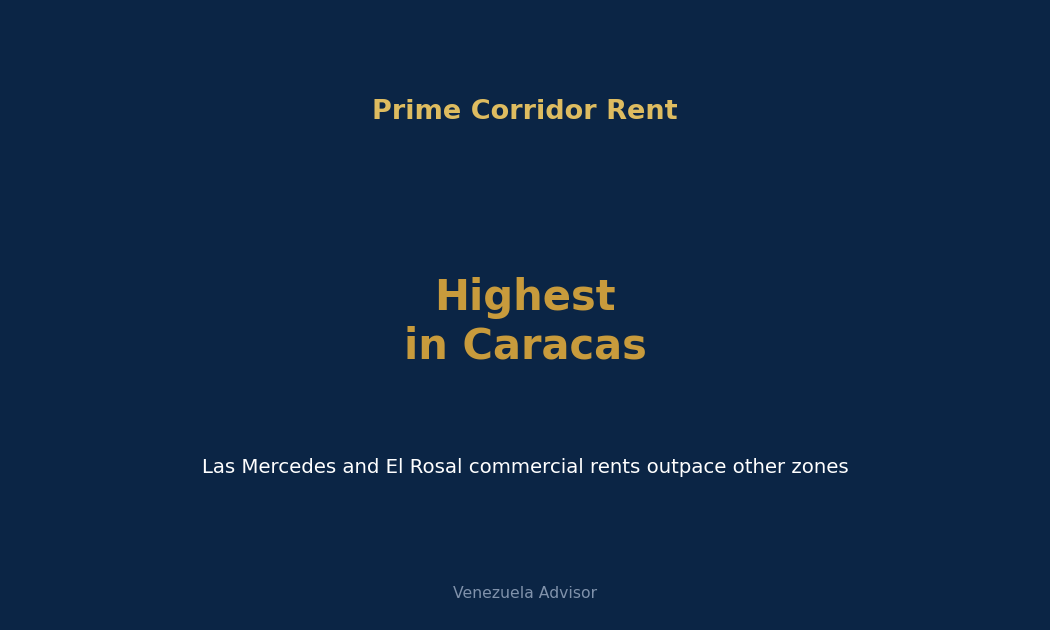
- Location: high-traffic dollarized corridors carry correspondingly higher commercial rents, which must be reflected honestly in your break-even projections from day one.
Franchisors based abroad sometimes underestimate how much of a Venezuelan franchisee's operational complexity sits outside the standard operations manual — supply chain workarounds, payment processing quirks, staffing considerations specific to the local labor market. A franchisee who can articulate these differences clearly during negotiations is better positioned to secure contract terms that reflect the market's real conditions, rather than terms copied from the franchisor's standard template for a more conventional market. This kind of well-informed negotiation is only possible if the franchisee has done the underlying market research themselves, rather than relying entirely on the franchisor's own assessment of the opportunity.
4. Where dollarized demand actually concentrates
Understanding exactly where this demand lives — and doesn't — is the single most important input into a realistic revenue projection, more important even than the brand's own performance benchmarks from other countries.
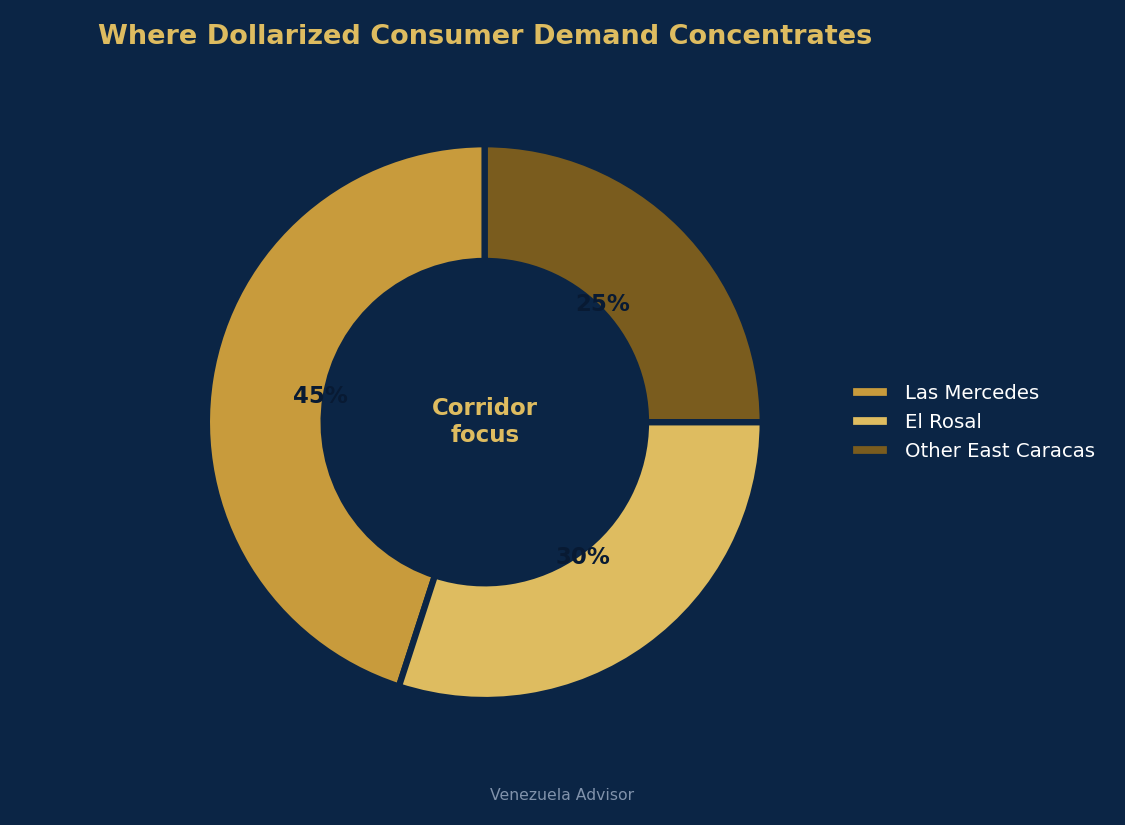
Las Mercedes and El Rosal together account for the large majority of the corridor's dollarized foot traffic, but they're also where competition for prime storefronts is fiercest and where landlords have the most negotiating leverage. A location just outside this core, in a zone with growing but not yet saturated demand, sometimes offers a better risk-adjusted return than fighting for the most visible, most expensive storefront in the most established corridor. Some of the more successful recent openings we've observed deliberately chose a slightly less central location specifically to negotiate better lease terms, betting on the corridor's continued expansion to eventually bring the core customer base to them.
5. Questions to ask before you sign
A franchisor with recent experience operating in markets with currency controls or import complexity similar to Venezuela's is generally a stronger partner than one entering this kind of market for the first time through you. Ask directly about their experience in comparable markets — Argentina, Nigeria, or other economies with similar currency and import dynamics — rather than accepting general reassurances about the brand's global success as a substitute for market-specific experience. A franchisor who can speak specifically about how they handled a comparable market's challenges is showing you they've actually thought through this scenario, not just licensed you their brand and moved on.
Financial questions that deserve a written answer
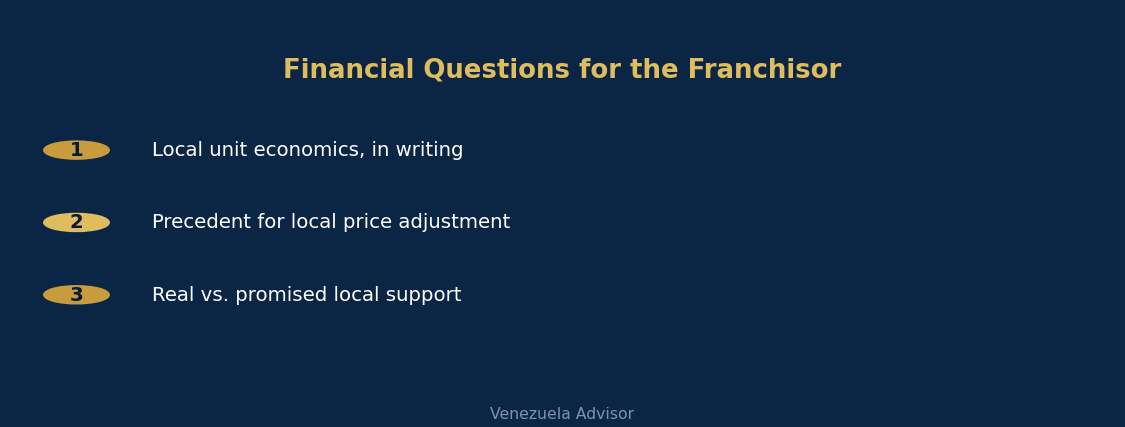
Beyond the qualitative questions above, request the franchisor's written position on: minimum viable unit economics for the Venezuelan market specifically, any precedent for adjusting standard menu pricing or service offerings to local purchasing power, and what support — marketing, training, supply chain — the franchisor actually provides locally versus what falls entirely on the franchisee. A franchisor unwilling to put these answers in writing, even informally via email, is signaling something worth taking seriously before you commit capital.
Operational questions specific to daily execution
Ask how the franchisor expects quality control audits to work given the practical realities of operating in Venezuela — do they plan in-person visits, remote monitoring, or a hybrid approach, and how frequently? Brands that haven't thought through this in advance often end up applying inconsistent standards that create friction later, when a franchisee is judged against expectations that were never clearly communicated from the start.
Planning your exit before you plan your opening
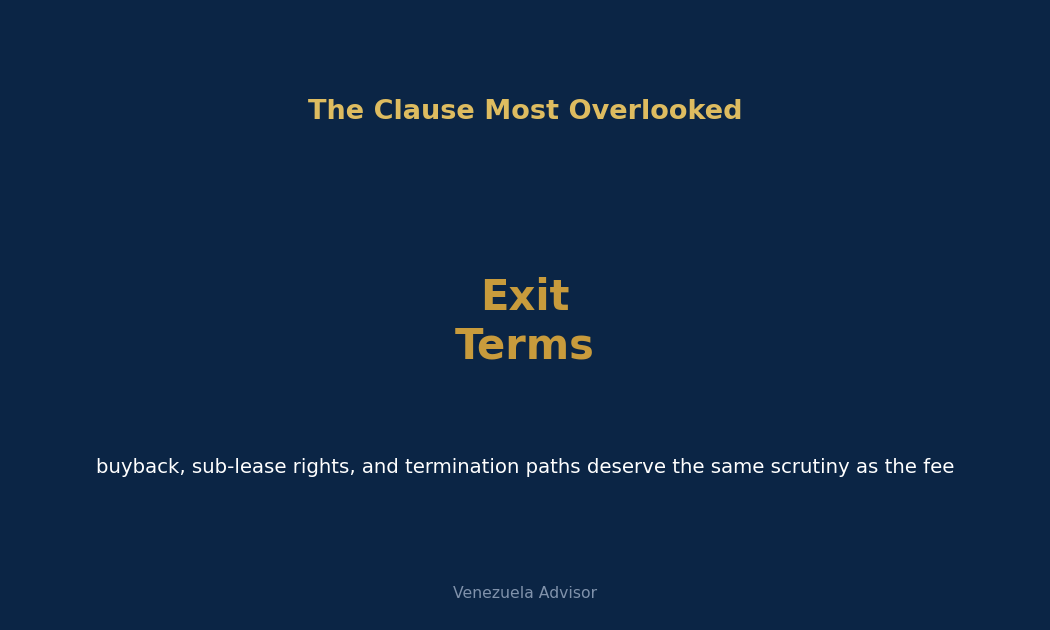
Every franchise agreement should be evaluated with an exit scenario in mind, not just an opening-day plan. What happens to your remaining lease obligations if the concept underperforms? Can you sub-lease the space to another operator if you need to close? Does the franchise agreement include a buyback provision or a straightforward termination path, or does exiting require years of remaining royalty obligations regardless of performance?
This isn't pessimism — it's the same due diligence discipline we recommend throughout this guide series for real estate transactions, applied to a different kind of commitment. A franchise agreement with clear, reasonable exit terms is a meaningfully better deal than an identical agreement without them, even if the headline economics look the same on day one. We've seen franchisees discover, only after a location underperformed, that their agreement locked them into royalty payments for years regardless of whether the store remained open — a detail that a careful pre-signing review would have caught and could have been negotiated away entirely.
Common mistakes we see franchise evaluators make
These three mistakes, more than any single contract term, most often determine whether a franchise investment in Venezuela ultimately succeeds or disappoints. Each one is entirely avoidable with the right upfront diligence.
Applying home-market unit economics directly
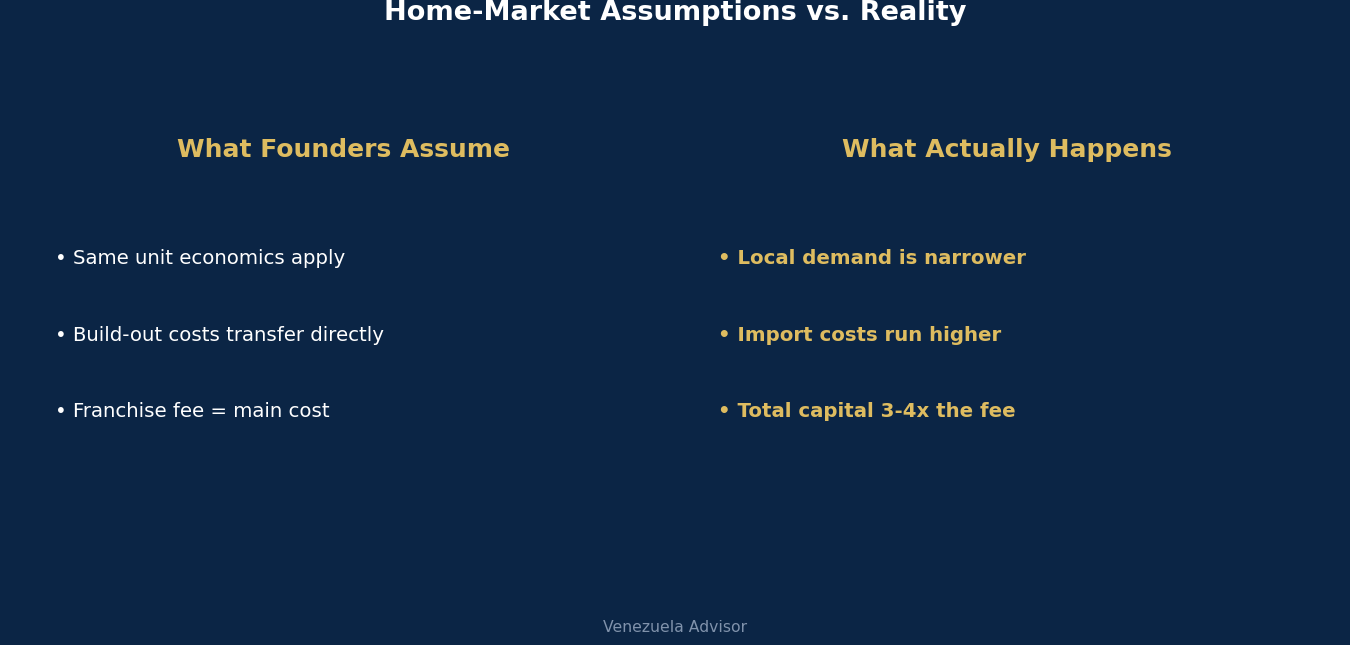
A franchise's published average unit revenue from its home market rarely translates directly to Venezuela, where purchasing power, competitive density, and consumer habits all differ. Building your own bottom-up projection, informed by but not copied from the franchisor's benchmarks, produces a far more defensible business case. This means starting from local rent data, local labor costs, and a realistic estimate of dollarized foot traffic in your specific location, rather than adjusting a home-market model by a single blanket discount factor.
Underestimating build-out costs
Imported fixtures, equipment, and finishes required by brand standards can carry meaningfully higher landed costs in Venezuela than in the franchisor's home market, for the same reasons described in our import/export guide. Build-out budgets modeled on home-market costs consistently run over in this specific line item, sometimes significantly enough to change the entire viability calculation for the location.
Treating the franchise fee as the primary capital commitment
The franchise fee itself is often a small fraction of total launch capital once build-out, initial inventory, working capital, and the first several months of operating losses are accounted for. Founders who budget primarily around the franchise fee consistently underestimate their true capital requirement, sometimes by a factor of three or four once every real cost is included in the total.
Glossary
Royalty: ongoing payments to the franchisor, typically a percentage of gross revenue rather than net profit.
Territorial restriction: contractual limits on where a franchisee may operate under the brand.
Master franchise: an agreement granting rights to develop multiple locations within a territory, potentially including the right to sub-franchise to other operators.
Build-out: the physical construction and fit-out work required to bring a location to brand standard before opening.
Key takeaways
- The return of franchise interest reflects real, if geographically concentrated, dollarized consumer recovery.
- Royalty repatriation and import-dependent supply chains deserve scrutiny before signing, not after.
- Prime dollarized corridors carry rent premiums that must be built into break-even projections from day one.
- Start with a single-location agreement before committing to a master franchise, unless you already have proven local operating experience.
- Negotiate exit terms before you sign, not after you're already committed to years of remaining obligations.
- Build your financial model from local costs upward, not by discounting the franchisor's home-market benchmarks.
If you're evaluating a franchise opportunity in Venezuela, we can help you assess location economics and connect you with attorneys experienced in franchise agreements — the same combination of local market knowledge and legal review that runs throughout every guide in this series.