
Professionalizing a Family Business in Venezuela: What the Research Actually Shows Works

By: Venezuela Advisor — Published 2026 · Share
Family businesses built or rebuilt during Venezuela's dollarization-era recovery are now hitting the point where founders think seriously about the next generation. The pattern below isn't unique to Venezuela, but it's worth confronting directly before assuming your business is the exception — the research is consistent enough across very different markets and cultures that "our family is different" is rarely a safe assumption to build a succession strategy on.
- 1. The generational survival pattern
- 2. Revenue concentration: the risk professionalization actually reduces
- 3. Governance structure: from one person to a system
- 4. Where professionalization effort matters most
- 5. Succession planning: start earlier than feels necessary
- 6. Mistakes we see family businesses make
- Glossary
- Bringing in external advisors: why family businesses resist it, and why it usually helps
- Key takeaways
1. The generational survival pattern
The pattern documented across family business research globally is stark: roughly 30% of family businesses survive into the second generation as family-owned enterprises, and the figure drops sharply again by the third. [VERIFY: these specific percentages are widely cited in family business literature but should be confirmed against a specific, current source before publishing as a precise statistic rather than a general pattern.] The pattern holds across very different economies and legal systems, which suggests the underlying causes are structural — how decisions get made, how conflict gets resolved, how leadership actually transfers — rather than specific to any one country's business environment, including Venezuela's.
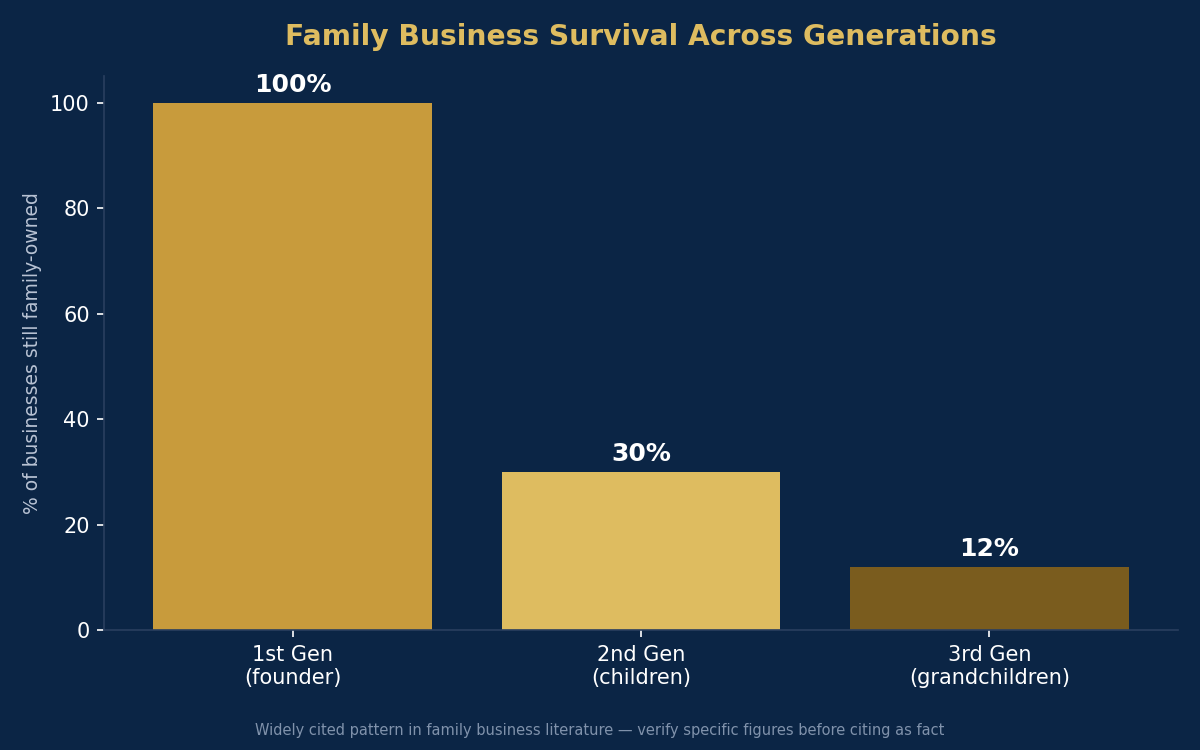
What makes this pattern particularly relevant for businesses built or rebuilt during Venezuela's dollarization-era recovery is timing: many of these businesses are now roughly five to eight years old, meaning founders are approaching exactly the point where succession questions move from theoretical to urgent, whether or not the business has done anything meaningful to prepare for it.
2. Revenue concentration: the risk professionalization actually reduces
One of the clearest, most measurable risks in an unprofessionalized family business is revenue concentration — dependence on a single customer, product, or relationship that the founder personally controls. This is a risk you can actually measure with a specific number: what percentage of total revenue comes from your single largest customer or contract, and how would the business genuinely survive if that relationship ended tomorrow without warning.
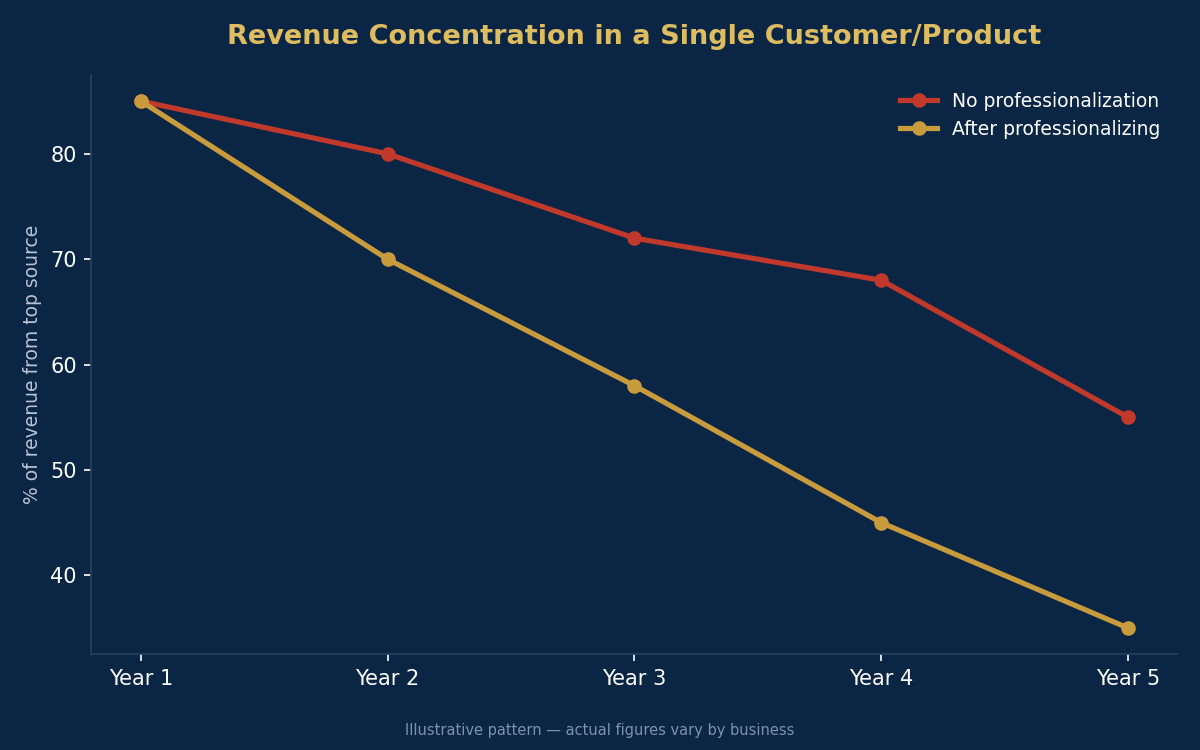
The mechanism behind this improvement is usually straightforward: a professionalized sales function, documented customer relationships that don't depend entirely on the founder's personal rapport, and deliberate diversification efforts that a founder juggling every function of the business rarely has bandwidth to pursue systematically. Businesses we've worked with in sectors from restaurant operations to import-dependent retail show this same pattern: concentration risk falls specifically because someone was given the explicit mandate and time to address it, not because it improved on its own with time — a distinction worth internalizing before assuming this risk will simply resolve itself as the business matures.
3. Governance structure: from one person to a system
The single most consequential change professionalization makes is structural: moving decision-making from one person's judgment to a defined system with distributed accountability.
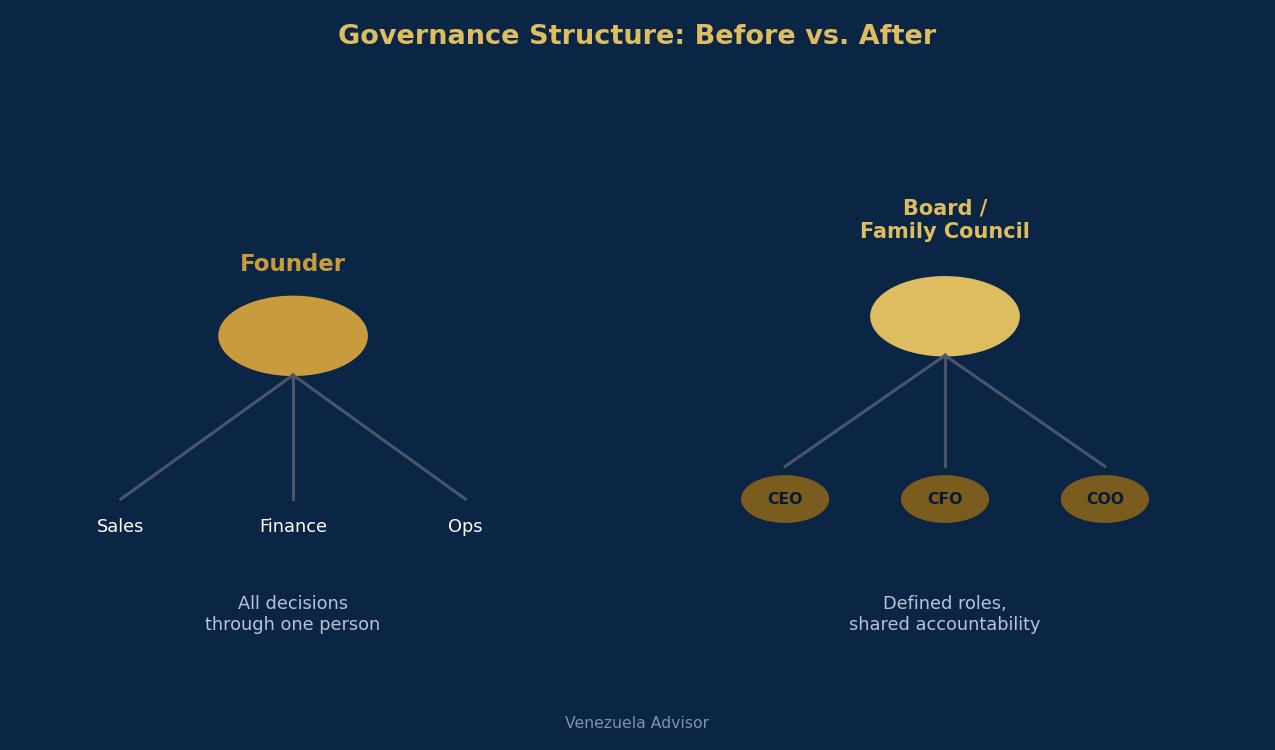
In the "before" structure, every functional decision — sales, finance, operations — routes back through the founder, which works while the business is small but becomes a genuine bottleneck as it grows, and becomes an outright crisis if the founder is suddenly unavailable, whether through illness, a planned transition, or simple burnout from carrying every decision personally for years on end. The "after" structure distributes specific decision authority to defined roles, with a board or family council handling the higher-level questions that affect ownership and strategic direction rather than day-to-day operations.
Why family councils and operating boards need to be genuinely separate
A common mistake in this transition is creating a board in name only, where the same people making operational decisions also constitute the entire governing body, with no real separation between "running the business day to day" and "deciding on ownership and strategic direction." A functioning structure keeps these conversations distinct, even if the same people are involved in both — because conflating them tends to let urgent operational pressure crowd out the longer-term governance conversations that matter most for the business's survival beyond the founder's own active involvement.
4. Where professionalization effort matters most
Not every professionalization initiative delivers equal value. Based on common consulting frameworks applied to family businesses, formal financial reporting and governance structure tend to matter more than any other single intervention.
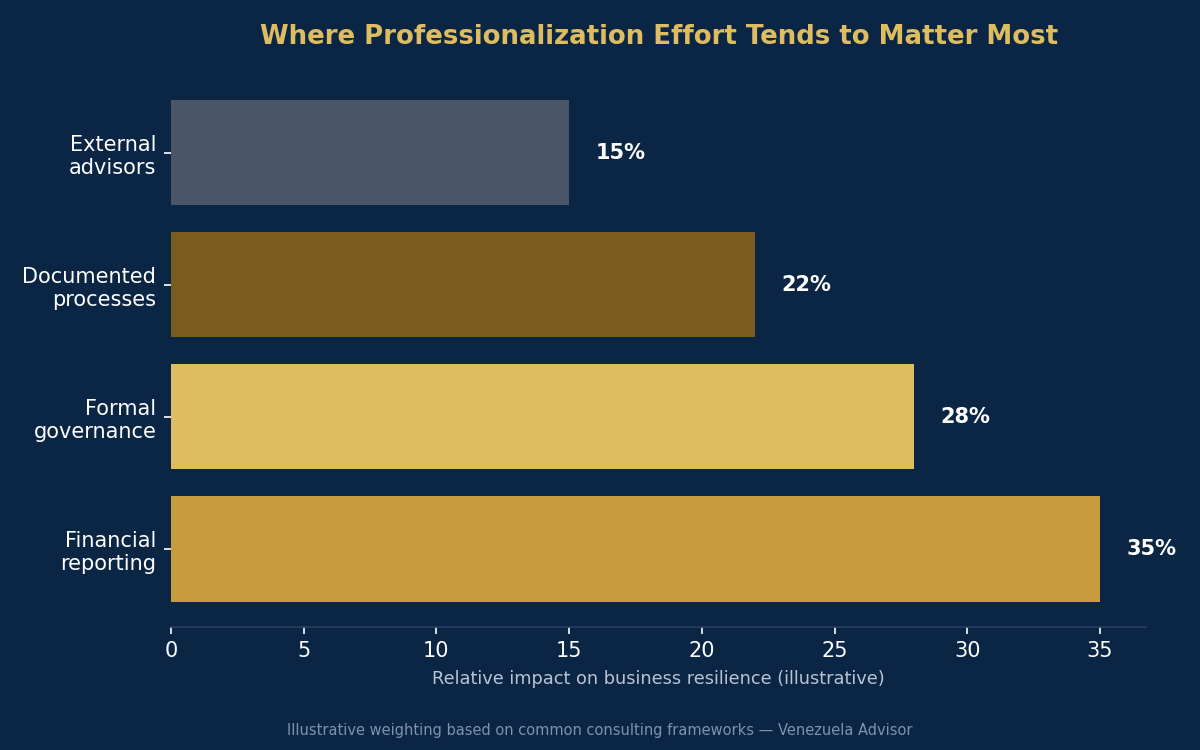
Formal financial reporting ranks first for a specific reason: nearly every other professionalization effort depends on having reliable numbers to make decisions from. A business that can't clearly answer "what did we actually earn last quarter, and from which parts of the operation" can't meaningfully evaluate whether its revenue concentration is improving, whether a new hire is paying for themselves, or whether the business can actually afford the succession transition it's planning. Governance structure ranks second precisely because it's what turns those reliable numbers into actual decisions, rather than information the founder reviews alone without any structured process for acting on it or sharing it with anyone else.
Documented processes: lower priority, but not optional
Documented processes — the written procedures, checklists, and playbooks that let someone other than the founder perform a function correctly — rank lower in relative impact than financial reporting or governance, but they're what actually makes a leadership transition survivable in practice. A successor with clear authority and good financial information, but no documented understanding of how the business actually operates day to day, still faces a steep and risky learning curve during exactly the period when stability matters most for everyone depending on the business.
5. Succession planning: start earlier than feels necessary
Succession planning that begins only when a founder is ready to step back is, by definition, starting late — the successor needs years of real decision-making experience before taking full control, not a rushed handoff at the moment of transition. Starting this process while the founder is still fully active, even if the actual transition is a decade away, is what separates businesses that survive the second generation from those that don't.
What "starting early" actually looks like in practice
Concretely, this means identifying potential successors — whether family members or trusted non-family executives — years before any transition, giving them progressively larger real decision-making authority rather than only titular responsibility, and creating structured opportunities for the founder to observe how they actually handle pressure and ambiguity. A successor who has only ever executed decisions the founder already made hasn't been tested on the judgment that leadership actually requires. A useful benchmark: by the time a formal transition happens, a successor should have already made — and lived with the consequences of — several genuinely difficult calls on their own, not just capably carried out instructions.
The non-family option founders often dismiss too quickly
Not every family has a member both willing and suited to lead the business, and treating this as an acceptable, even common outcome — rather than a failure to be avoided at all costs — opens up a much larger pool of potential leadership. A professionally managed business with family ownership retained, rather than family management insisted upon regardless of fit, has in many cases proven more durable than forcing a transition to a reluctant or unprepared family successor simply because they carry the family name and everyone assumed that was how it had to work.
6. Mistakes we see family businesses make
Waiting until a health crisis or unexpected event forces succession decisions, keeping financial information informal and undocumented even as the business scales, and avoiding difficult conversations about which family members are actually suited to leadership roles are the three mistakes most consistently linked to the steep generational drop-off shown above.
Conflating ownership with management
Family members can hold ownership stakes without necessarily holding management roles, but many family businesses default to assuming every family member who wants a role in the business should have an operational job, regardless of skill fit. Separating the question of "who owns this business" from "who runs this business day to day" — even when the answer for both is currently the same person — creates the conceptual space to make each decision on its own merits as the business and family both evolve. This separation also makes it far easier to bring in outside professional management later, without that decision reading as a rejection of the family's role, since ownership and family legacy remain intact regardless of who holds the operating titles.
Treating the family council as a formality rather than a functioning body
Even businesses that establish a family council on paper sometimes never actually convene it with a real agenda, treating it as a symbolic structure rather than a functioning decision-making body. A family council that meets on a defined schedule, with real topics — dividend policy, how new family members join the business, how disputes get resolved — provides a structured outlet for exactly the conversations that otherwise surface as unplanned conflict during a succession crisis. The families who handle this well treat the council meeting with the same seriousness as a board meeting for an outside investor, rather than an informal family gathering that happens to touch on business matters.
Glossary
Family council: a formal body, separate from business operations, where family members discuss ownership and governance matters.
Revenue concentration: the degree to which a business depends on a single customer, product, or relationship for its income.
Succession planning: the deliberate, multi-year process of preparing a successor for leadership before the transition actually occurs.
Ownership vs. management: the distinction between who holds financial stake in a business and who makes its day-to-day operating decisions — roles that don't have to be held by the same people.
Bringing in external advisors: why family businesses resist it, and why it usually helps in the long run
An outside accountant, attorney, or board member without a personal stake in family dynamics can raise questions and flag risks that family members often avoid raising with each other directly, precisely because family relationships carry emotional weight that a professional relationship doesn't. This isn't about distrust of family judgment — it's about recognizing that some conversations are genuinely easier to have with someone who isn't going to be at the next family dinner regardless of how the conversation goes.
Resistance to bringing in outside advisors is common and understandable: it can feel like an admission that the family can't manage on its own, or an intrusion into matters that have always stayed within the family. In practice, the businesses that professionalize most successfully tend to reframe this not as outside intrusion but as buying access to pattern recognition — an experienced outside advisor has likely seen the exact succession conflict, the exact governance gap, or the exact financial blind spot your business is facing, simply because these patterns repeat across many family businesses rather than being unique to any one family. Paying for that pattern recognition upfront is almost always cheaper than learning the same lesson the hard way, through a conflict or a financial surprise the business wasn't prepared for.
Choosing the right kind of external advisor for your stage
A business just beginning to formalize its finances needs a different kind of advisor than one actively navigating a succession transition — an accountant who can build reliable financial reporting from scratch is solving a different problem than a family business consultant mediating a dispute between siblings about future leadership. Matching the advisor's specific expertise to your business's actual current stage, rather than hiring generically "a consultant," produces far better results for the fee involved. A useful first step is naming, as specifically as possible, the single biggest gap the business currently faces — financial visibility, governance clarity, succession readiness — and hiring toward that gap directly rather than a generalist engagement that touches everything lightly.
Key takeaways
- The generational survival drop-off is a well-documented pattern, not an exaggeration — assume your business is at risk rather than exempt.
- Revenue concentration is a measurable, addressable risk, not an inevitable feature of a founder-led business.
- Governance structure — moving from one decision-maker to a defined system — is the single most consequential professionalization step.
- Succession planning that starts early consistently outperforms planning that starts at the moment of forced transition.
- Separating ownership from management creates flexibility that many family businesses never realize they have.
- An outside advisor matched to your specific stage often surfaces patterns and risks family members struggle to raise with each other directly.
If you're thinking about professionalizing a family business in Venezuela, we can help you think through governance structure and succession planning specific to your situation, and connect you with advisors matched to where your business actually is today.