
E-Commerce in Venezuela: Platforms, Payments, and Logistics That Actually Work for Sellers (2026)

By: Venezuela Advisor — Published 2026 · Share
Selling online in Venezuela requires solving three problems most e-commerce guides written for other markets don't address well: which payment methods your customers can actually use, how delivery genuinely works in your city, and which platform choices support both. This guide addresses each in turn, along with the operational and marketing considerations that determine whether a well-designed storefront actually turns into a sustainable business over its first year.
- 1. Payment methods to support
- 2. Last-mile delivery reality
- 3. Choosing your platform
- 4. Why mobile-first isn't optional
- 5. Building customer trust without a physical storefront
- 6. Mistakes we see new online sellers make
- Glossary
- Inventory and fulfillment: the operational backbone customers never see
- Marketing channels that actually drive Venezuelan e-commerce traffic
- Key takeaways
1. Payment methods to support
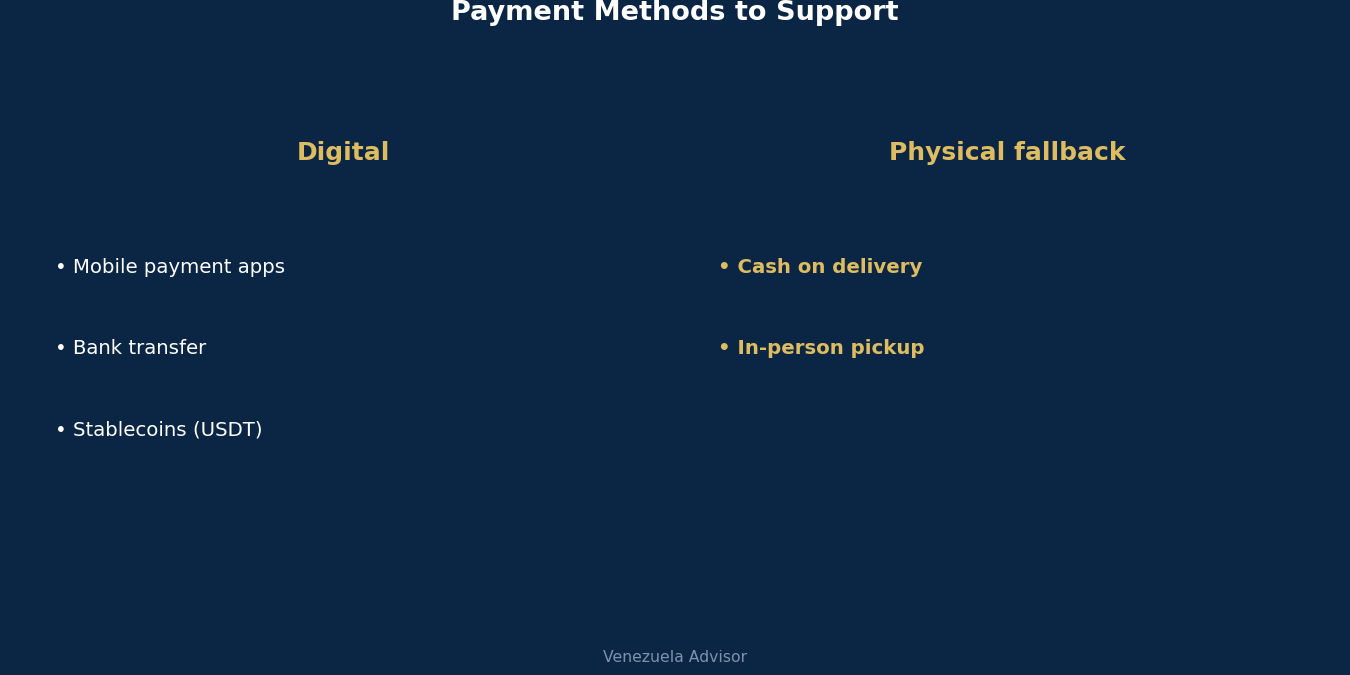
Supporting a single payment method — even a modern, digital-first one — meaningfully narrows your addressable customer base. A workable e-commerce operation typically supports both digital and physical fallback options. This principle mirrors the payment-channel flexibility we recommend for property transactions in our Caracas buying guide — meeting the customer where their actual payment capability sits, rather than where you'd prefer it to sit.
Mobile payment apps and bank transfers cover a large share of dollarized digital commerce, but a meaningful segment of potential customers either lacks access to these tools or simply prefers a physical fallback for a first purchase from a seller they don't yet know. Cash on delivery, while operationally more complex than a fully digital checkout, converts a real slice of otherwise-hesitant first-time buyers, and dropping it entirely to simplify operations often costs more in lost sales than it saves in operational complexity — a tradeoff worth weighing deliberately rather than defaulting to whatever's simplest to implement.
2. Last-mile delivery reality
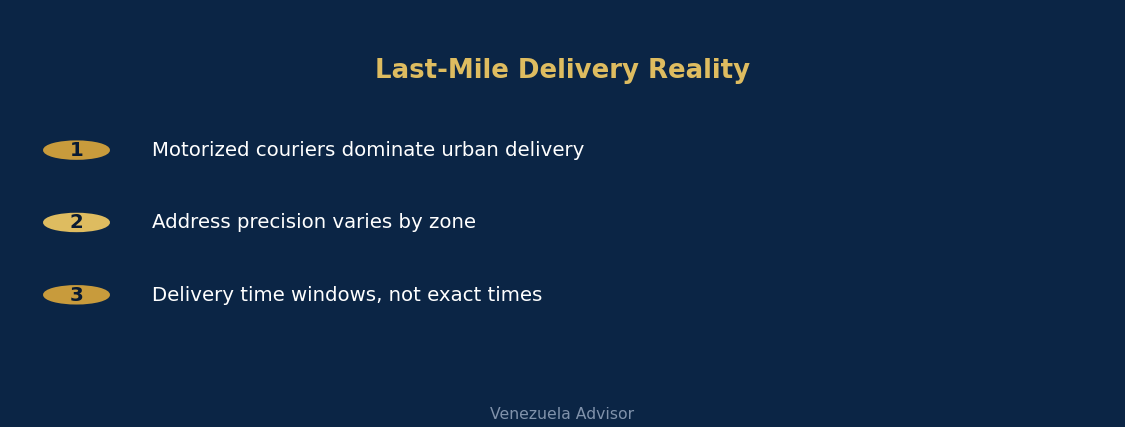
Motorized couriers dominate urban delivery in Caracas, and address precision varies considerably by zone — a system built around exact street addresses, as common in more formally mapped cities, needs adaptation here. This same navigational challenge is one reason many customers ultimately prefer arranging pickup near recognizable landmarks in corridors like Las Mercedes or Altamira, rather than relying purely on a formal delivery address.
Many successful online sellers ask customers for a landmark-based description alongside a formal address — "next to the pharmacy," "blue gate, second floor" — because this hybrid approach consistently reduces failed deliveries compared to relying on formal addressing alone. Setting delivery time windows rather than exact promised times also better reflects the genuine variability couriers face navigating Caracas traffic, and manages customer expectations more honestly than an overly precise promise you can't reliably keep, which only damages trust once the first delay inevitably happens.
3. Choosing your platform
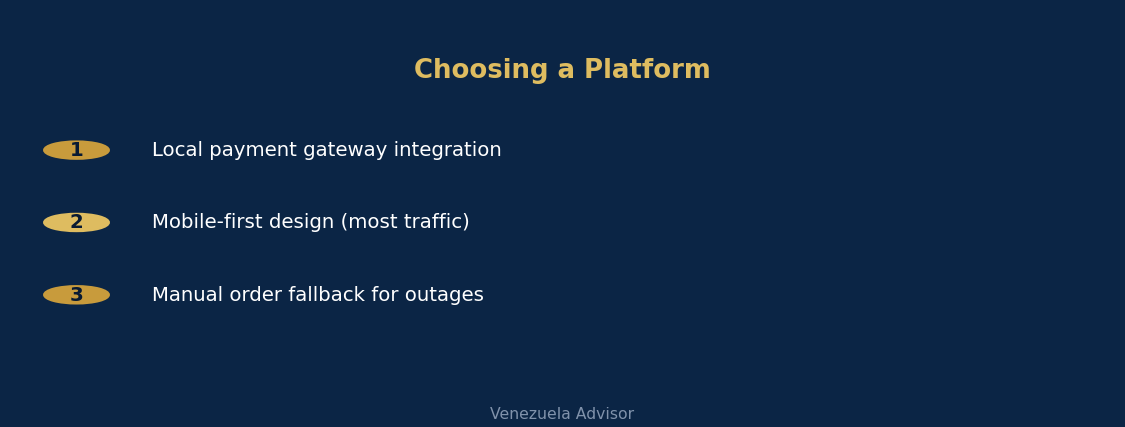
These three criteria matter more in the Venezuelan context than in a typical e-commerce market evaluation, and are worth weighing before defaulting to whichever platform is most popular internationally. A platform decision made without these criteria in mind often needs to be revisited within the first few months, once the gap between the platform's assumptions and the local market's reality becomes apparent through lost sales rather than through careful planning up front. Treat this evaluation the same way we recommend treating a property purchase decision throughout this guide series: gather the specific local facts first, then decide, rather than importing assumptions wholesale from a different market.
- Confirm the platform integrates with a payment gateway your customers actually use locally, not merely one popular internationally elsewhere.
- Prioritize mobile-first design, since most traffic arrives from phones, not desktop computers, in this specific market.
- Build a manual order fallback for when digital payment processing experiences an unexpected outage, which happens more often than in more infrastructure-stable markets.
A platform that's excellent by international standards but lacks local payment gateway integration will consistently underperform a less polished platform that customers can actually complete a purchase on. Evaluate platform choice from the customer's checkout experience backward, not from a features list forward — the same principle applies whether you're choosing e-commerce software or an attorney for a property closing.
4. Why mobile-first isn't optional

A checkout flow that works smoothly on desktop but feels clunky on mobile will quietly lose the majority of potential customers before they ever reach payment. This isn't a Venezuela-specific pattern in isolation, but it's amplified here by how consistently mobile-dominant browsing behavior is across the region, making a mobile-first design decision less optional than it might be in a market with more balanced desktop and mobile usage. A store that loads slowly on a mid-range Android phone over a spotty connection has effectively excluded a large share of its potential customer base before they've seen a single product.
What mobile-first actually means in practice
Beyond simply having a "responsive" site, mobile-first means testing your actual checkout flow — not just your homepage — on a real phone, in real network conditions, before launch. Slow-loading product images, forms with tiny tap targets, and multi-step checkouts that assume a larger screen all quietly bleed conversions in ways that only become visible when you actually walk through the purchase process yourself on a mid-range phone rather than a top-of-the-line testing device. This kind of hands-on testing catches problems no amount of reading about "mobile best practices" will surface on its own.
5. Building customer trust without a physical storefront
Without a physical location a customer can visit, trust signals — verified reviews, responsive customer service, clear return policies — carry disproportionate weight in a Venezuelan customer's decision to complete a first purchase from an unfamiliar online seller. This is worth internalizing early: the polish of your website matters less to a hesitant first-time buyer than tangible evidence that a real, responsive business stands behind it.
A visible, quick-responding customer service channel — even something as simple as a monitored messaging line — reduces the hesitation that keeps a first-time visitor from completing a purchase. Displaying real photos of actual inventory rather than only stock imagery, and being transparent about realistic delivery timelines rather than overpromising, both build the kind of credibility that converts a browsing visitor into a repeat customer over time. Consistency across every one of these small signals, rather than excellence in just one, is what actually earns trust from a cautious first-time buyer.
The role of social proof in a market with limited formal review infrastructure
Where formal, verified review systems are less established than in more mature e-commerce markets, social proof often flows through more informal channels — customer photos shared directly, word of mouth within existing customer networks, visible engagement on social media. Actively cultivating this informal social proof, rather than waiting passively for it to accumulate, meaningfully accelerates a new online seller's path to a customer base willing to trust them with a first purchase. Simply asking a satisfied customer if they'd be willing to share a photo of their order, and making that easy for them to do, converts a routine transaction into visible proof for the next hesitant visitor considering their own first purchase.
6. Mistakes we see new online sellers make
Supporting only one payment method, underestimating delivery time communication with customers, and building a desktop-first experience for a mobile-majority audience are the three most common and most avoidable mistakes. Each one is individually straightforward to fix once identified, which makes it all the more worth reviewing this list before launch rather than discovering these gaps through lost sales after the fact.
Underestimating the operational load of cash on delivery
Offering cash on delivery converts hesitant first-time buyers, but it also introduces real operational complexity: coordinating exact change, handling failed deliveries where the customer isn't available, and reconciling cash payments against orders. Sellers who add this payment option without planning the operational workflow around it often find it creates more customer service friction than the additional sales justify — the fix is planning the workflow deliberately, not abandoning the payment method entirely. A simple written protocol for couriers — what to do if the customer isn't home, how to handle a customer who wants to pay a different amount than invoiced — resolves most of this friction before it ever becomes a recurring problem.
Treating shipping cost as an afterthought in pricing
New online sellers frequently price products without fully accounting for delivery costs, only to discover margins are thinner than expected once courier fees are factored in across every order. Building delivery cost into your pricing model from the start, rather than treating it as a separate line item to absorb later, produces a far more sustainable margin structure. Running the math on delivery cost as a percentage of average order value, before setting final prices, catches this gap while it's still cheap to correct.
Launching without a returns process defined
A customer's first experience with your return policy is often the moment that determines whether they become a repeat customer or never order again. Defining this process clearly before launch, rather than improvising it the first time a return request arrives, protects both your margins and your reputation. A clearly stated policy, even a modestly generous one, tends to build more customer confidence at the point of purchase than an ambiguous one that seems more flexible but leaves the customer uncertain about what actually happens if something goes wrong.
Glossary
Payment gateway: the technical service processing a customer's payment during checkout.
Last-mile delivery: the final leg of delivery from a local hub to the customer's door.
Cash on delivery: a payment method where the customer pays upon receiving the product rather than at checkout.
Fulfillment: the process of storing, picking, packing, and shipping inventory to complete an order after it's placed.
Conversion: the percentage of visitors to an online store who complete a purchase, a figure directly affected by checkout friction on mobile devices.
Inventory and fulfillment: the operational backbone customers never see
Behind every smooth checkout experience sits an inventory and fulfillment system that most customers never think about but that determines whether the order they placed actually arrives as promised. For sellers importing inventory, the timelines and documentation requirements described in our import/export guide apply directly — an e-commerce operation is, at its core, still a physical goods business with all the logistics complexity that implies, wrapped in a digital storefront. Underestimating this reality is one of the more common blind spots among founders coming from a purely digital or services background into their first physical-goods venture.
Maintaining accurate, real-time inventory counts prevents the particularly damaging scenario of accepting an order for a product that's actually out of stock — a mistake that erodes trust far more than simply not offering the product in the first place. Sellers who build even a simple manual inventory-checking discipline into their order-processing workflow avoid this failure mode consistently, while those who don't inevitably encounter it, usually at the worst possible moment with a customer who was particularly excited about their purchase. A basic spreadsheet, updated after every order, is often sufficient at small scale — the discipline matters more than the sophistication of the tool.
Marketing channels that actually drive Venezuelan e-commerce traffic
Social media, particularly platforms with strong regional adoption, tends to drive a disproportionate share of e-commerce discovery in Venezuela compared to search-engine-driven traffic that dominates in more mature digital markets. Building a consistent, authentic social media presence — not necessarily a large one, but a genuinely engaged one — often outperforms a larger paid advertising budget spent without that organic foundation already in place. A modest, consistent posting rhythm with genuine engagement tends to outperform sporadic bursts of activity, even when the sporadic approach involves more total content over time.
Word-of-mouth referrals, amplified through social sharing, also carry particular weight in a market where formal trust infrastructure (established review platforms, well-known brand names) is less developed than in markets with decades of mature e-commerce history. Actively encouraging satisfied customers to share their experience — a simple, genuine ask rather than an elaborate incentive program — often generates more sustainable growth than aggressive paid acquisition alone. Sellers who make this ask a routine part of every successful order, rather than an occasional afterthought, build a compounding referral engine that costs little beyond the discipline of asking consistently.
Key takeaways
- Support multiple payment methods, including a physical fallback for customers without digital options.
- Design for mobile first — most of your traffic will arrive from a phone.
- Build trust signals deliberately in the absence of a physical storefront customers can visit.
- Use landmark-based delivery descriptions alongside formal addresses to reduce failed deliveries.
- Price shipping costs into your product margins from the start, not as an afterthought.
- Treat inventory accuracy and a clear returns policy as core to the customer experience, not back-office details.
If you're building an e-commerce operation targeting Venezuelan customers, we can help you think through platform and payment choices specific to this market.