
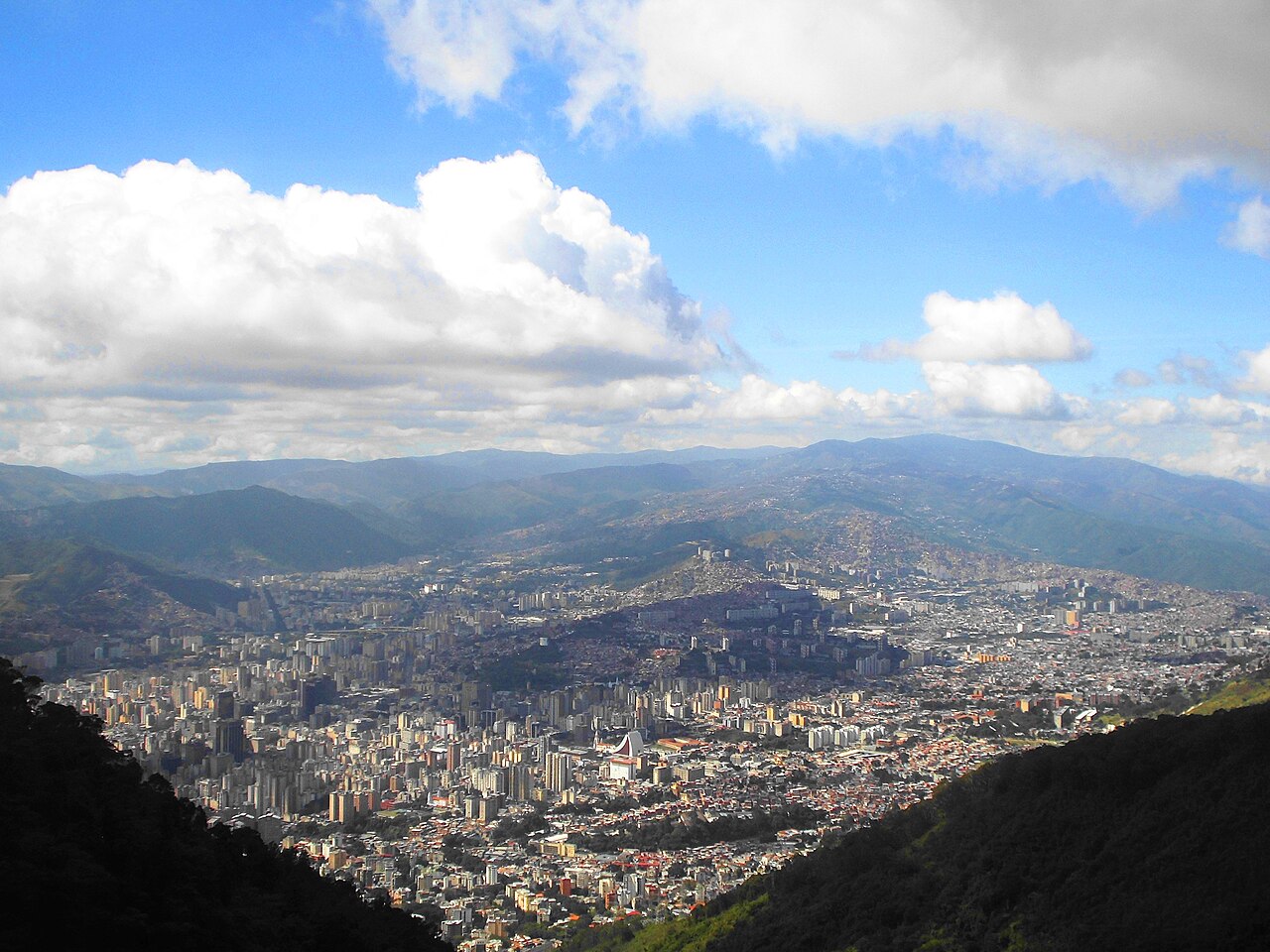
- Introduction: A Dollarized Market with Historically Low Prices
- How Caracas Actually Works, Beyond the Official Map
- Altamira and La Castellana: Caracas's Historic Center of Luxury and Diplomacy
- El Rosal: The Capital's Financial and Corporate Corridor
- Las Mercedes: The Dining and Nightlife Scene Anchoring the Dollarized Upper Class
- Los Palos Grandes: Accessible Prestige and Caracas's Most Walkable Urban Living
- El Hatillo: Greater Caracas's Luxury Suburban Retreat
- Baruta, El Cafetal, and La Trinidad: Residential Growth with the Best Value
- Chuao and Santa Fe: Corporate Demand Beside Caracas's Oldest Shopping Center
- Strategic Guide: Which Caracas Neighborhood Fits Which Buyer Profile?
- Conclusions: A Real Opportunity, But Only for Those Who Approach It With Eyes Open
Introduction: A Dollarized Market with Historically Low Prices
Caracas occupies a unique position in the Latin American real estate market today, and that uniqueness has a precise historical explanation. Over the past decade, the Venezuelan capital has undergone one of the most drastic economic transformations recorded in any major city in the hemisphere: a severe contraction, a hyperinflation episode that completely eroded the bolívar's value, the mass emigration of several million people, and finally a de facto dollarization that rewrote the real estate market's rules from the ground up. The result is a market that now offers conditions found nowhere else in the region: transactions denominated almost entirely in US dollars, historically low entry prices compared to similar cities, and a modest but verifiable recovery concentrated in the city's main residential and commercial corridor.
That recovery, however, is uneven and fragile. Infrastructure shortcomings — intermittent power outages, water rationing, and a public transit system that stopped expanding more than a decade ago — remain part of daily life in most Caracas neighborhoods. Security has improved noticeably in a handful of exclusive areas, but it remains the single factor that most determines a neighborhood's viability for living or investing. Political and regulatory risk also remains a reality no foreign investor can afford to ignore over a multi-year horizon.
The Caracas Market in Three Figures
in covered neighborhoods
gross rental yield
and real transaction price
for most deals today
How Caracas Actually Works, Beyond the Official Map
Formally, Caracas is the Distrito Capital, but what most residents and investors call "Caracas" also includes four municipalities in Miranda state that together make up Greater Caracas: Chacao, Baruta, El Hatillo, and Sucre. The Distrito Capital itself is dominated by Municipio Libertador, home to the historic center, national government institutions, and extensive lower-income areas that have suffered disproportionate deterioration over the past twenty years.
For strictly real estate purposes, the genuinely active, transactable market is concentrated in just three municipalities: Chacao (Altamira, La Castellana, El Rosal, Los Palos Grandes), Baruta (Las Mercedes, El Cafetal, La Trinidad, Chuao, Santa Fe), and El Hatillo. These three share stronger security track records, more reliable private infrastructure — generators, water tanks, organized security — and, put simply, the overwhelming majority of quality housing supply currently on the market in the capital.
Since the de facto dollarization that followed 2019, virtually every transaction is quoted and settled in dollars, eliminating currency risk on the purchase price but introducing genuine liquidity constraints and title procedures that require experienced local legal counsel. Average prices in the neighborhoods covered in this guide range from $700 to $2,500 per square meter, with rental yields typically between 5% and 9% annually.
Greater Caracas: Key Municipalities
eastern core
& western districts
& southern corridor
residential zones
Altamira and La Castellana: Caracas's Historic Center of Luxury and Diplomacy
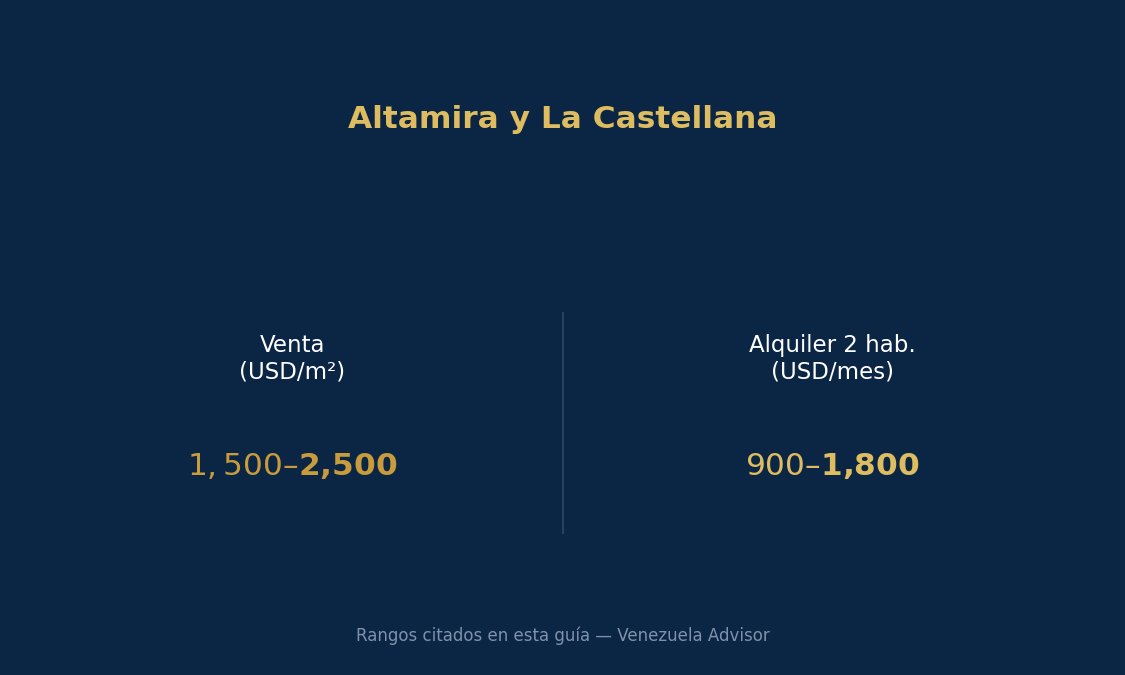
Altamira and its immediate neighbor, La Castellana, both located in Municipio Chacao, have long been Caracas's most prestigious and sought-after addresses. Plaza Francia in Altamira remains one of the city's most recognizable public spaces, surrounded by embassies, international organizations, and the offices of the country's leading law firms and financial institutions. Bordering Altamira to the west, La Castellana offers a quieter residential atmosphere, larger lots, and some of the best-preserved single-family homes in Greater Caracas.
Sale prices currently range between $1,500 and $2,500 per square meter in well-maintained buildings, while luxury penthouses typically sell for considerably more. Monthly rents for two-bedroom apartments usually range between $900 and $1,800, while three-bedroom units in luxury residential towers can reach $2,500 or more.
Altamira also benefits from the city's most consolidated private security infrastructure, with numerous condominium buildings offering 24-hour security and one of the largest police presences in Greater Caracas. Even so, practically every high-quality residential building now treats backup power generators and independent water storage systems as essential features and non-negotiable requirements before purchasing any property.
El Rosal: The Capital's Financial and Corporate Corridor
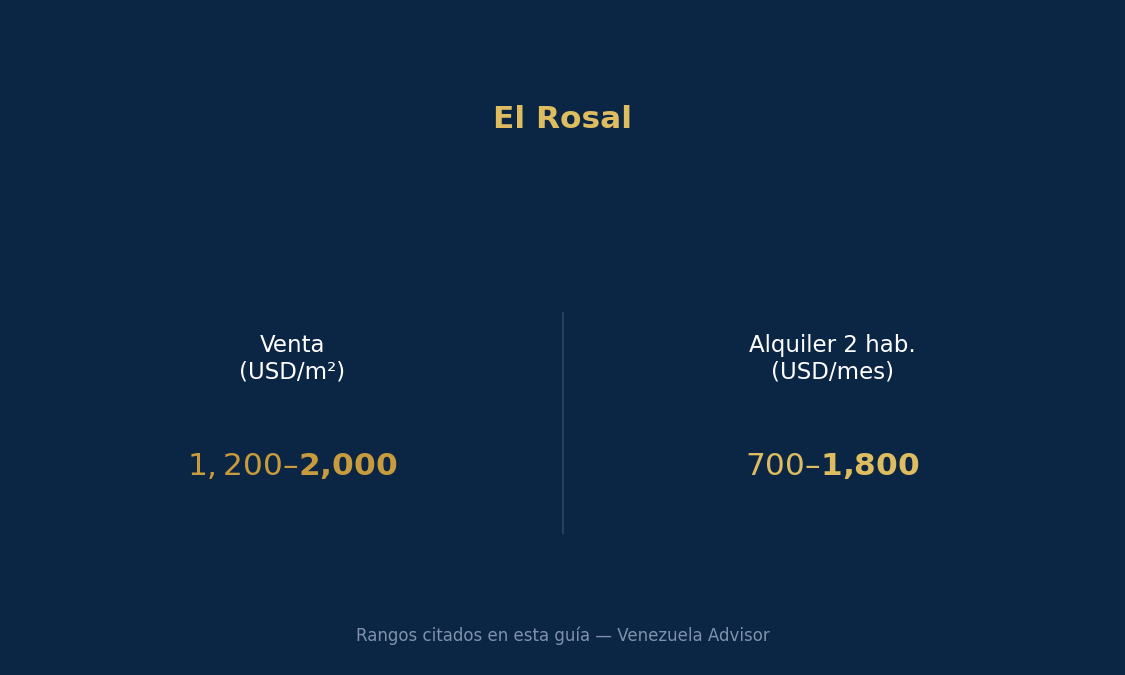
El Rosal, also within Municipio Chacao, is today Caracas's leading commercial and financial district, and has been almost continuously since the 1990s. The Avenida Francisco de Miranda corridor holds the city's highest concentration of bank headquarters, law firms, international accounting firms, and hotel chains, making El Rosal the address of choice for executives prioritizing a short commute.
Housing prices directly reflect proximity to the financial district: apartments range from $1,200 to $2,000 per square meter. One-bedroom apartment rents range from $700 to $1,100 monthly, while two-bedroom units run between $1,100 and $1,800. Corporate leases — where the tenant is a company — command an additional premium and carry lower default risk, making them especially attractive to investors seeking income stability over capital appreciation.
Traffic congestion on Avenida Francisco de Miranda is a constant issue, and while the neighborhood is walkable within its immediate perimeter, it is poorly served by public transit for anyone without a car.
Las Mercedes: The Dining and Nightlife Scene Anchoring the Dollarized Upper Class
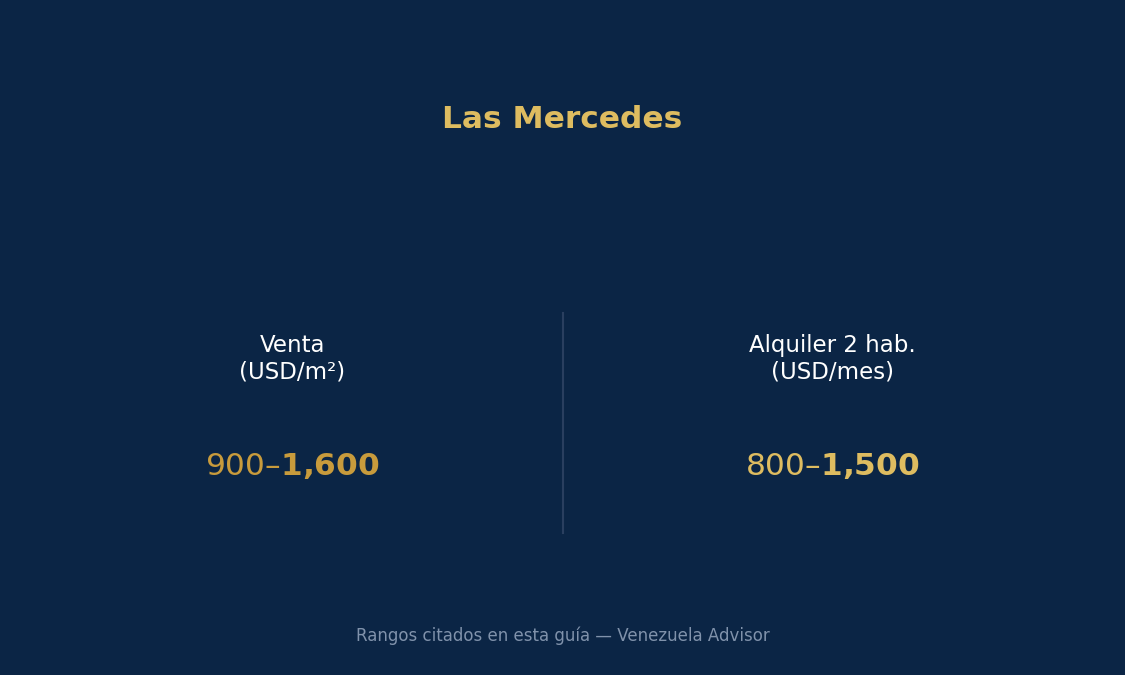
Las Mercedes, located in Municipio Baruta, is today Caracas's most dynamic mixed-use neighborhood, and perhaps the one that best illustrates the city's economic reconfiguration in recent years. Its main commercial spine, Avenida Principal de Las Mercedes, holds the capital's highest concentration of fine-dining restaurants, bars, boutiques, and gyms. In a city that lost much of its commercial infrastructure over the past decade, Las Mercedes has become the most visible exception: a district where economic activity genuinely recovered, driven by dollar-denominated spending from an upper class redefined after years of crisis and emigration.
Sale prices average between $900 and $1,600 per square meter, while two-bedroom apartment rents range from $800 to $1,500 monthly. One clarification is worth making, however: the neighborhood's appeal is closely tied to the strength of Venezuela's current economic stabilization, and this consumer base, while real, remains relatively small compared to the size of the city.
Los Palos Grandes: Accessible Prestige and Caracas's Most Walkable Urban Living
Los Palos Grandes, located between Altamira and the Guaire River within Municipio Chacao, offers considerably more accessible entry into Caracas's luxury real estate market without sacrificing too much in terms of location. Its most distinctive feature is Avenida Luis Roche, a human-scale commercial corridor of mid-range cafés and restaurants, combined with a relatively flat street grid that makes it one of the most walkable neighborhoods in a car-dominated city.
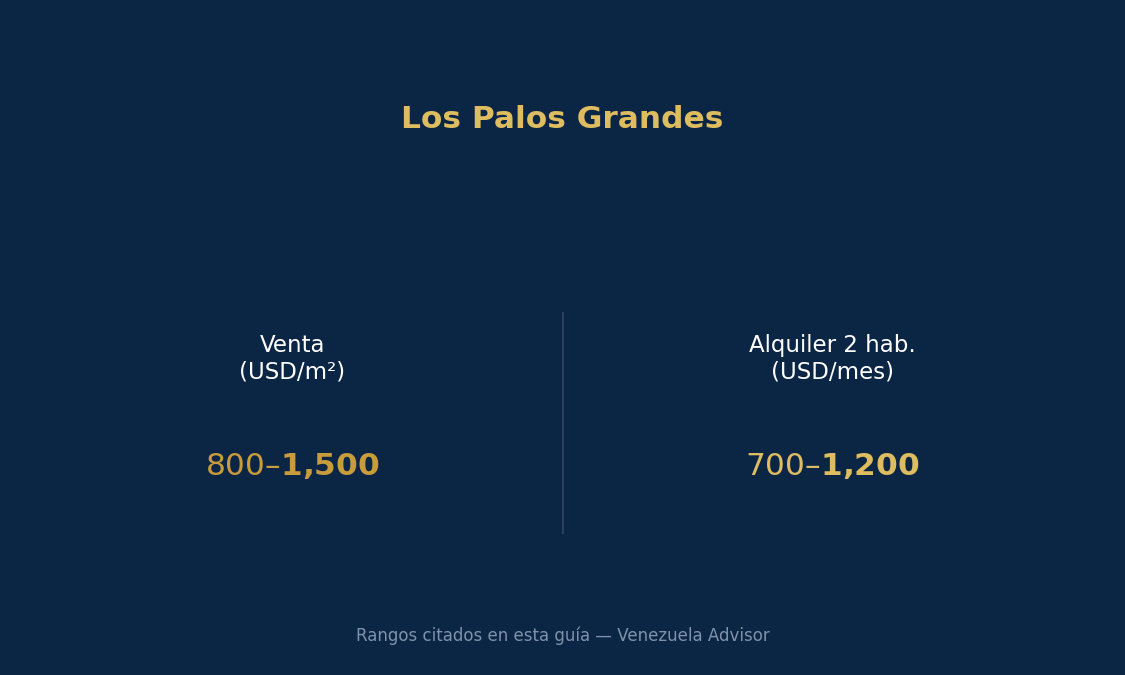
Sale prices range from $800 to $1,500 per square meter, while two-bedroom apartment rents run around $700 to $1,200 monthly. Construction quality, however, is notably uneven: most buildings were built between the 1960s and 1980s, meaning any serious buyer needs to carefully evaluate electrical systems and water storage capacity before closing. This disparity is precisely the neighborhood's main risk factor: the address carries prestige and recognition, but the quality of individual properties varies significantly from one building to the next.
El Hatillo: Greater Caracas's Luxury Suburban Retreat
Municipio El Hatillo, at the far southeastern edge of Greater Caracas, is the clearest example of a luxury suburban retreat: a cooler, greener setting with considerably lower population density. Sitting between 1,000 and 1,400 meters above sea level, it enjoys temperatures 3 to 5 degrees Celsius lower than downtown Caracas and retains a colonial-era historic center that gives it a distinctive character within the metropolitan area.
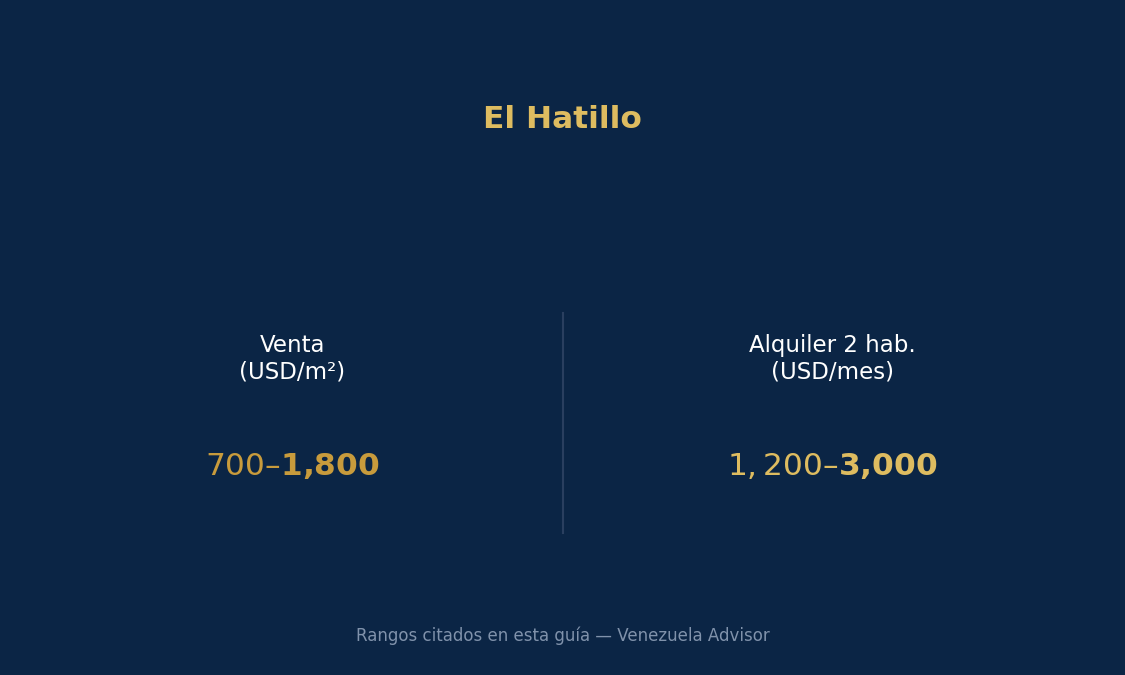
El Hatillo has seen the most consistent real estate development in Greater Caracas over the past five years, with gated communities offering organized internal security as the dominant product. Sale prices range from $700 to $1,800 per square meter, while monthly rents in quality gated communities range from $1,200 to more than $3,000.
The main practical challenge is connectivity: commuting to Chacao or El Rosal can easily take 45 to 75 minutes under normal traffic conditions. Even so, this structurally car-dependent setting offers the most economically stable buyer and tenant profile anywhere in the metropolitan area.
Baruta, El Cafetal, and La Trinidad: Residential Growth with the Best Value
The inner areas of Municipio Baruta — El Cafetal, La Trinidad, Cumbres de Curumo, and adjacent zones — represent today Caracas's largest upper-middle-class residential segment. These neighborhoods developed mainly during the 1970s and 1980s as the city expanded southward, and they retain a distinctly suburban character: low- and mid-rise buildings, well-preserved townhouses, and local shops alongside long-established schools.
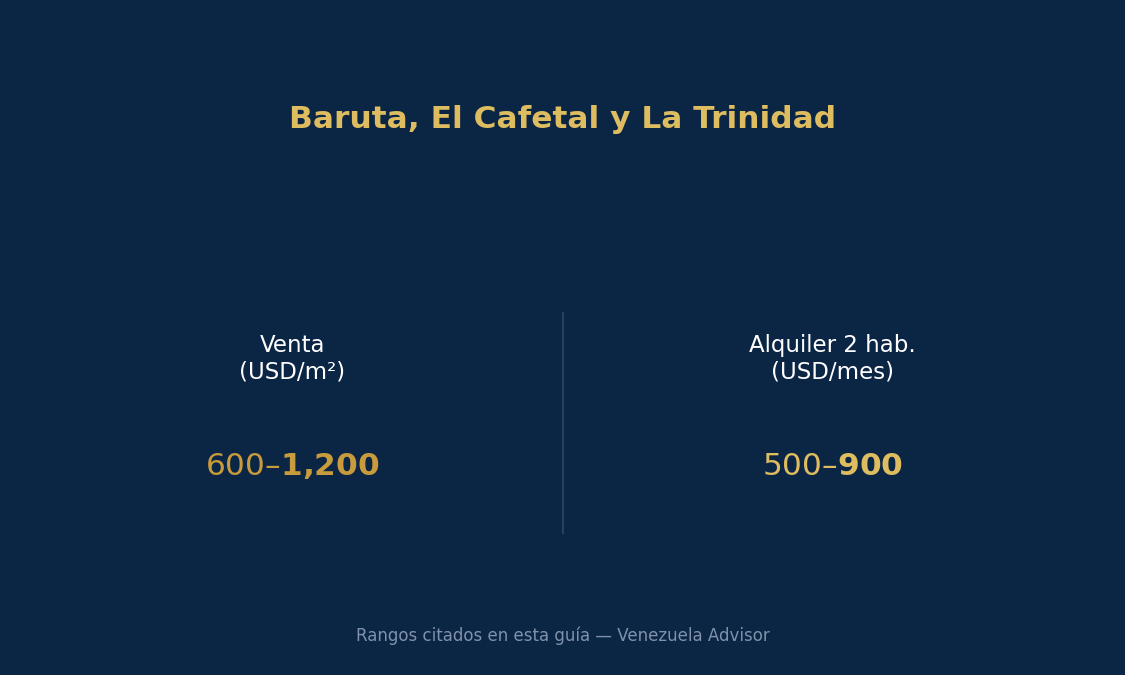
Sale prices range from $600 to $1,200 per square meter — the most accessible entry point into Caracas's stable real estate market — while two-bedroom apartment rents range from $500 to $900 monthly. El Cafetal, in particular, enjoys a strong reputation for community stability: schools like Colegio Moral y Luces and Colegio Francia remain a pillar of family demand year after year. For buyers seeking a long-term home, Baruta's mid-range neighborhoods offer genuine quality of life at prices that, by any reasonable regional comparison, represent excellent value.
Chuao and Santa Fe: Corporate Demand Beside Caracas's Oldest Shopping Center
Chuao, at the eastern edge of Municipio Baruta, sits precisely at the intersection of Caracas's commercial zone and its established residential areas. Chuao's business district, home to major Venezuelan corporations, the CCCT (Centro Ciudad Comercial Tamanaco), and several institutions near embassies, generates steady housing demand from executives, diplomats, and professionals. Santa Fe, split into Norte and Sur sectors, rounds out this corridor with a more residential character and direct access to the Francisco Fajardo highway.
Sale prices range between $750 and $1,400 per square meter, while two-bedroom apartment rents sit between $650 and $1,100 monthly. The CCCT complex, while showing its age in several respects, remains a fundamental anchor of the area. For investors, corporate rental demand in Chuao likely represents the clearest and most predictable value proposition on this corridor: its proximity to the CCCT complex makes it the practical default choice for companies needing to house expatriate staff in Caracas.
Greater Caracas: Key Municipalities
eastern core
& western districts
& southern corridor
residential zones
Strategic Guide: Which Caracas Neighborhood Fits Which Buyer Profile?
Price per m² Across 7 Caracas Neighborhoods
- Altamira / La Castellana
- El Rosal
- Las Mercedes
- Los Palos Grandes
- Chuao / Cafetal
- El Hatillo
- Baruta corridor
The Caracas market is clearly segmented by the specific profile of the buyer or investor, and understanding that segmentation is, in practice, more useful than memorizing a single price range in isolation. For high-end capital seeking maximum liquidity, Altamira, La Castellana, and El Rosal offer the best combination of address recognition, diplomatic and corporate demand, and a solid resale market, with entry prices still far below comparable areas in Panama City, Bogotá, or Lima.
For those seeking a lifestyle-focused investment, Las Mercedes currently offers the best quality of life at somewhat lower prices, though its recovery remains tied to Venezuela's still-fragile economic stabilization. For families or long-term buyers, the residential areas of El Hatillo and Baruta offer genuine quality of life at the lowest prices in the Caracas real estate market, with the tradeoff of lower liquidity and longer commutes.
For investors focused on yield, Los Palos Grandes and Chuao offer the best balance between rental return and entry price, though careful asset selection is essential in both cases.
One final observation applies across every category: the Caracas market still suffers from very limited price transparency; there is no MLS (Multiple Listing Service) equivalent, and actual transaction prices commonly differ from listed prices by 15% to 30%. Working with experienced local real estate agents and attorneys is the difference between a good outcome and a mediocre one.
The Caracas Market in Three Figures
in covered neighborhoods
gross rental yield
and real transaction price
for most deals today
Conclusions: A Real Opportunity, But Only for Those Who Approach It With Eyes Open
Caracas remains, without question, a complex market — but also a genuinely opportunity-rich one for buyers willing to approach it with realistic expectations and proven local knowledge. It is not a market suited to every kind of investor: the structural risks — persistent political uncertainty, real infrastructure shortcomings, limited dollar liquidity — are real and should not be underestimated.
However, for those who understand this environment, retain genuinely competent local legal and real estate advisors, and focus on the defensible areas described in this guide, Caracas today offers something increasingly scarce in Latin America: genuinely high-quality urban real estate at prices well below comparable properties elsewhere in the region, within a fully dollarized market with real rental demand.
This market's trajectory over the next three to five years will depend on factors beyond any individual buyer's control: the evolution of Venezuelan politics, the durability of dollarization, and the pace of infrastructure investment. Those who treat Caracas as part of a diversified strategy, rather than as a primary bet, will find this to be one of the more compelling entry opportunities the Latin American real estate market has offered in recent years.