
- Why Closing in Venezuela Is Different
- The Five Closing Costs at a Glance
- (1) Registry Fees – SAREN Charges
- (2) ISLR Advance – The 0.5% Seller's Tax
- (3) Municipal Real Estate Transaction Tax (ITBI)
- (4) Drafting Attorney's Fees
- (5) Solvency Certificates and Document Costs
- Practical Examples Across Three Price Ranges
- Additional Steps If You're a Foreigner
- Use Your Knowledge to Negotiate
- Key Takeaways
Why Closing in Venezuela Is Different
Anyone who has bought a house in North America or Europe knows the drill: attorneys, title insurance, registry offices, and half a dozen government agencies each take a small cut of the agreed sale price. Venezuela isn't fundamentally different — you pay notary fees, registry fees, and taxes to the tax authority — but the country has its own particularities that catch foreign buyers off guard.
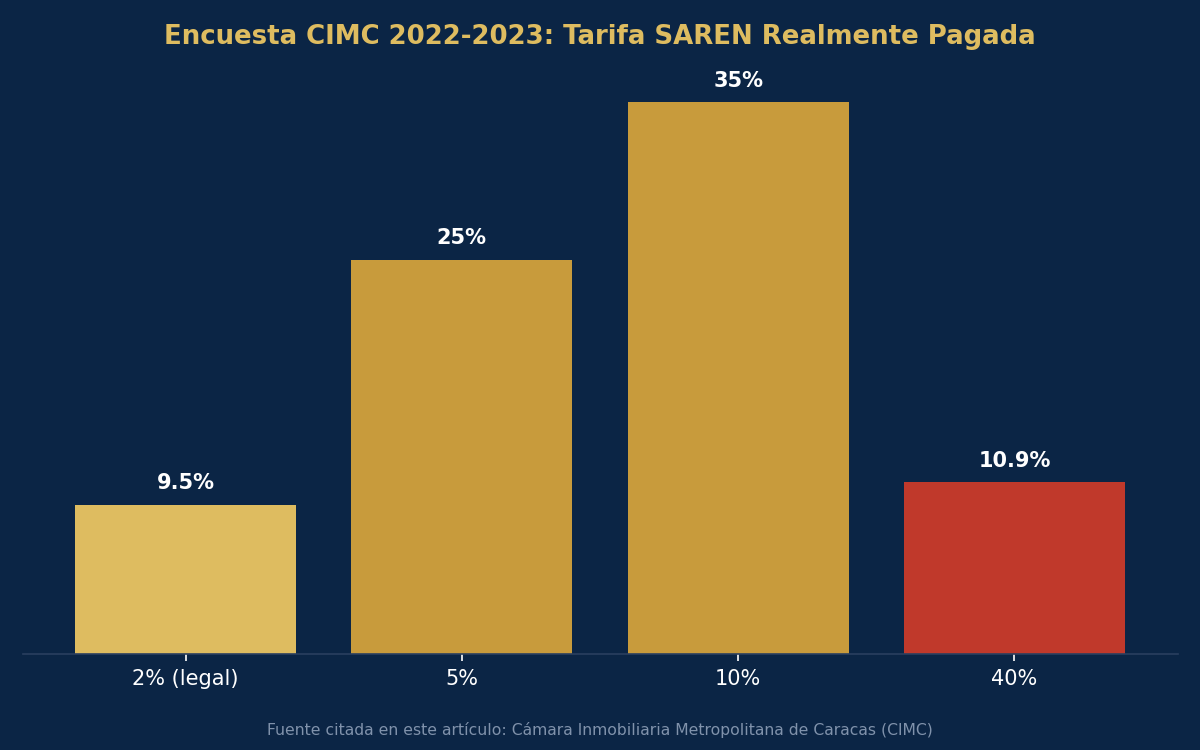
The biggest surprise: while the Registries and Notaries Law caps the SAREN registration fee at 2% of the deed value, surveys conducted by the Venezuelan Real Estate Chamber (CIMC) have revealed that buyers are routinely charged between 5% and 40% of the property's value, depending on the registry office, the valuation the registrar decides to use, and whatever "informal" surcharges happen to be in effect that day. Only around 10% of buyers surveyed by the CIMC paid the legal 2% rate.
Add to this that prices are usually negotiated in US dollars but registered in bolívares at the BCV exchange rate, that the seller's 0.5% ISLR advance is paid up front via SENIAT Form 33, and that you can't even sign at the registry without a stack of municipal solvency certificates, and it's easy to see why most first-time buyers find the process bewildering.
Key Documents for a Foreign Buyer
- Valid passport — identification for the transaction
- RIF (SENIAT) — Venezuelan tax ID required for registry
- Valid immigration status — or power of attorney if remote
- Proof of funds — bank letters / source of funds as requested
- Property dossier — title, solvency certificates, building docs
I'm writing this guide after having accompanied several foreign buyers through closings in Caracas, Valencia, and Margarita — transactions in which neither party fully understood how much was owed, who owed it, or why the SAREN invoice was four times what the law stipulated. The goal of this article is simple: to explain every closing cost clearly, show you precisely how it's calculated, and give you the vocabulary and negotiating leverage you need.
In Venezuela, budget between 5% and 8% of the deed price for closing costs, covering mainly SAREN fees and registration charges.
The Five Closing Costs at a Glance
Before getting into the details, here are the five recurring line items in any closing of a property purchase in Venezuela, and who typically pays them:
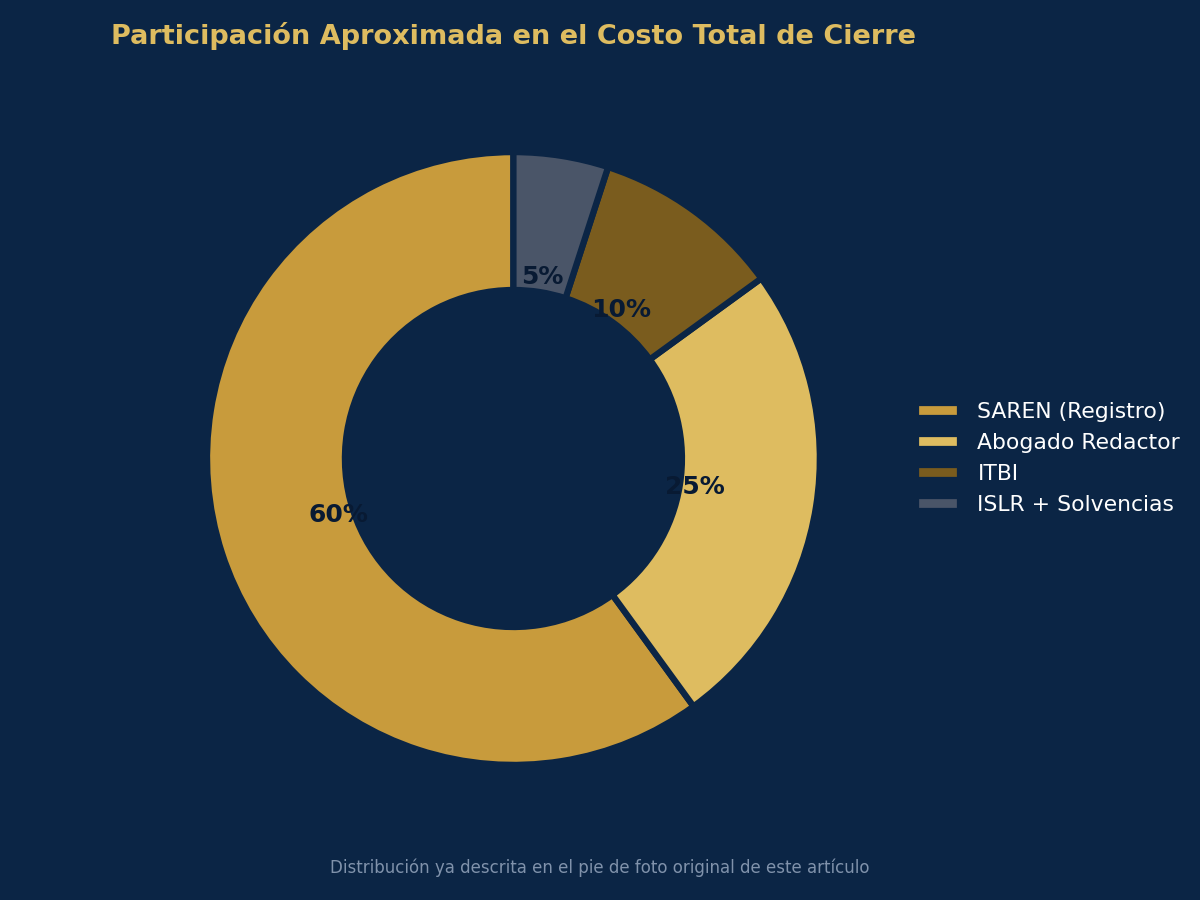
- Registry Fees (SAREN): The fee paid to the Autonomous Service of Registries and Notaries to formalize the deed. Legally up to 2% of the deed value; often 5% to 10% in practice. Paid 100% by the buyer.
- ISLR Advance (SENIAT Form 33): A 0.5% income tax advance paid before the registry will accept the deed. Paid 100% by the seller when the seller is an individual; companies fall under a different ISLR regime.
- Municipal Tax / ITBI: A municipal transfer tax that varies by municipality (generally 0.5% to 1.5%). Normally split 50/50, but practice varies and the option-to-purchase contract should specify it.
- Drafting Attorney's Fees: The attorney's fee for drafting and endorsing the deed. Per the Federation of Venezuelan Bar Associations' fee schedule, this ranges roughly from 2% to 6% depending on the transaction value. Paid 100% by the buyer.
- Solvency Certificates and Document Costs: Derecho de frente (frontage tax), Hidrocapital/water, Corpoelec/electricity, condominium fees, lien certificate, RIF, cadastral ID card, copies, "diligencias" — a long list of small charges. Solvency certificates are the seller's responsibility; the buyer pays for the lien certificate and any documents tied to their own RIF and identity.
(1) Registry Fees – SAREN Charges
SAREN — the Autonomous Service of Registries and Notaries — is the public registry that holds the official record of real property ownership in Venezuela. Until your deed is formally recorded at the applicable Registro Inmobiliario, you are not the legal owner, regardless of what your option-to-purchase contract says.
The Registries and Notaries Law sets a maximum cap of 2% of the deed value for formalizing a sale. That's what the law says. The Caracas Real Estate Chamber (CIMC) has spent years asking SAREN to charge that 2% and nothing more.
In practice, here's what tends to happen at the counter:
- The registry may reassess your property at a value higher than the price stated in your deed (this is the registrar's prerogative).
- That reassessed value — not the declared sale price — is what the percentage gets multiplied against.
- On top of the "fees," you may be quoted "autonomous services," "digitization," or simply a higher rate that's hard to dispute on the spot.
According to a survey conducted by the Real Estate Chamber between 2022 and 2023 among 220 buyers, only 9.5% reported paying the legal 2%. The most common rate was 10%, followed closely by a large group who paid 5%. Around 10.9% reported paying 40% of the property's value, almost always due to substantial overvaluation by the registrar.
Two practical takeaways:
- Get your registry quote in writing in advance. Before signing your option-to-purchase contract, have your attorney call the Registro Inmobiliario where the deed will be recorded and confirm the current rate. Rates vary by office.
- Prepare for the worst case. When advising foreign buyers, I budget 8% of the deed value for SAREN and treat anything lower as a pleasant surprise.
(2) ISLR Advance – The 0.5% Seller's Tax
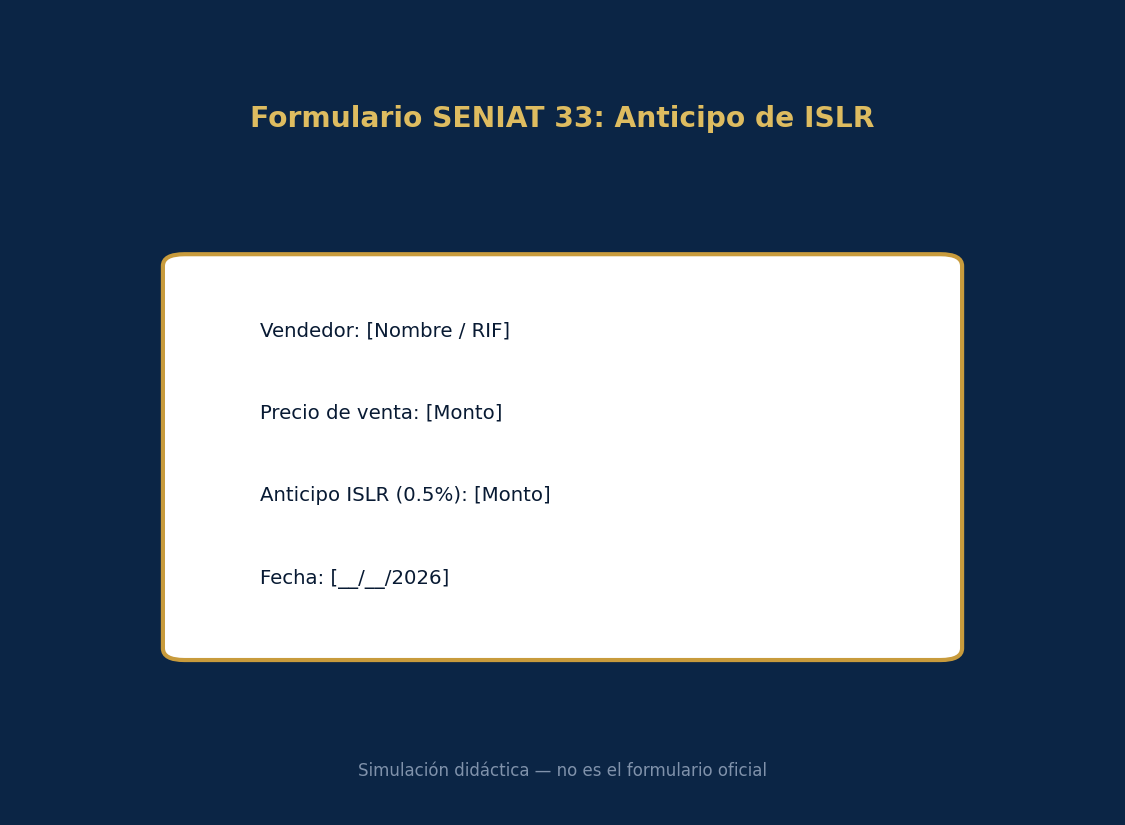
Under Article 86 of Venezuela's Income Tax Law (Ley de ISLR), the seller of real property must pay an income tax advance equal to 0.5% of the sale price before the deed can be formally recorded. Payment is made via SENIAT Form 33 ("ISLR Advance"), and the receipt is one of the documents the registrar will require at the counter.
A few important nuances:
- Technically, it's an advance, not the final tax. If the seller realized a capital gain, the difference is settled in the annual ISLR filing. In practice, since the property is valued in bolívares for tax purposes, this 0.5% is usually the entire tax owed.
- It's paid by the seller, not the buyer. Don't let the seller try to pass this to you — it is clearly the seller's responsibility.
- It applies only to individuals. If the property is held under a company (CA or SA), the company is taxed under the corporate ISLR regime and the 0.5% Form 33 advance doesn't apply at closing.
- Primary residence exemption. If the property being sold is the seller's registered primary residence, and the seller commits to purchasing a replacement primary residence within two years, the 0.5% can be waived — but only if the primary residence was registered with SENIAT in advance.
- Low-value exemption. Sales under 3,000 Tax Units (with the 2025 Tax Unit at Bs. 43, that's Bs. 129,000 — a negligible figure in dollars) are exempt. In practice, this almost never applies.
(3) Municipal Real Estate Transaction Tax (ITBI)
Every Venezuelan municipality has the right to collect its own tax on real estate transactions, set by ordinance. The constitutional cap is 3% of the gross value, but in practice most municipalities apply between 0.5% and 1.5%. The exact rate depends on where the property is located.
- Municipio Libertador (downtown Caracas)
- Municipio Chacao (Altamira, La Castellana, El Rosal)
- Municipio Baruta (Las Mercedes, Santa Fe, El Cafetal)
- Municipio Sucre (Petare, Los Dos Caminos, La California)
- Municipio El Hatillo (La Lagunita, Los Naranjos)
…and so on for each city. The rate in effect in your municipality is fixed in the local Ordenanza sobre Transacciones Inmobiliarias, available through the SUMAT (Municipal Tax Superintendency) of the relevant mayor's office.
By convention, this cost is split evenly between buyer and seller, similar to departmental transfer taxes in Colombia or Spain. However, just as with those Colombian transfer taxes, this is the line item sellers most often try to shift entirely onto an inexperienced foreign buyer. The split should be governed by what's stated in the option-to-purchase contract — one more reason to insist that your own attorney draft that document.
Municipalities with Their Own ITBI Ordinance (0.5%–1.5%)
(4) Drafting Attorney's Fees
In Venezuela, every property deed must be drafted and stamped by a licensed Venezuelan attorney. Templates aren't allowed, and foreign attorneys cannot be used for this purpose.
The Federation of Venezuelan Bar Associations publishes a national minimum-fee schedule (Reglamento Nacional de Honorarios Mínimos) that attorneys are expected to follow. The headline rates for drafting a purchase-sale document vary by transaction size:
- 6% on the lowest bracket of transactions
- 4% on the middle bracket
- 2% on higher-value transactions (the bracket thresholds are updated frequently as the bolívar depreciates; check with your attorney for current limits)
In practice, for dollar-denominated transactions involving foreign buyers, most experienced Caracas real estate attorneys charge a flat fee of 1% to 2% of the deed value, often with a minimum of around USD 1,500–2,500 for the closing of a home. This covers: drafting the option-to-purchase contract, drafting the deed, requesting the lien certificate, accompanying you to SENIAT for Form 33, accompanying you to SAREN for recording, and managing the solvency-certificate follow-up.
This fee is paid entirely by the buyer, since it's the buyer who commissions the drafting. If the seller retains their own attorney (recommended for them), that's an additional cost on the seller's side.
Drafting Attorney Fees: Official Schedule vs. Practice
(foreign buyers)
(5) Solvency Certificates and Document Costs
Before SAREN will record your deed, the seller must present a series of "solvencias" — certificates from various authorities confirming the property has no outstanding debts. The buyer also has a handful of documents to handle. This is where Venezuelan closings take on their own particular character, and where delays tend to start.
Seller's responsibility:
- Derecho de frente solvency (municipal property tax) — the primary solvency certificate for any urban property.
- Hidrocapital solvency (or the local water utility — Hidrocaribe, Aguas de Mérida, etc.) — required for houses and lots.
- Corpoelec solvency (electricity).
- Urban sanitation solvency (waste collection).
- Condominium solvency (issued by the condominium board for any apartment or unit in a managed building).
- Current cadastral ID card (cédula catastral, valid for two years — issued by the municipality).
- Primary residence certificate, if claiming the ISLR primary-residence exemption.
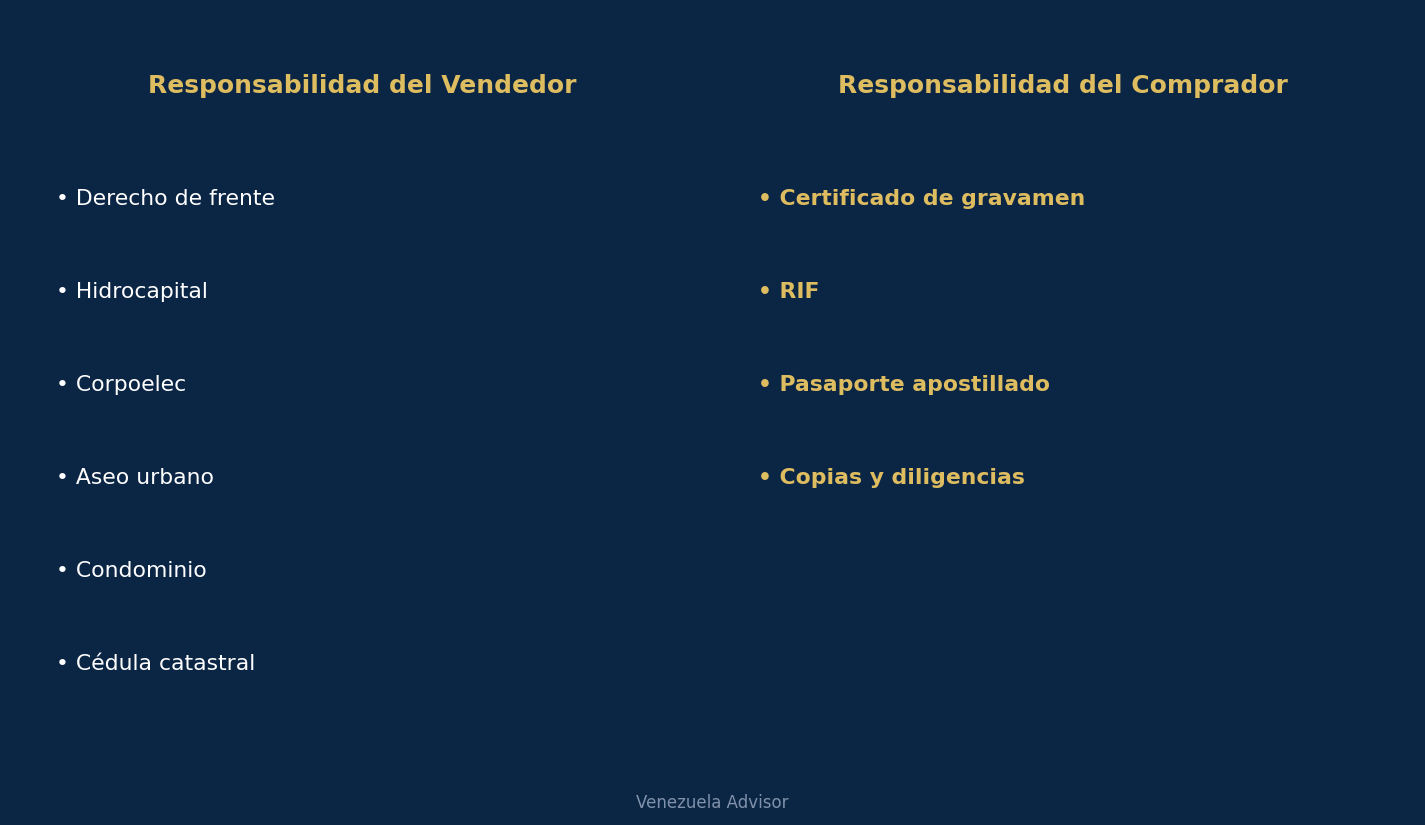
Buyer's responsibility:
- Lien certificate (certificado de gravámenes) — issued by the Public Registry, valid for 30 days. Confirms the property has no liens (mortgages, judicial seizures, etc.). Usually costs between USD 30 and 80, depending on the registry.
- RIF (tax ID): required for all parties, including foreign buyers. It's free from SENIAT, but requires a Venezuelan address.
- Cédula or apostilled passport, plus documentation of immigration status (see the foreigners' section below).
- Copies, "diligencias," processing fees, and various minor administrative costs that together usually add up to between USD 200 and 500.
Practical Examples Across Three Price Ranges
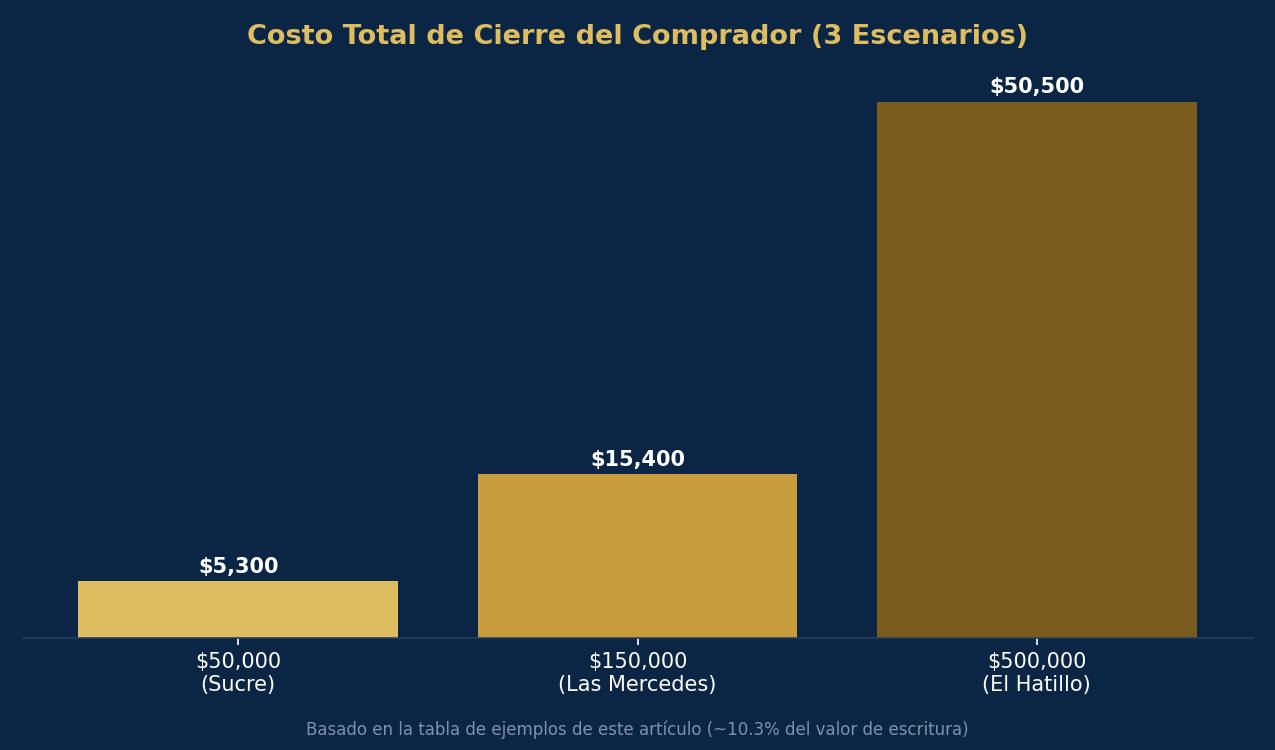
To make this concrete, here are estimated total closing costs for a buyer across three common price ranges. I've modeled SAREN at 8% of the deed value (a realistic middle case for 2025–2026), municipal ITBI at 1% split 50/50, and attorney's fees at 1.5%. The seller's 0.5% ISLR is shown separately so you can see the full picture.
Closing Costs in Venezuela: Buyer Breakdown
as % of declared value
(buyer side)
transfer charges
closing cost range
| $50,000 Apartment (Sucre) | $150,000 Apartment (Las Mercedes) | $500,000 Villa (El Hatillo) | |
|---|---|---|---|
| SAREN Registry (8%) | $4,000 | $12,000 | $40,000 |
| Drafting Attorney (1.5%) | $750 | $2,250 | $7,500 |
| ITBI (1%, split) | $250 each | $750 each | $2,500 each |
| Certificate + misc. (buyer) | ~$300 | ~$400 | ~$500 |
| ISLR Advance 0.5% (seller) | $250 | $750 | $2,500 |
| Solvencies (seller, est.) | ~$200 | ~$300 | ~$500 |
| Buyer total | ~$5,300 (10.6%) | ~$15,400 (10.3%) | ~$50,500 (10.1%) |
| Seller total | ~$700 (1.4%) | ~$1,800 (1.2%) | ~$5,500 (1.1%) |
Additional Steps If You're a Foreigner
A foreign national can legally own real estate in Venezuela; there are no nationality restrictions for most property types. However, the paperwork is more involved than for a Venezuelan buyer, and it's worth starting well before you find the ideal apartment.
- Apostilled passport. Original plus a notarized copy. The apostille must come from the issuing country.
- RIF. Issued by SENIAT, free of charge, but requires you to designate a Venezuelan tax address. Many foreign buyers use their attorney's office as their tax domicile.
- Immigration status. You cannot legally formalize a property purchase on a tourist visa. The appropriate path is the investor transient visa (TR-I) or, in some cases, the business transient visa (TR-N). Both require SAIME approval and can take 6 to 12 weeks. Plan ahead.
- SAREN registration. Once you have your visa and RIF, register your full details in the SAREN system so the registrar can find you when the deed is presented.
- Funds transfer. Venezuela doesn't have an active mortgage market for foreigners. Payment must be made in cash, typically via USD bank transfer to the seller's offshore account (Panama, Florida, etc.), following milestones agreed in the option-to-purchase contract. Make sure your bank's compliance department is comfortable with the destination before you commit.
Investor Transient Visa (TR-I)
SAIME approval time
before registry signing
Use Your Knowledge to Negotiate
Negotiation Example #1: "I'll Handle the Paperwork"
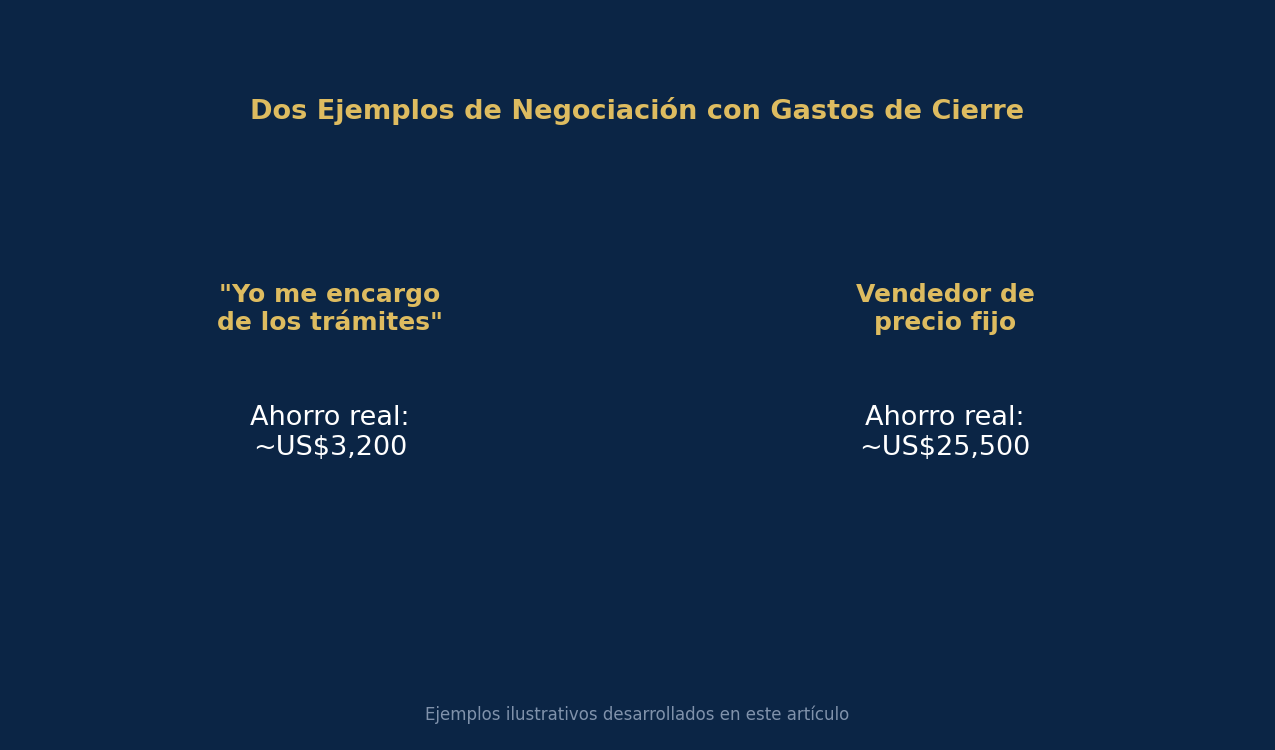
Say you're buying a $150,000 apartment. The seller's ISLR responsibility as an individual is $750, half of ITBI is $750, solvencies run $300 — the seller's total outlay is roughly $1,800. Many sellers, especially those living abroad or unfamiliar with the local process, considerably overestimate what they owe. A clean line to use is:
"I'll take care of all the notarial and registry paperwork, and the associated costs, as long as we bring the price down by USD 5,000."
The seller feels like they've dodged a big headache; in reality, you've secured a discount of more than $3,000 in exchange for roughly $1,800 in costs you're taking on. (Don't do this if the seller's ISLR or solvencies are genuinely high — for example, an overdue derecho de frente requiring five years of back payments.)
Negotiation Example #2: The Fixed-Price Seller
Many Venezuelan sellers anchor on a round dollar figure — $200,000, $300,000, or $500,000 — and won't budge. In that case, it's worth shifting the focus to closing costs instead:
"Okay, I'll pay the $300,000 you're asking, but you cover 100% of the ITBI and SAREN registry costs."
With SAREN at 8% plus half of a 0.5% ITBI on $300,000, you've effectively negotiated a discount of roughly $25,500, while the seller can still tell their family they hit their number.
Key Takeaways
- In Venezuela, budget between 8% and 10% of the deed value for the buyer's closing costs — significantly more than in Colombia, Mexico, or the United States. The largest single cost is SAREN registration.
- SAREN's legal cap is 2%, but a higher effective rate is typically applied in practice. Call the applicable Registro Inmobiliario before signing your option-to-purchase contract to confirm the current rate.
- The 0.5% ISLR advance is the seller's tax, not yours. Don't let it get shifted onto you.
- ITBI should be split 50/50 unless the option-to-purchase contract states otherwise. The first-sale exemption was eliminated in April 2025; pre-construction units are now taxed as well.
- A Venezuelan attorney is mandatory for drafting and endorsing the deed. Foreign attorneys cannot be used.
- Solvency certificates are the seller's responsibility — require them before releasing any reserve funds.
- Foreigners need a RIF, an apostilled passport, and an investor transient visa before they can legally formalize a purchase. Start the visa process before you start your property search.
- Use closing costs as a negotiating lever. Once you understand who owes what, you can trade assumed costs for price reductions, or vice versa.
Key Documents for a Foreign Buyer
- Valid passport — identification for the transaction
- RIF (SENIAT) — Venezuelan tax ID required for registry
- Valid immigration status — or power of attorney if remote
- Proof of funds — bank letters / source of funds as requested
- Property dossier — title, solvency certificates, building docs
Conclusion — Closing Costs on Venezuelan Real Estate Transactions
The Venezuelan real estate market is both appealing and complex for foreign investors. Closing costs extend well beyond the purchase price, with SAREN fees, attorney fees, ITBI, the ISLR advance, and solvency certificates typically adding 5% to 8% of the deed value to a buyer's costs. Sellers also face tax obligations and solvency requirements that directly affect the transaction. Foreigners must obtain a RIF and an Investor Transient Visa before signing at the registry, adding further complexity to the process. Lack of preparation can lead to delays and unexpected costs that weaken your negotiating position. Understanding these costs clearly is essential to protecting your investment and ensuring smoother closings. The Venezuelan market demands careful planning, but it offers real opportunity for those who manage their legal and financial requirements with precision.
Sources used in preparing this article: Cámara Inmobiliaria Metropolitana de Caracas (CIMC) — survey on SAREN fee charges, 2022–2023. Ley de Impuesto Sobre la Renta (LISLR), Article 86 — 0.5% advance withholding on property sales. SENIAT Providencia Administrativa SNAT/2025/000048 — Tax Unit adjustment to Bs. 43, June 2025. Federación de Colegios de Abogados de Venezuela — National Minimum Fee Schedule. Ordenanzas sobre Transacciones Inmobiliarias — Municipios Libertador, Chacao, Baruta, Sucre, El Hatillo. SAREN — Ley de Registros y Notarías, Art. 83 (maximum registration fee cap).