
Starting a Company in Venezuela: 6 Practical Steps Every Foreign Entrepreneur Should Know (2026)

By: Venezuela Advisor — Published 2026 · Share
Whether you're formalizing an existing informal operation or launching something entirely new, the process described in this guide applies broadly across sectors, with the sector-specific notes toward the end covering the most common exceptions. Founders coming from countries with more streamlined, digital-first business registration systems sometimes underestimate how much in-person coordination this process still requires in Venezuela — planning for that reality up front avoids unnecessary frustration later.
- 1. Choosing your business structure: C.A. vs. S.R.L.
- 2–3. The six-step registration process
- Who does what: attorney, accountant, and you
- 4. Documents a foreign entrepreneur needs in advance
- 5. Costs and timeline to budget
- Why the bank account step deserves extra planning
- 6. Common mistakes we see
- Glossary
- A brief note on sector-specific requirements
- Key takeaways
1. Choosing your business structure: C.A. vs. S.R.L.
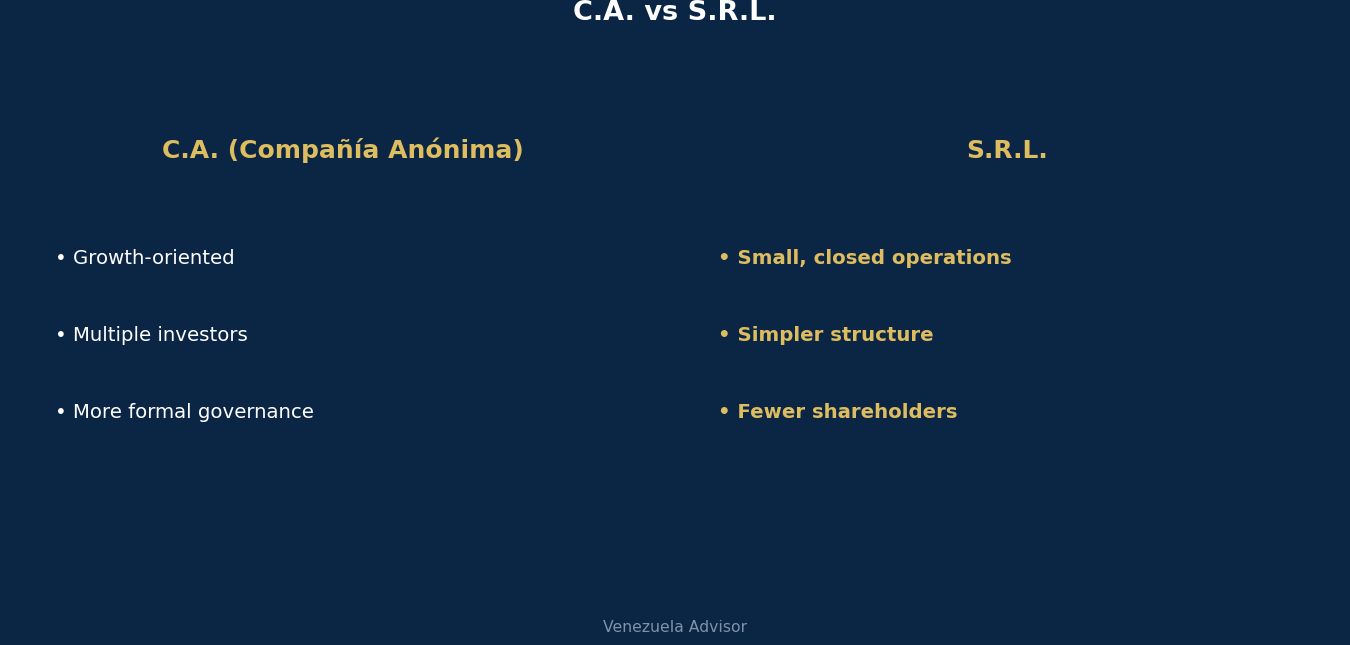
The two most common corporate structures in Venezuela are the Compañía Anónima (C.A.) and the Sociedad de Responsabilidad Limitada (S.R.L.). The C.A. is the more common choice for businesses with growth ambitions or multiple investors, while the S.R.L. tends to suit smaller, closed operations with fewer shareholders and simpler governance needs. Neither structure is inherently better — the right choice depends entirely on your specific business plan and how you expect ownership to evolve over the next several years.
Why most foreign entrepreneurs default to a C.A.
Beyond its formal governance structure, the C.A. is generally the more recognizable entity type to banks, suppliers, and potential partners, which can matter more than its added administrative overhead if you plan to raise capital, bring in additional investors, or scale beyond a single founder's operation. Most of the foreign-owned businesses we've helped structure in Venezuela have opted for a C.A. specifically for this reason, even when the initial operation is modest. Banks in particular tend to have more established processes for C.A. accounts, simply because they're more common, which can translate into a somewhat smoother account-opening experience than an equally well-documented S.R.L. might face. This pattern holds across most of the sectors we work with, from real estate holding companies to service businesses to import-oriented operations.
When an S.R.L. makes more sense
If you're setting up a small, closely held operation — a single-location retail business, a consulting practice with one or two partners — the S.R.L.'s simpler governance can reduce both setup complexity and ongoing administrative burden. The tradeoff is that it's generally less suited to bringing in outside investors later, so it's worth considering your growth trajectory before defaulting to the simpler option purely for convenience. Converting from one structure to the other after formation is possible but adds cost and complexity that's easily avoided by making the right choice from the start. If you're genuinely uncertain which fits your plans, discussing both scenarios explicitly with your attorney before drafting anything is far cheaper than converting structures later.
2–3. The six-step registration process
Each step in this sequence depends on the one before it, which is why attempting to parallelize the process — starting the bank application before the RIF is issued, for instance — usually creates more delay than it saves. Think of it less as six independent tasks and more as a single chain where the weakest link determines your overall timeline.
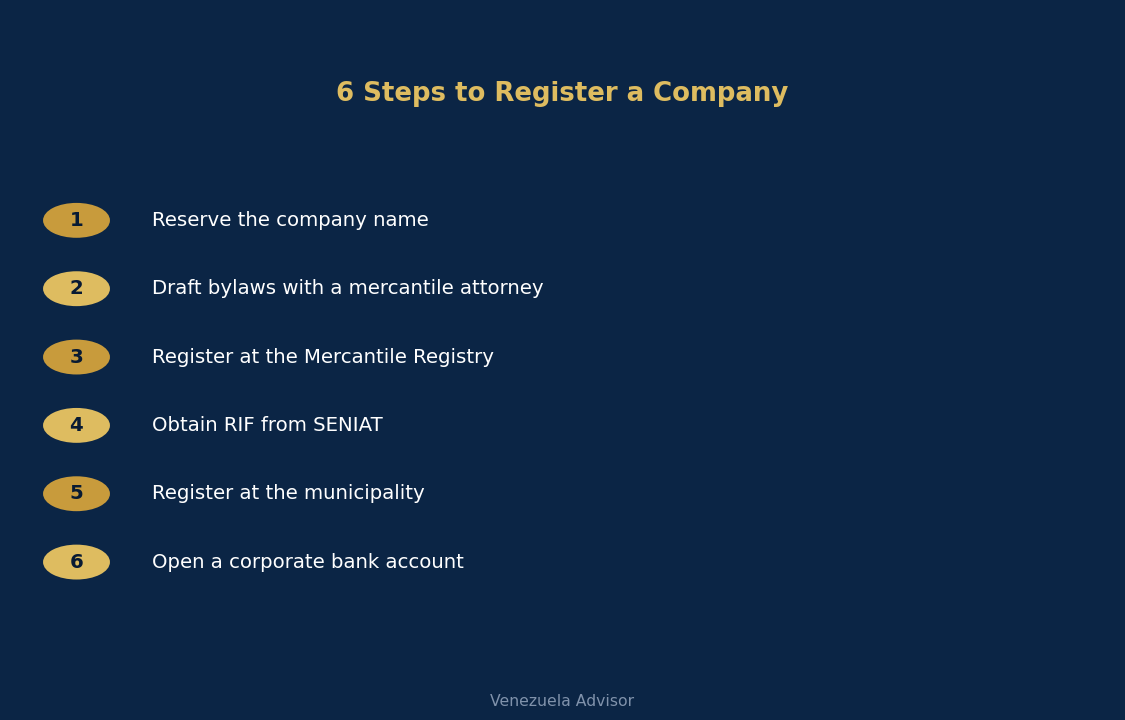
- Reserve the company name with the relevant Mercantile Registry, confirming it isn't already in use.
- Draft the bylaws (documento constitutivo) with a mercantile attorney, defining corporate purpose, capital, and shareholder structure clearly enough to avoid ambiguity later.
- Register at the Mercantile Registry of the jurisdiction where the company will operate.
- Obtain the RIF (Registro de Información Fiscal) from SENIAT, the tax authority whose fiscal address requirement was already flagged in the documents section above.
- Register at the municipality for local economic activity licensing, a step whose specific requirements can vary noticeably from one municipality to another.
- Open a corporate bank account — a step that can take longer than the registration itself, depending on the bank and documentation required, as discussed in more detail below.
Choosing the right Mercantile Registry for step three matters more than founders often expect — some registries in high-demand jurisdictions carry longer processing queues than others, and your attorney's recent experience with the specific office you'll use is often more valuable than general knowledge of the process nationwide.
Who does what: attorney, accountant, and you
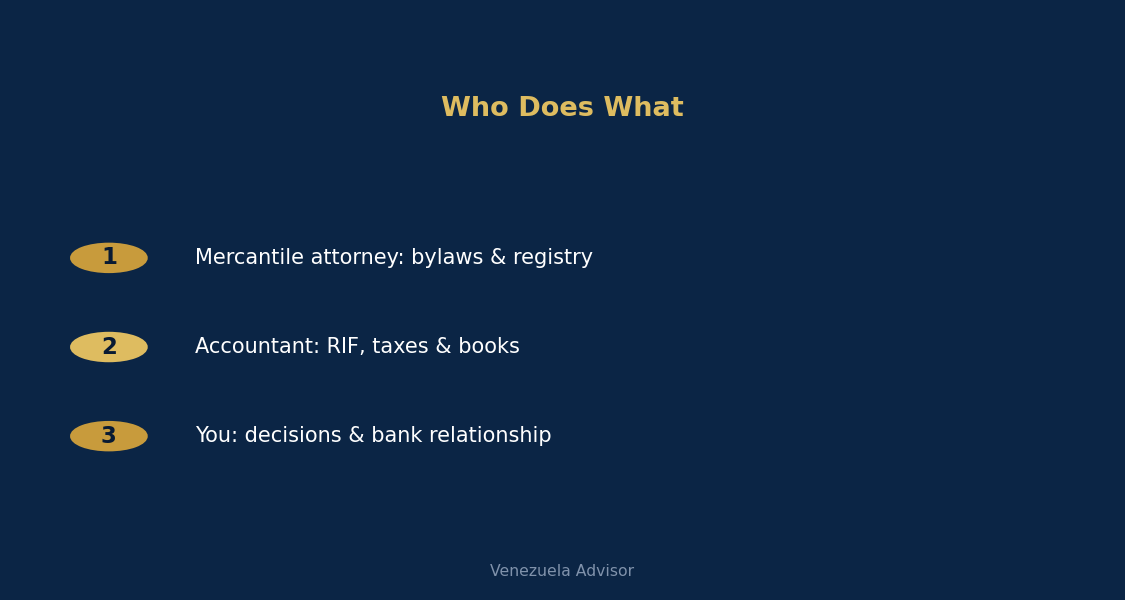
A common source of delay is unclear division of responsibility between the professionals involved. Your mercantile attorney handles the legal formation — bylaws, registry filing, corporate documentation. A separate accountant, ideally engaged from day one rather than after formation, handles the RIF application, ongoing bookkeeping obligations, and tax filing calendar. You retain final decision authority and, crucially, the direct relationship with whichever bank you choose for the corporate account.
We've seen founders assume their attorney would also handle accounting setup, or that their accountant would follow up on registry filings, simply because no one explicitly assigned those tasks. Writing down who owns each step — even in a simple shared document — before the process begins removes this ambiguity entirely, and takes far less time than untangling a missed step discovered weeks later. This same principle, incidentally, applies just as directly to real estate transactions, where the same kind of unclear handoff between a real estate agent and an attorney causes a similar share of avoidable delays.
4. Documents a foreign entrepreneur needs in advance
Gathering these three items before you begin — rather than mid-process — is the single easiest way to compress the overall timeline, since document delays are consistently the largest source of avoidable friction we see. Each one has its own lead time worth planning around: apostilles can take days to weeks depending on the issuing country, and a personal RIF requires a Venezuelan fiscal address, which itself may require coordination with your attorney before you can even apply.
- Apostilled passport, original and notarized copy.
- Notarized power of attorney, if acting through a local representative.
- Personal RIF, a prerequisite to appearing as a shareholder or partner.
Entrepreneurs who begin gathering these documents before deciding on final business details — rather than treating documentation as a final step before filing — consistently move through the six-step process faster, simply because nothing is waiting on a document that could have been in hand weeks earlier.

5. Costs and timeline to budget
Beyond attorney fees, budget for registration duties, publication costs where applicable, and administrative time — delays at any single office can extend the overall timeline even when each individual step is straightforward on its own. Attorney fees for company formation typically scale with the complexity of the bylaws and the amount of customization required, rather than a flat rate regardless of structure.
It's worth budgeting for accountant fees separately from attorney fees, since the two roles cover distinct responsibilities: the attorney gets you legally formed, while the accountant sets up the bookkeeping and tax compliance infrastructure you'll need from your very first transaction. Treating accounting as an afterthought, to be arranged once the company is already operating, tends to produce messier books than setting it up in parallel with the legal formation itself. A realistic total budget, including a reasonable contingency for the delays described throughout this guide, protects you from the frustration of running short on funds mid-process — a situation that, in company formation as in real estate closings, tends to weaken your negotiating position with any professional you're relying on to finish the work.
Why the bank account step deserves extra planning
Opening a corporate bank account is, in our experience, the step most likely to surprise founders with its timeline. Banks may request additional documentation beyond what the registration process itself required — proof of the beneficial owner's identity, a description of expected transaction volume, sometimes an in-person visit by a company representative. Starting this process the moment your RIF is issued, rather than waiting until registration fully closes, saves real time overall.
Different banks also apply meaningfully different standards to foreign-owned companies, and a bank that processes domestic company accounts quickly may still take considerably longer for an entity with foreign shareholders on record. Asking your accountant which local banks have recent, positive experience specifically with foreign-owned companies — rather than choosing based on brand recognition alone — can meaningfully shorten this step.
6. Common mistakes we see
These three mistakes account for the majority of the delays we've observed in company formations we've been involved with, and all three are entirely avoidable with the right advance planning.

Skipping the name reservation step
Some founders draft complete bylaws around a company name before confirming it's actually available, only to discover a conflict at filing and having to redo the paperwork with a new name. This single mistake alone can add several weeks to a process that would otherwise have taken far less time, simply because it requires reworking documents that had already been finalized and, in some cases, already submitted.
Using a generic bylaws template
Bylaws copied from an online template rarely reflect the specific governance structure, capital arrangement, or shareholder agreements that actually apply to your business, and registries increasingly scrutinize documents that appear boilerplate. Beyond the risk of rejection, generic bylaws can also fail to address situations specific to your business — how decisions get made if shareholders disagree, what happens if a partner wants to exit — that only surface as real problems months or years after formation, when they're far more expensive to resolve than they would have been to address in the original drafting.
Delaying the bank account application
As discussed above, this step alone can take longer than everything else combined — starting it as early as your RIF allows is one of the highest-leverage decisions in the entire process. Founders who treat the bank account as a final formality, to be handled once everything else is complete, consistently end up waiting the longest overall, purely because they started this particular clock later than they needed to.
An attorney with recent, specific experience in the exact registry you'll be using consistently outperforms one working from general knowledge of the process — reducing delays more than any procedural shortcut could.
Glossary
Documento constitutivo: the founding bylaws document filed with the Mercantile Registry.
RIF: Registro de Información Fiscal, Venezuela's tax ID, required for both individuals and companies.
Mercantile Registry: the public registry where corporate formation documents are filed and made legally effective.
Beneficial owner: the individual who ultimately owns or controls a company, a detail banks increasingly require during corporate account opening regardless of the formal shareholder structure on paper.
Corporate purpose clause: the section of the bylaws defining exactly what business activities the company is authorized to conduct, which some sectors require to include specific regulatory language.
A brief note on sector-specific requirements
Certain business sectors — food service, healthcare, financial services, import/export — carry additional licensing requirements beyond the general company formation process described in this guide. If your business falls into one of these categories, confirm sector-specific requirements with your attorney before finalizing your bylaws, since some sectors require specific language in the corporate purpose clause that's easier to include correctly the first time than to amend later.
This is particularly relevant for entrepreneurs considering ventures like the restaurant concepts described in our broader guide series, where health permits and municipal licensing add a layer of process beyond standard company registration — worth planning for from the outset rather than discovering partway through. Import/export businesses face a similar situation: the general formation process described above is necessary but not sufficient, and the additional registrations required to actually move goods across the border should be planned in parallel with, not after, company formation.
Key takeaways
- Choose your structure (C.A. or S.R.L.) based on growth plans and shareholder count, not just simplicity.
- The process combines mercantile, fiscal, and municipal steps that must be completed in order.
- A foreigner can be a shareholder, but needs an apostilled passport and personal RIF beforehand.
- Budget weeks, not days, and choose an attorney with recent experience in your specific registry.
- Start the bank account process as soon as your RIF is issued — it's typically the longest single step.
- Assign clear, separate roles to your attorney, accountant, and yourself from the very first week.
- Check sector-specific licensing requirements before finalizing your bylaws, not after formation is complete.
If you're planning to start a business in Venezuela, we can connect you with mercantile attorneys and accountants experienced in exactly this process, coordinated from day one rather than brought in piecemeal as issues arise. The businesses that move through this process fastest are consistently the ones that treat it as one coordinated project from the start, rather than six separate errands handled by whoever happens to be available.