
Financial Instruments for Venezuelans Abroad: 5 Practical Options and Where Real Estate Really Fits

By: Venezuela Advisor — Published 2026 · Share
- 1. Why your country of residence changes everything
- 2. Options typically available outside Venezuela
- A note on currency risk across your full portfolio
- 3. Instruments inside Venezuela: what we can and can't confirm
- 4. The principle that protects you most: diversification
- How much should actually go toward Venezuela?
- 5. Before you move any capital
- Building your professional team across two countries
- Glossary
- Questions we hear most often from clients abroad
- Key takeaways
1. Why your country of residence changes everything
A Venezuelan living in the United States, Spain, or Colombia has access to radically different financial instruments — and different from what's accessible operating directly inside Venezuela. There's no single answer to "where should I invest": your tax residency, immigration status, and the financial regulation of your country of residence determine your real options before the eventual destination of the capital even enters the conversation. We open with this point deliberately, because most of the confusion we see in client conversations traces back to applying advice meant for one residency situation to a completely different one.
United States residents
Venezuelans with US tax residency generally have the broadest menu of regulated brokerage options, but also the most complex reporting requirements — including obligations tied to foreign accounts and foreign real estate that don't apply to someone investing purely domestically. A US-based accountant familiar with foreign asset reporting is worth the cost before any Venezuela-related transaction of meaningful size, and this is one area where the cost of getting it wrong — penalties for unreported foreign assets — can dwarf the fee for getting proper advice up front.
Spain and the European Union
Spanish tax residency brings its own wealth-reporting requirements (notably declarations of foreign assets above certain thresholds) that are frequently overlooked by Venezuelans who assume EU rules mirror US ones. The specific thresholds and forms are worth confirming with a Spanish tax advisor rather than assumed from general knowledge of EU regulation, since penalties for non-disclosure in Spain have historically been treated seriously and specific rules vary meaningfully from one EU country to the next despite the shared regulatory bloc.
Colombia and other Latin American countries
Venezuelans resident in Colombia or elsewhere in the region often have more streamlined paths to move capital toward Venezuela, given geographic and cultural proximity, but should still confirm local reporting obligations — regional proximity doesn't exempt anyone from formal disclosure requirements where they apply. Several of our clients based in Bogotá or Panama City have found that the shorter travel distance also makes the in-person site visits recommended throughout this guide series meaningfully easier to schedule than for clients based further afield.
2. Options typically available outside Venezuela
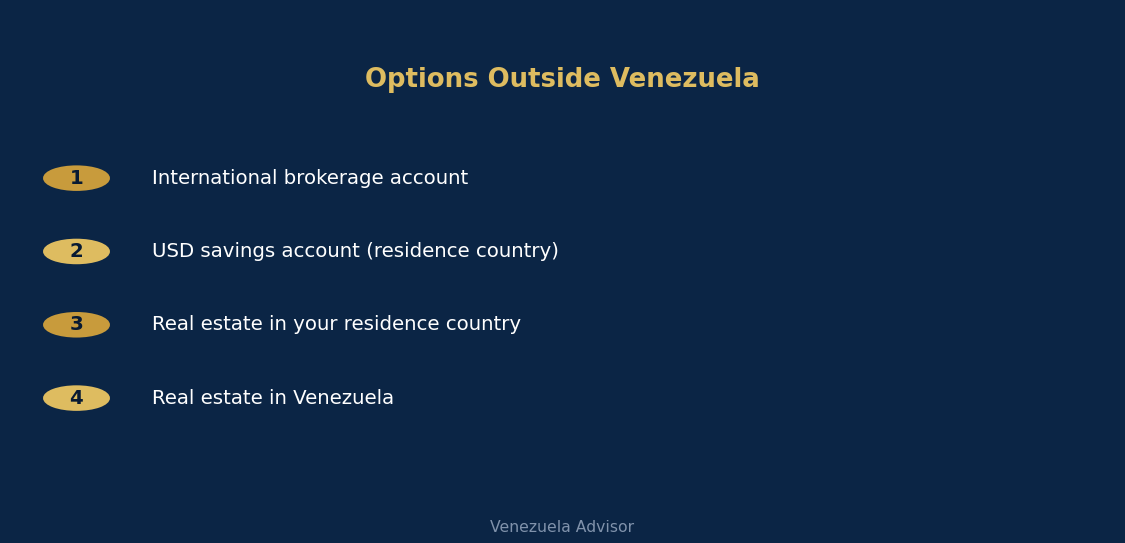
The table below summarizes the most common instruments we discuss with clients, roughly ordered from most liquid and globally diversified to most Venezuela-specific. None of these is inherently superior to the others in the abstract — the right combination depends entirely on the goals and constraints specific to your situation.
| Instrument | Best for |
|---|---|
| International brokerage account (stocks, bonds, ETFs) | Global market exposure independent of Venezuela's situation |
| USD savings account in country of residence | Value preservation while you decide on a longer-term destination |
| Real estate in country of residence | Geographic diversification without direct Venezuela exposure |
| Real estate in Venezuela | Diversification into a market with low entry prices, as part of a wider portfolio — not the whole of it |
A note on currency risk across your full portfolio
An easy mistake, once you're holding assets across multiple countries, is to evaluate each one's currency risk in isolation rather than looking at your total exposure. A US-based investor with dollar-denominated Venezuelan real estate, dollar savings, and a dollar brokerage account has effectively no currency diversification at all, despite holding assets in two countries — everything moves together against a single reference currency. A Spain-based investor holding the same assets, by contrast, is running a genuine multi-currency exposure between euros and dollars that deserves its own explicit consideration, separate from the country-diversification benefits already discussed above.
This distinction matters because "diversification" is sometimes used loosely to mean simply "more than one asset," when the more useful question is whether those assets actually respond differently to the same economic shocks. Two dollar-denominated assets in two different countries reduce your country-specific risk, but not your dollar-specific risk — a nuance worth discussing explicitly with whichever advisor helps you set your overall allocation.
3. Instruments inside Venezuela: what we can and can't confirm
What we can say with confidence is structural rather than specific: any domestic Venezuelan instrument you consider should be evaluated against the same questions you'd apply to a domestic instrument anywhere — is the intermediary regulated, what happens to your capital if the intermediary fails, and how liquid is the instrument if you need to exit before your original horizon. These questions matter more, not less, in a market where regulatory continuity has been historically less predictable than in more established financial centers, and asking them explicitly, in writing, is a reasonable expectation to set with any intermediary you're evaluating.
Real estate as the most tangible domestic instrument
For most of our clients, Venezuelan real estate ends up being the most tangible — and most thoroughly documented in this guide series — domestic instrument available, precisely because it doesn't depend on the continuity of a specific financial intermediary the way a brokerage account does. A deed, once properly registered as described in our buying guide, exists independently of any single institution's ongoing operation. This durability is part of why real estate features so heavily in diaspora portfolio conversations, even among clients who are otherwise quite conservative about domestic Venezuelan financial exposure more broadly.
4. The principle that protects you most: diversification
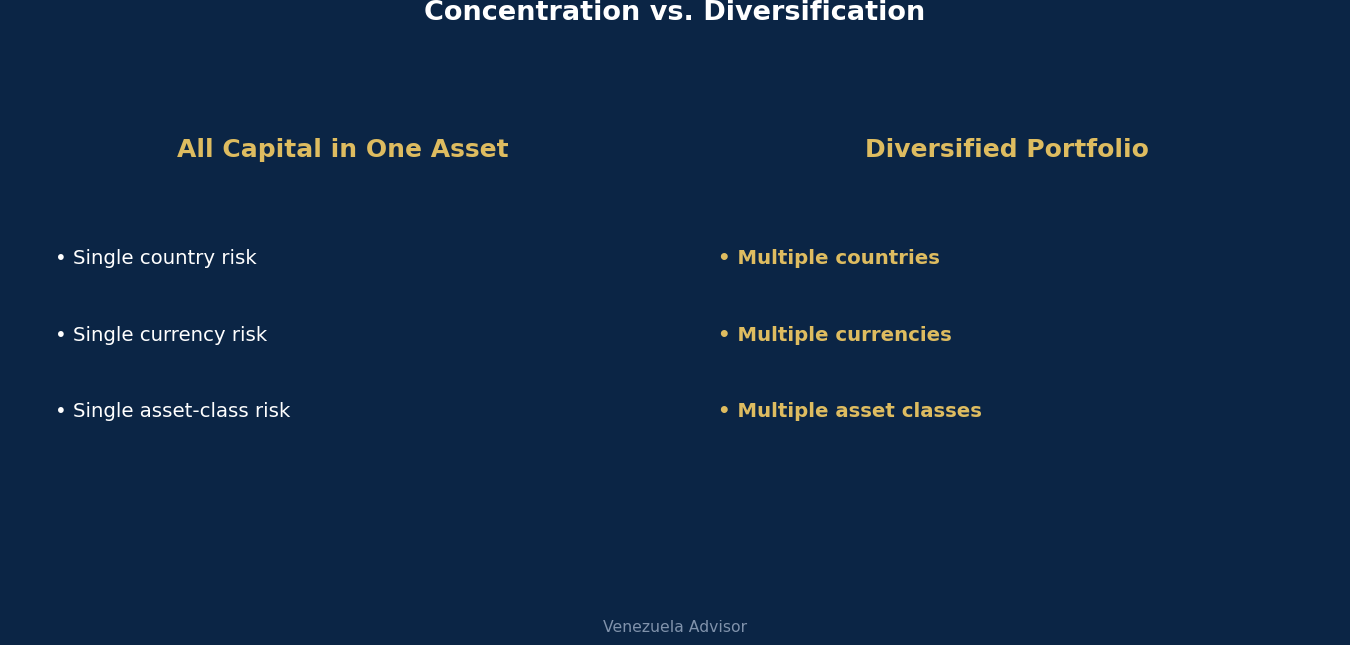
Regardless of the specific instrument you choose, the principle that most consistently protects a diaspora investor is not concentrating all wealth in one country, one currency, or one asset class. Venezuelan real estate can — and in our experience, should — be part of a diversification strategy, never the entirety of it.
How much should actually go toward Venezuela?
There's no universal percentage that fits every investor, but a framework we've found useful as a starting point for conversation — not a personalized recommendation — treats Venezuela exposure as one slice of a broader portfolio rather than its foundation.
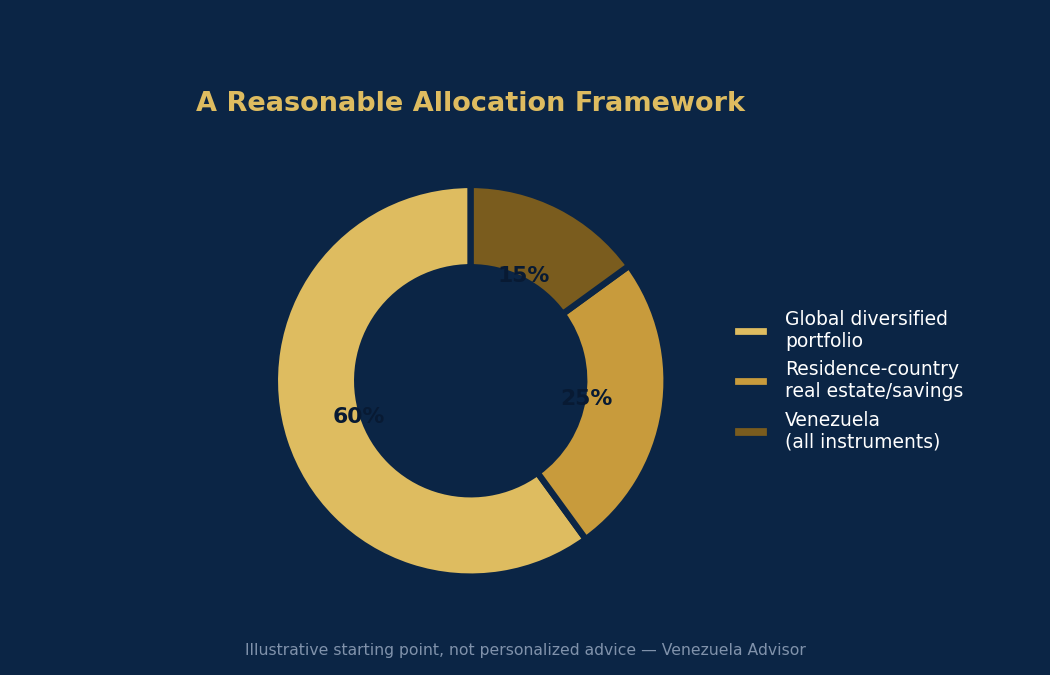
Where you land within — or outside — that illustrative split depends on factors specific to you: your age and time horizon, your existing exposure to Venezuela through family or property already owned, and your tolerance for the country-specific risks described throughout this guide series. A financial advisor familiar with your full picture, not a generic percentage from an article, should ultimately set your specific target. A 28-year-old just beginning to build wealth abroad, a 55-year-old planning an eventual return, and a 70-year-old primarily concerned with an inheritance for children still in Venezuela will each reasonably land in very different places within — or well outside — this illustrative range, and that variation is appropriate rather than a sign that one of them is doing it wrong.
5. Before you move any capital
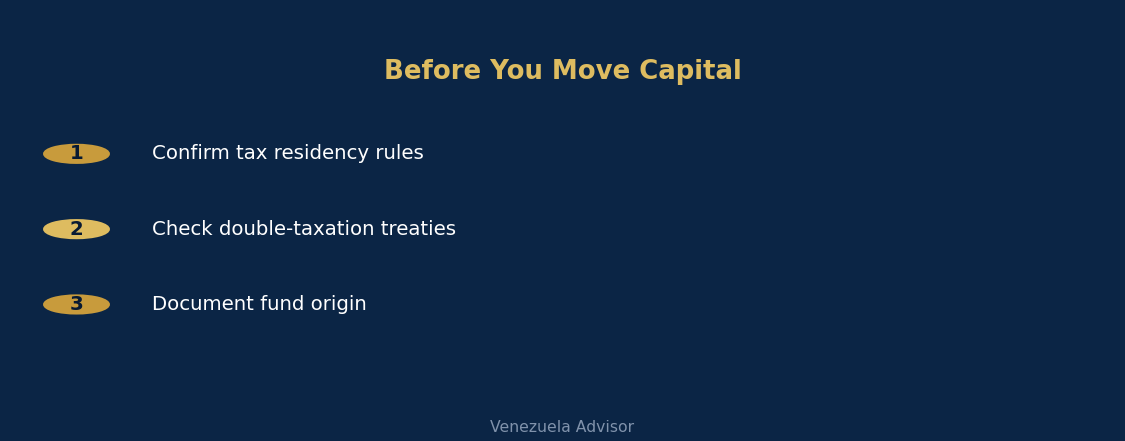
These three checks apply regardless of which instrument or destination you've chosen, and each one protects against a different kind of problem — fiscal, legal, and documentary — that becomes far harder to resolve after the fact than before it.
- Confirm your tax situation in your country of residence — some countries tax foreign-source income and capital gains differently than domestic-source income, and this distinction alone can meaningfully change the after-tax return on the same nominal investment.
- Check whether a double-taxation treaty relevant to your situation exists between your country of residence and Venezuela — and if one exists, understand which specific income types it actually covers, since coverage is often narrower than investors initially assume.
- Document the origin of funds before any significant transfer to or from Venezuela — this protects you both fiscally and during an eventual property closing, as described in our Caracas buying guide, and a documentation habit built early is far easier to maintain than one assembled retroactively under time pressure.
Building your professional team across two countries
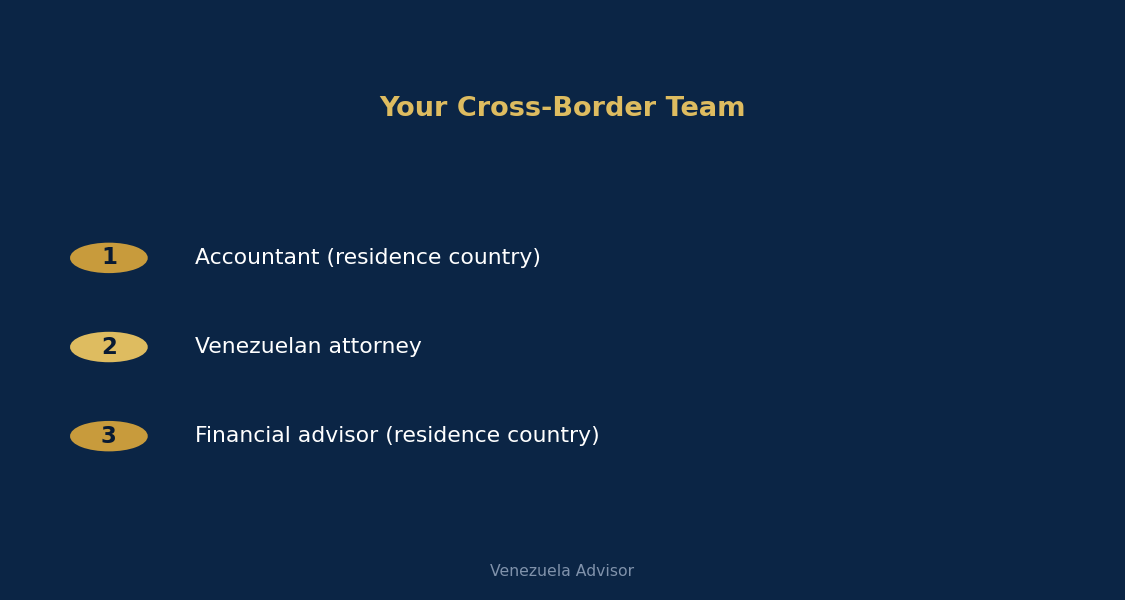
The single most common structural mistake we see isn't a bad instrument choice — it's relying on only one professional to advise across two completely different regulatory systems. An excellent Venezuelan attorney typically isn't positioned to advise on your US or Spanish tax exposure, and your residence-country accountant typically doesn't know Venezuelan property or transfer regulations. You need both, coordinated, rather than expecting either one alone to cover the full picture.
In practice, coordination means more than simply having both professionals' contact information. It means each one understands the other's role well enough to flag when a decision on their side has implications on the other — your Venezuelan attorney recognizing when a transaction structure might create an unexpected tax event back home, or your residence-country accountant understanding enough about Venezuelan closing costs to help you plan cash flow accurately around the timeline described in our closing costs guide. Few professionals naturally think this way unless the relationship is set up to encourage it from the start.
Glossary
Diversification: spreading capital across multiple countries, currencies, or asset classes to reduce concentrated risk.
Double-taxation treaty: an agreement between two countries that prevents the same income from being taxed twice.
Tax residency: the country where you're legally obligated to report and pay tax on your worldwide or local income, which may differ from your citizenship or physical location.
Currency exposure: the degree to which the value of your total holdings moves with a single reference currency, regardless of how many countries those holdings are spread across.
Questions we hear most often from clients abroad
"Should I wait for a better exchange rate before moving capital?"
Because most Venezuelan real estate transactions are dollar-denominated, as described in our dollarization guide, this question matters less than it would in a bolívar-priced market. Your bigger timing consideration is usually the property market itself, not a bolívar exchange rate that has limited bearing on a dollar-to-dollar transaction. Clients coming from markets where currency timing genuinely matters for real estate sometimes bring that instinct into a Venezuelan transaction where it doesn't apply in the same way, and it's worth explicitly resetting that expectation early in the process.
"Is it better to buy in cash or wait to build up more capital?"
Since mortgage financing isn't realistically available to foreign buyers, this is really a question about opportunity cost: capital sitting in a low-yield account while you wait versus capital deployed into an asset with the appreciation and rental potential described in our neighborhood guide. There's no universal right answer, but it's worth running the comparison explicitly rather than defaulting to "wait" out of general caution, since the entry prices described throughout this guide series don't necessarily hold indefinitely as the broader market continues to stabilize.
"Can I invest in Venezuela without ever visiting?"
Technically, parts of the process can be handled remotely with power of attorney arrangements, but we generally discourage completing an entire purchase without at least one in-person visit to the property and the professionals involved. Photographs and video calls simply can't substitute for walking through a building's common areas or meeting your attorney face to face before entrusting them with a significant transaction. Clients who have skipped this step, in our experience, are also the ones most likely to discover a mismatch between expectations and reality only after the transaction is already complete and much harder to unwind.
Key takeaways
- Available financial instruments depend heavily on your country of residence, more than on your Venezuelan nationality.
- Geographic and instrument diversification more reliably protects total wealth than betting everything on a single asset.
- Your personal tax situation in your country of residence should be reviewed before moving capital, not after.
- An illustrative allocation framework can start the conversation, but your specific target should come from an advisor who knows your full financial picture.
- Build a coordinated professional team spanning both your residence country and Venezuela — no single advisor typically covers both sides well.
If you're weighing Venezuelan real estate as part of a broader diversification strategy, we can help you think through how it fits alongside the other instruments available to you, and connect you with the right professionals on both sides of the transaction.