
Crypto in Venezuela: 6 Real Uses, Risks and Opportunities Every Investor Should Understand
By: Venezuela Advisor — Published 2026 · Share
- 1. Why Venezuela adopted crypto before most of the region
- 2. The three practical uses we actually see
- 3. What changes constantly: the regulatory framework
- 4. Risks an investor shouldn't minimize
- Crypto vs. cash vs. bank transfer: a quick comparison
- 5. Does it have a place in a real estate transaction?
- 6. Practical steps if you do use crypto in a deal
- Choosing an exchange or intermediary responsibly
- A note on taxes and reporting obligations
- Common mistakes we see with crypto-funded transactions
- Glossary
- Key takeaways
1. Why Venezuela adopted crypto before most of the region
The combination described in our de facto dollarization guide — documented hyperinflation, the bolívar's collapse as a store of value, and years of currency controls — created exactly the conditions under which stablecoins (crypto assets pegged 1:1 to the dollar, like USDT) find their most natural use case: a way to hold dollar value without depending entirely on a banking system with uneven access. Understanding this origin story matters, because it explains why crypto adoption here looks so different from the speculative narrative that dominates crypto coverage elsewhere.
This isn't a uniquely Venezuelan phenomenon — similar adoption patterns have emerged in other economies that went through severe currency crises — but Venezuela's combination of hyperinflation, capital controls, and a young, mobile-connected population accelerated the pattern earlier and more broadly than in most comparable cases. For an investor evaluating the country from abroad, this matters less as an interesting economic footnote and more as a signal: it tells you something real about how quickly this population adapts financial behavior when the traditional banking system fails to serve their needs.
2. The three practical uses we actually see
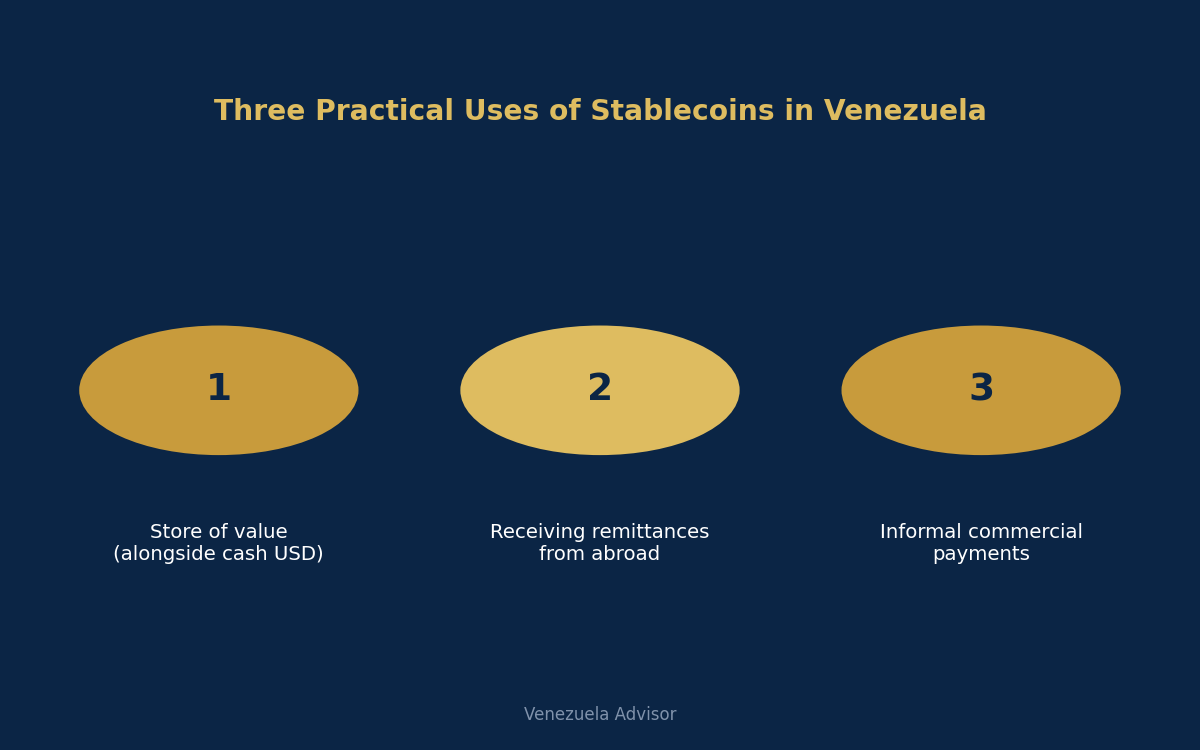
Understanding which of these three uses applies to your specific situation matters, because the risk profile and the documentation you'll eventually need differ meaningfully between them.
- Complementary store of value: alongside physical dollar cash, many people hold part of their savings in stablecoins for ease of transport and exact division of amounts.
- Receiving remittances: some families receive part of their remittances in crypto and then convert to cash locally, seeking to reduce fees compared to traditional banking channels — a strategy that pairs naturally with the disciplined saving approach in our remittances guide.
- Informal commercial payments: certain businesses and independent professionals accept USDT as a practical alternative to physical cash, especially for amounts that would be awkward to handle in bills.
What we don't see as much: speculative trading
Contrary to what outside observers sometimes assume, the dominant local use case isn't speculative trading in volatile crypto assets — it's the practical, almost boring use of dollar-pegged stablecoins as a parallel cash system. Most of the families and small business owners we've spoken with treat crypto the way they'd treat a second wallet, not an investment vehicle in its own right. This distinction matters for anyone evaluating Venezuela from outside: the crypto adoption story here is fundamentally a monetary-substitution story, not a speculative-investment story, and the risks and opportunities that follow from it are shaped accordingly.
3. What changes constantly: the regulatory framework
This regulatory uncertainty isn't unique to Venezuela — most countries are still actively developing their crypto regulatory frameworks — but the pace and unpredictability of change in Venezuela specifically means that guidance which was accurate a year ago may no longer reflect the current rules. Building in a verification step before any significant crypto-related decision, rather than relying on information that may already be outdated, is simply prudent practice here more than in most jurisdictions.
4. Risks an investor shouldn't minimize
None of what follows should be read as a reason to avoid crypto entirely in your Venezuela-related financial planning — it's a reason to approach it with the same rigor you'd apply to any financial instrument carrying real, documented risk.
- Regulatory risk: as noted above, the rules of the game have been inconsistent over time, and what applied last year may not apply today.
- Counterparty risk: operating with informal exchanges or intermediaries without clear traceability exposes you to fraud — a risk that exists in any country but is aggravated where regulatory oversight is less predictable.
- Volatility outside stablecoins: any other crypto asset carries the typical volatility of the global crypto market, which adds to — not replaces — Venezuela-specific risk.
The specific case of counterparty risk in informal exchanges
Because much of the crypto-to-cash conversion happens through informal, peer-to-peer arrangements rather than regulated exchanges, the buyer or seller on the other end of that conversion is effectively a stranger with no institutional accountability if something goes wrong. This is meaningfully different from a bank wire, where a regulated institution stands behind the transaction. Treating a large crypto-to-cash conversion with the same caution you'd apply to any transaction with an unverified counterparty — smaller test transactions first, in-person verification where feasible — meaningfully reduces this exposure.
Crypto vs. cash vs. bank transfer: a quick comparison
| Method | Speed | Traceability | Best for |
|---|---|---|---|
| Physical USD cash | Immediate | None | Small, local transactions |
| International bank wire | Days | High | Formal real estate closings |
| Stablecoin (USDT) | Minutes | Variable, depends on exchange used | Remittances, informal commerce |
Notice that no single method wins on every dimension. The right choice depends on what you're optimizing for in a given transaction: speed favors stablecoins, legal defensibility favors bank wires, and immediate liquidity favors cash. Most of the clients we work with end up using more than one of these methods across the lifecycle of a single property purchase — crypto or remittances to accumulate savings, then a bank wire for the actual closing.
5. Does it have a place in a real estate transaction?
We've seen informal transactions in the Venezuelan real estate market involve crypto assets as part of the fund transfer process. Our recommendation, without exception, is that any transaction of this kind should first go through rigorous legal and compliance review: the buyer must be able to clearly demonstrate the origin, conversion, and final destination of the funds before any serious attorney will agree to incorporate it into a deed, per the documentation standards described in our Caracas buying guide. Skipping this step to save time almost always costs more time later, once a notary or registrar raises a question the buyer wasn't prepared to answer.
In practice, we've found it far more common — and far cleaner from a legal standpoint — for buyers to convert crypto holdings into a traditional bank transfer well before the transaction begins, rather than attempting to route the closing itself through crypto. This adds a step, but it also means your attorney is working with a fund flow that any notary and registry office in Caracas already knows how to process without raising questions. The extra week or two this conversion step takes is, in nearly every case we've seen, a far better trade than the delays and complications that arise from asking a notary's office to process an unfamiliar fund structure mid-closing.
6. Practical steps if you do use crypto in a deal
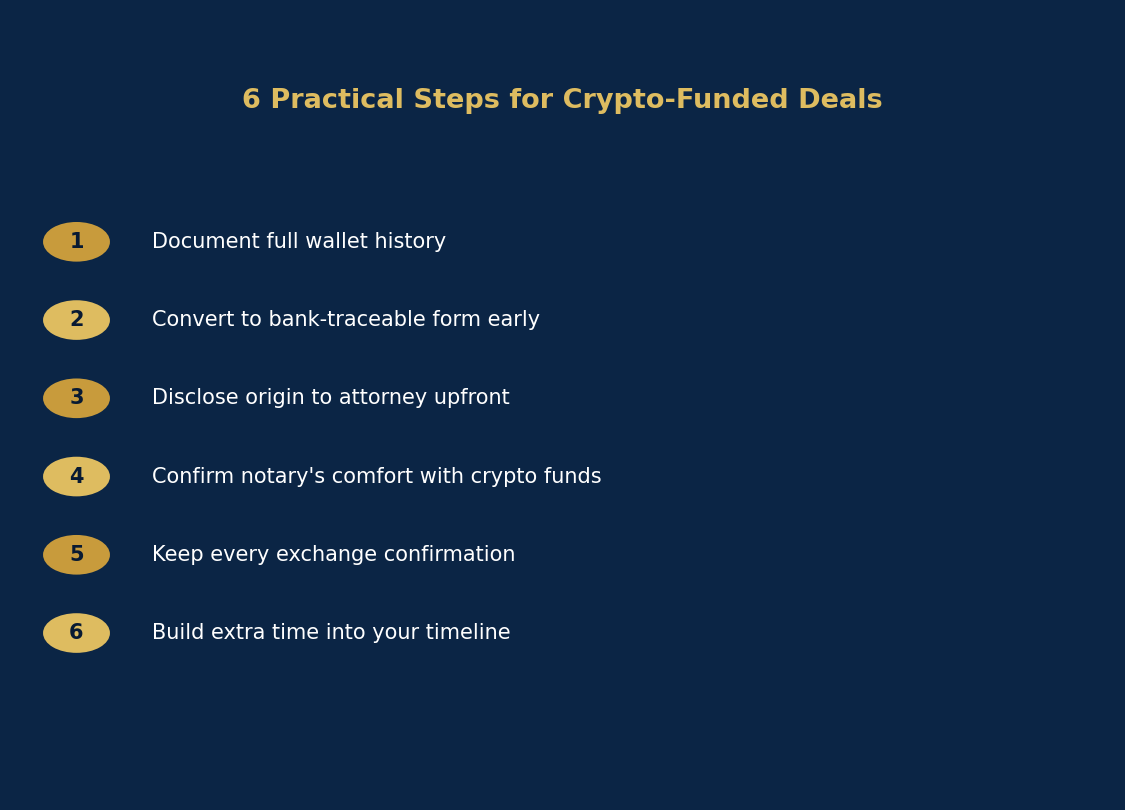
- Document the full transaction history of the wallet used, not just the final transfer.
- Convert to a bank-traceable form before the funds reach the seller, where possible.
- Disclose the crypto origin to your attorney upfront — never let it surface for the first time at closing.
- Confirm whether the specific notary or registry office has any informal reluctance around crypto-sourced funds before you're mid-transaction.
- Keep screenshots and exchange confirmations for every conversion step, not just the final bank deposit — attorneys and, if relevant, tax authorities may ask for the full chain later.
- Build in extra time in your closing timeline specifically to accommodate the conversion step, rather than assuming it will happen as quickly as a same-day cash transaction.
Choosing an exchange or intermediary responsibly
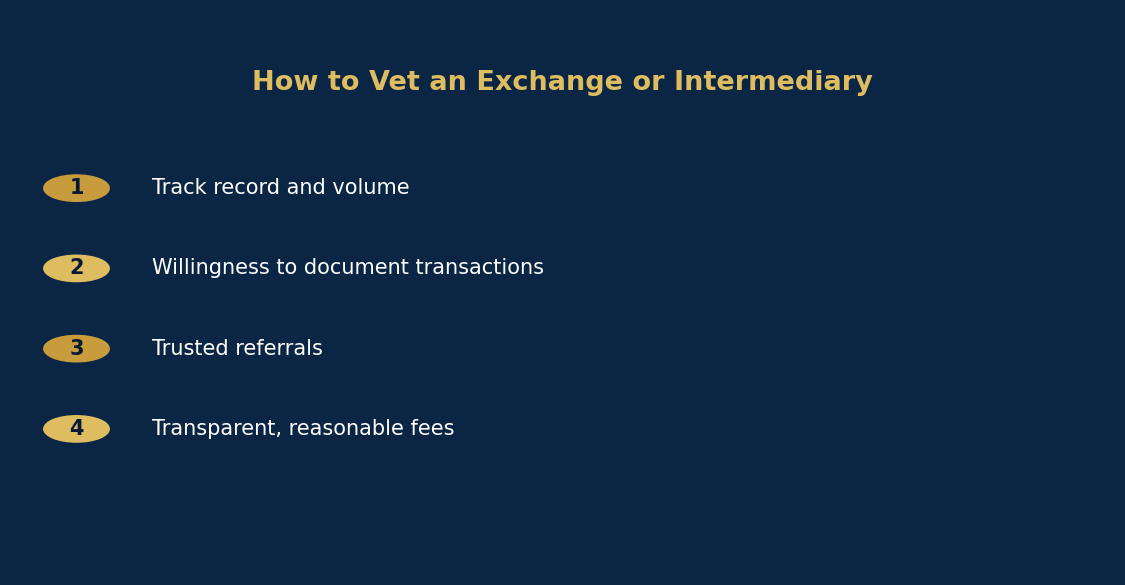
Not every platform offering crypto-to-cash conversion in Venezuela operates with the same level of transparency or accountability. A few practical filters help separate more reliable intermediaries from riskier ones:
- Track record and volume: an intermediary with years of consistent, high-volume operation carries different risk than one that appeared recently with no verifiable history.
- Willingness to document the transaction: a legitimate intermediary won't hesitate to provide a transaction receipt or confirmation; reluctance to document is itself a warning sign.
- Reputation among people you already trust: a referral from someone who has used the same intermediary repeatedly, without incident, is worth more than any marketing claim the platform makes about itself.
- Reasonable, transparent fees: a rate that seems unusually favorable compared to every other option available is worth treating with suspicion rather than excitement — it's often a sign the platform is compensating for something else, whether liquidity risk or outright unreliability.
Glossary
Stablecoin: a crypto asset designed to maintain a fixed 1:1 value against a reference currency, most commonly the US dollar.
USDT: Tether, the most widely used dollar-pegged stablecoin in informal Venezuelan transactions.
Counterparty risk: the risk that the other party in a transaction — an exchange, an individual — fails to fulfill their side of the deal.
Peer-to-peer (P2P) exchange: a direct transaction between two individuals converting crypto to cash or vice versa, typically without a regulated institution intermediating.
A note on taxes and reporting obligations
Depending on where you're tax resident, converting crypto to cash — or holding significant crypto value — may carry reporting obligations that have nothing to do with Venezuela specifically but that are easy to overlook when the funds' ultimate destination is a foreign real estate purchase. This is worth raising with your accountant in your country of residence before, not after, any large conversion, precisely because the paper trail your Venezuelan attorney needs and the reporting your home tax authority expects are two separate requirements that both need to be satisfied.
Many countries have introduced or tightened crypto reporting requirements in recent years, and the specific thresholds and forms involved change often enough that guidance from even a year or two ago may no longer be current. Treat this the same way we recommend treating Venezuela-specific regulatory questions in this guide: verify with a qualified professional before acting, rather than relying on general assumptions about how crypto is taxed.
Common mistakes we see with crypto-funded transactions
Assuming anonymity protects you
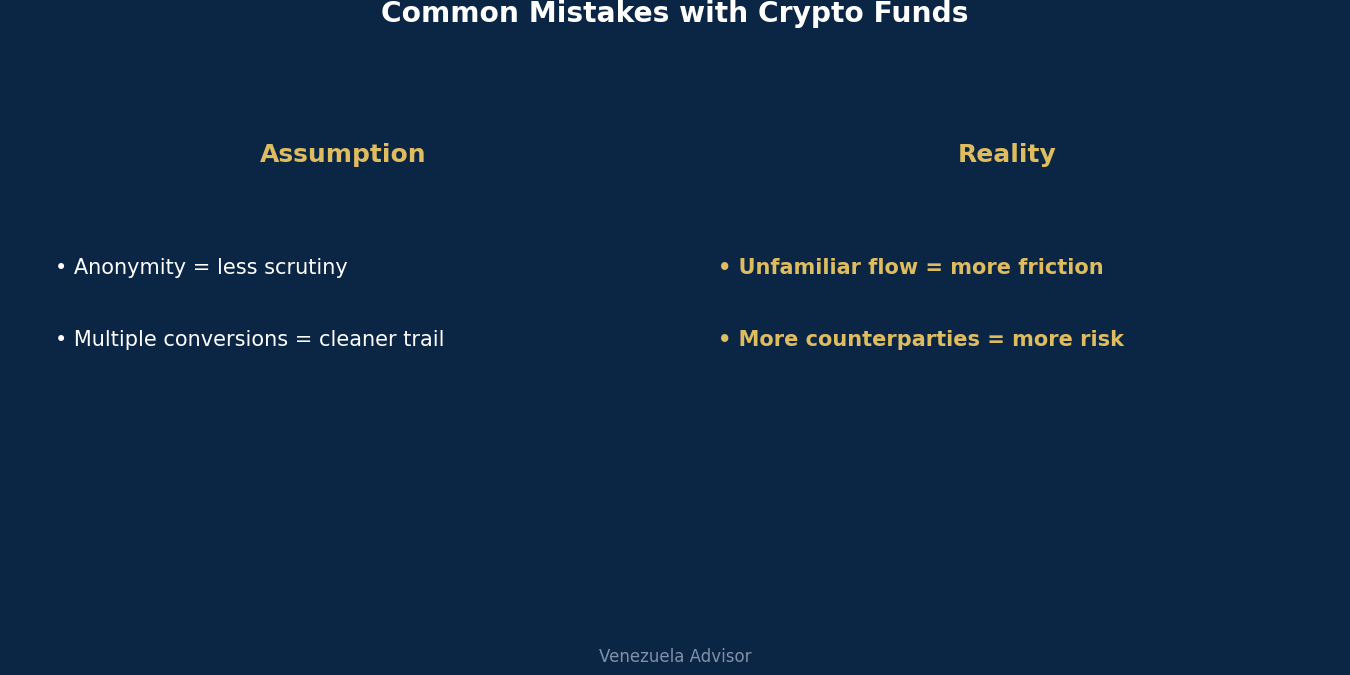
Some buyers assume that because crypto transactions can feel less visible than a bank wire, they face less scrutiny during a real estate closing. In practice, the opposite is often true: a fund flow your attorney can't easily explain to a notary or registrar creates more friction, not less, precisely because it's unfamiliar to the professionals processing your transaction.
Converting through multiple intermediaries to "clean" the trail
Routing funds through several conversions or intermediaries to obscure their origin doesn't simplify your documentation — it multiplies the number of counterparties whose reliability you're now depending on, and makes the eventual paper trail harder, not easier, to present coherently to your attorney.
Waiting until closing to mention crypto involvement
The single most avoidable mistake in this category: a buyer who reveals crypto-sourced funds only when the attorney asks pointed questions during due diligence, rather than disclosing it from the first planning conversation. Attorneys can structure around a known crypto component far more effectively than they can react to one discovered mid-transaction, when timelines and expectations are already set.
Key takeaways
- Stablecoins serve a documented practical role in the Venezuelan economy today, not just speculation.
- The regulatory framework changes frequently; confirming current rules before operating is not optional.
- For real estate, any crypto-sourced funds require reinforced documentation and legal review from the very first conversation with your attorney.
- Converting crypto to a traditional bank transfer well before closing is generally cleaner than attempting to route the transaction itself through crypto.
- Choose intermediaries with a verifiable track record and a willingness to document transactions, not simply the platform offering the best rate.
- Confirm your home-country tax reporting obligations on crypto conversions separately from the Venezuelan documentation your attorney requires.
If your funds for a Venezuela property include any crypto-sourced portion, we can help you structure the documentation correctly before you approach a seller or attorney, so the transaction moves as smoothly as any conventional cash purchase.