
7 Steps to Turn Part of Your Remittances Into Real Investment Capital: A Practical Guide

By: Venezuela Advisor — Published 2026 · Share
- 1. The reality behind the average remittance
- Three sender profiles we see most often
- 2–4. The "dual remittance" idea: separating spending from investing
- 5. From $100 a month to a real down payment: the math
- 6. What can go wrong, and how to prevent it
- 7. Choosing the right transfer channel for the investment portion
- Why documentation matters even for a "family" arrangement
- A note on exchange rates and where to hold the fund
- Glossary
- Setting a realistic timeline for your family
- Key takeaways
1. The reality behind the average remittance
Family remittances are, for millions of Venezuelan households, the difference between covering the basics and not covering them. What we can state with confidence, because we've seen it consistently across the families we work with, is the usage pattern: the vast majority of that money goes, entirely understandably, toward immediate spending — food, medicine, utilities — leaving little or no room to build long-term wealth.
This isn't a criticism of how families use remittances today — covering basic needs is, and should be, the first priority. The point of this guide is narrower and more practical: for families who have some room beyond strict necessities, even a small, disciplined second stream can compound into something meaningful over a few years, without requiring any change to how the primary remittance is used. We wrote this guide after seeing the same pattern repeat across dozens of client conversations: families who assumed real estate investment was out of reach discovered, once they ran the actual numbers, that it wasn't as far away as they thought.
Three sender profiles we see most often
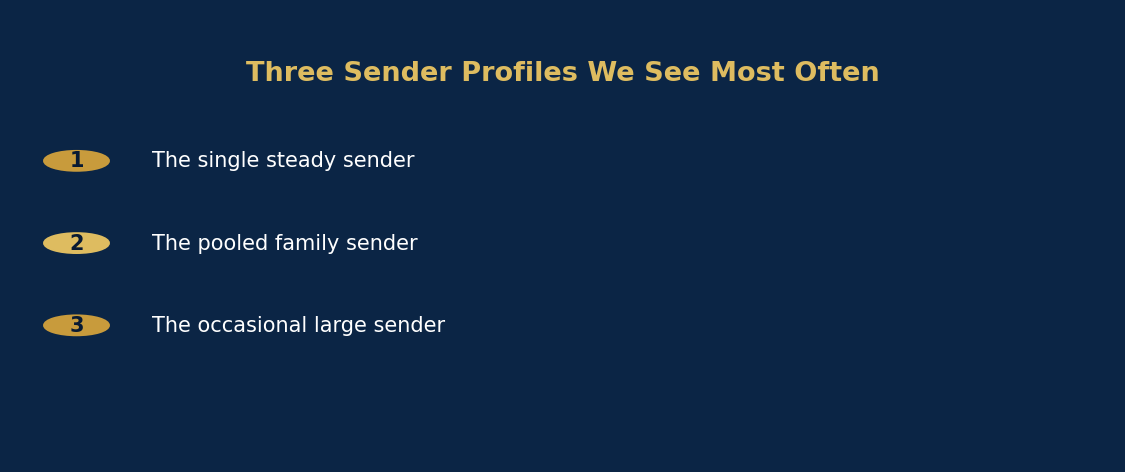
The single steady sender
A professional abroad sending a consistent monthly amount to a parent or sibling. This profile has the clearest path to a dual-remittance strategy, since the sending pattern is already predictable and simply needs a second, smaller transfer added alongside it.
The pooled family sender
Several family members abroad contributing irregularly to support one household. This profile requires more coordination — someone needs to own the "investment remittance" tracking, or it tends to dissolve into the general pool of spending money with no one accountable for the separate goal.
The occasional large sender
Someone who sends infrequent, larger amounts rather than a steady monthly flow. For this profile, the dual-remittance concept translates into designating a fixed percentage of each transfer — say 15%–20% — to the investment account, rather than a fixed dollar amount, since the sending rhythm itself is irregular.
2–4. The "dual remittance" idea: separating spending from investing
The strategy we've seen actually work for families who did build some wealth isn't sending more money — it's consciously separating two distinct flows, however small the second one is. This distinction sounds obvious stated plainly, yet in our experience it's the single most commonly skipped step among families who intend to save but never quite manage to.
- The spending remittance: covers monthly expenses, exactly as always.
- The investment remittance: a fixed amount, however modest, transferred to a separate account and never touched except for its original goal.
The discipline of keeping both flows completely separate — even in different accounts — is, in our experience, more decisive to this strategy's success than the exact monthly amount involved, and it's worth revisiting that discipline every few months as a family, not just setting it up once and assuming it will hold on its own.
Setting up the separation in practice
The mechanics matter more than they might seem. Families who succeed with this approach typically open a second account — sometimes in the receiving country, sometimes with the sender abroad — specifically labeled for the investment goal, and treat any withdrawal from it as requiring an explicit conversation between everyone involved, not a unilateral decision made under pressure of an unexpected expense.
Naming the goal changes behavior
Families who assign a specific name to the investment fund — "the Altamira fund," "the house fund" — report far less erosion of the balance over time than those who simply describe it as "extra savings." A concrete, named goal appears to function as a psychological commitment device that a vague savings label does not provide.
5. From $100 a month to a real down payment: the math
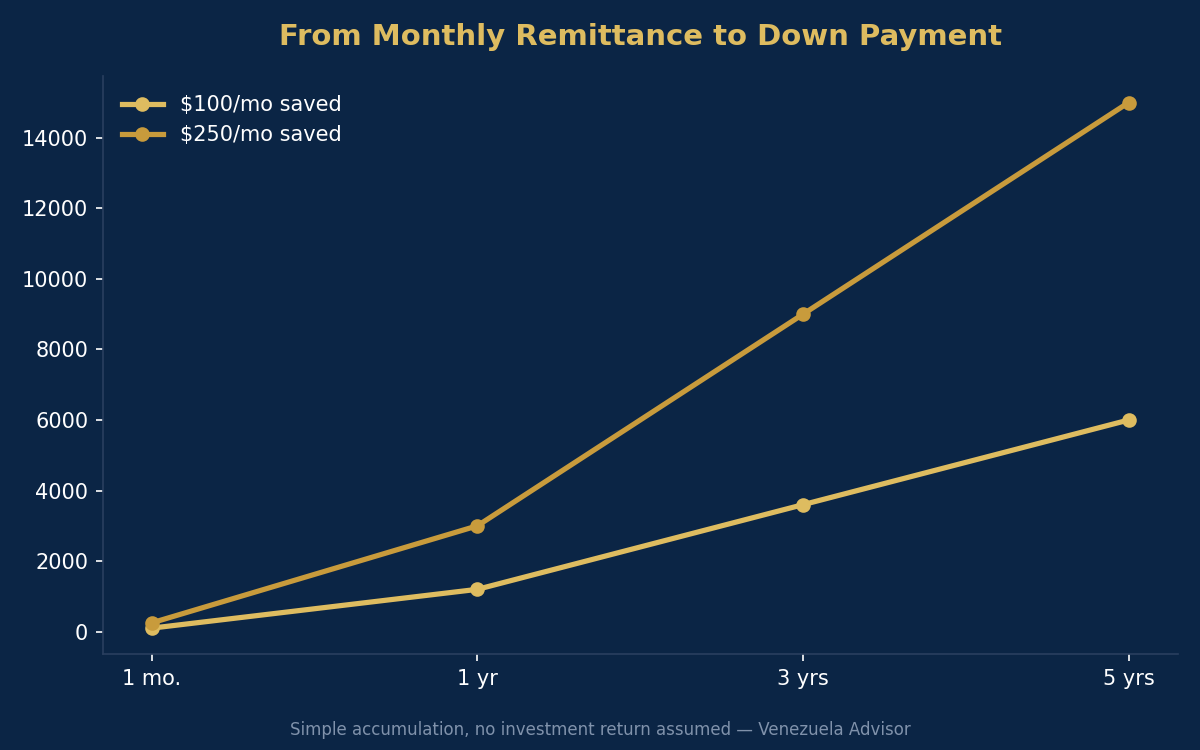
| Monthly contribution | Accumulated in 3 years | Accumulated in 5 years |
|---|---|---|
| $100 | $3,600 | $6,000 |
| $150 | $5,400 | $9,000 |
| $250 | $9,000 | $15,000 |
These figures don't include any investment return on the savings — this is simple disciplined accumulation. Even so, as our Caracas neighborhood guide shows, a $9,000–$15,000 amount is enough as a meaningful partial down payment in entry-level zones like Baruta or El Hatillo, even without mortgage financing available.
What happens if you can only manage $50 a month
Not every family can commit to $100 or more. At $50 a month, five years of disciplined saving still produces $3,000 — modest, but real, and often enough to cover a meaningful share of closing costs on an entry-level property as described in our closing costs guide, even if it doesn't fully fund a down payment on its own.
What happens if the amount grows over time
Many families start smaller and increase the investment remittance as income grows — a raise, a second job, a child finishing school. Modeling a gradual increase rather than a flat monthly amount often produces a more realistic and motivating savings trajectory than assuming a fixed contribution for five straight years.
6. What can go wrong, and how to prevent it
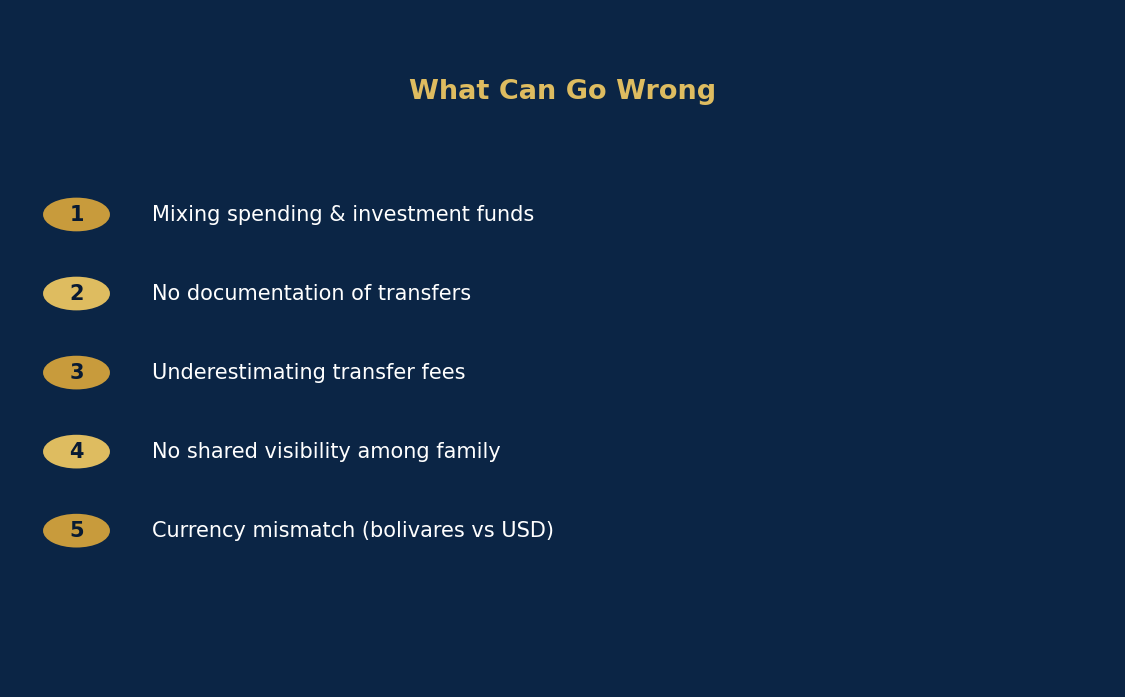
- Mixing the two flows: the temptation to use the investment fund "just this once" for an urgent expense is the most common way this plan gets abandoned.
- Not documenting the transfer channel: if the end goal is a formal real estate purchase as described in our buying guide, every transfer should be documented from month one, not reconstructed years later.
- Underestimating fees: on small, frequent transfers, percentage-based fees can erode a meaningful share of the amount — it's worth comparing the real cost of different channels before committing to one.
- No shared visibility: when only one family member abroad knows the fund exists, a change in that person's circumstances — job loss, a move, a family emergency — can quietly end the contributions without anyone else noticing until the goal is years behind schedule.
- Currency mismatch at the receiving end: if the investment fund sits in bolívares rather than dollars, inflation can erode it even while the account balance looks unchanged — keep the investment portion in dollars specifically, unlike the spending remittance, which may reasonably be converted as needed.
7. Choosing the right transfer channel for the investment portion
Not every remittance channel is equally suited to disciplined, long-term saving. A channel optimized for speed and convenience on spending remittances isn't necessarily the cheapest or most transparent one for accumulating an investment fund over years. It's worth treating this as a separate decision from your regular spending remittance provider, and comparing fee structures specifically for the smaller, recurring transfers this strategy requires.
Bank transfer vs. remittance apps
Traditional bank-to-bank transfers often carry higher flat fees that make sense for large, infrequent amounts but are inefficient for small monthly contributions. Dedicated remittance apps typically charge a percentage fee that scales better with smaller amounts, though the percentage itself varies enough between providers to be worth comparing directly rather than assuming your regular provider is the cheapest option for this specific purpose.
Keeping the investment portion separate from day-to-day currency conversion
Whatever channel you choose, avoid converting the investment portion into bolívares at any point before it's needed for the property transaction itself. As covered in our buying guide, Venezuelan real estate transactions are overwhelmingly dollar-denominated, so there's no practical reason to expose the fund to bolívar volatility in the meantime.
Why documentation matters even for a "family" arrangement
Because this fund often moves between family members rather than through a single formal account, it's tempting to treat it informally — a shared understanding rather than a documented arrangement. We'd recommend against that, for two practical reasons. First, if the eventual goal is a formal property purchase, your attorney will need to trace the fund's origin as part of standard due diligence, and a paper trail assembled from the start is far easier to produce than one reconstructed under time pressure during a transaction. Second, informal family financial arrangements are also where the most family conflict tends to originate — a simple shared spreadsheet recording each contribution removes ambiguity before it becomes a dispute. A basic log with date, amount, sender, and running total takes minutes to maintain each month and can save weeks of reconstruction work later.
Glossary
Dual remittance: the practice of splitting money sent home into a spending portion and a separate, untouched investment portion.
Down payment: the portion of a property's total cost paid upfront, particularly relevant in a market like Venezuela's with no active foreign mortgage financing.
Accumulation period: the span of time over which the investment remittance is saved before being deployed toward its goal — typically three to five years in the examples in this guide.
A note on exchange rates and where to hold the fund
Because the investment portion of this strategy is meant to sit untouched for years rather than months, where you actually hold it matters. Keeping it in a bank account in your country of residence, denominated in a stable currency, generally protects the fund better than transferring it into Venezuela early and holding it there until the purchase is ready to close. This isn't a comment on Venezuela's economy specifically — it's simply sound practice for any multi-year savings goal: minimize the number of currency conversions the fund passes through before it's actually needed, since each conversion carries both a fee and a timing risk. Some families are tempted to move the fund into Venezuela early "to get it out of the way," but doing so simply exposes it to an additional, unnecessary layer of currency and logistical risk during the years it should simply be growing untouched.
When the time comes to deploy the fund toward an actual purchase, the transfer mechanics described in our Caracas buying guide apply directly — the fund simply becomes the source of the wire transfer or bank transfer used to fund your deposit and closing.
Setting a realistic timeline for your family
One of the most common reasons dual-remittance plans stall isn't lack of discipline — it's an unrealistic timeline set at the outset. A family that commits to $150 a month expecting to buy a $150,000 apartment in two years is setting itself up for disappointment; the math in the table above simply doesn't support that expectation. Setting the timeline based on the actual contribution amount, rather than the desired property, keeps the plan credible and sustainable over the years it actually takes.
We generally recommend running the numbers backward: start from the entry-level property price ranges described in our neighborhood guide, decide what percentage of that you want to have saved before beginning your property search, and only then calculate the monthly contribution and timeline that gets you there — rather than picking a monthly amount first and hoping it's enough. This backward-planning approach also makes it easier to have an honest family conversation about what's actually achievable, rather than anchoring expectations to a property price that was never realistic given the contribution the family can sustain.
Key takeaways
- Separating spending and investment remittances, even with a modest second amount, is the most effective strategy we've seen work in practice.
- The discipline of not mixing both flows matters more than the exact monthly amount.
- Even modest, consistent contributions can become a real down payment within three to five years.
- Set your timeline based on your actual contribution amount, not on the property you eventually want to buy.
- Keep records from month one — both to protect the fund from family disputes and to support the due diligence your attorney will eventually need to perform.
- Minimize currency conversions on the investment portion until it's actually needed for the purchase itself.
If you're building toward a property purchase in Venezuela, we can help you think through both the savings strategy and the eventual buying process together — including how to structure the documentation so it holds up during your eventual closing. Many of the families we've worked with started exactly where you might be now: a modest monthly amount, a clear goal, and a plan to get there without disrupting the support they already send home.