
Dollar Rental Yield in Caracas: 6 Practical Steps to Calculate Your Real Return

By: Venezuela Advisor — Published 2026 · Share
- 1. Why the "gross yield" you're quoted is almost always misleading
- 2. The formula that actually matters, step by step
- 3. A full worked example with real market numbers
- 4. How the math changes by neighborhood
- 5. Self-managing vs. hiring a property manager
- 6. The step almost everyone skips: comparing against alternatives
- Common mistakes that quietly destroy your yield
- A second worked example: a larger property in El Hatillo
- Short-term rental vs. traditional lease
- The tax component many investors calculate last, or never
- When it makes sense to sell instead of keep renting
- Glossary
- Key takeaways
If you're comparing this property to buying outright versus renting one instead, our Caracas buying guide covers the acquisition side in full; this guide picks up exactly where that one leaves off — the day you decide to rent the unit out instead of living in it. Together, the two guides cover the full lifecycle of a Caracas investment property, from the purchase decision through the ongoing income it generates.
1. Why the "gross yield" you're quoted is almost always misleading
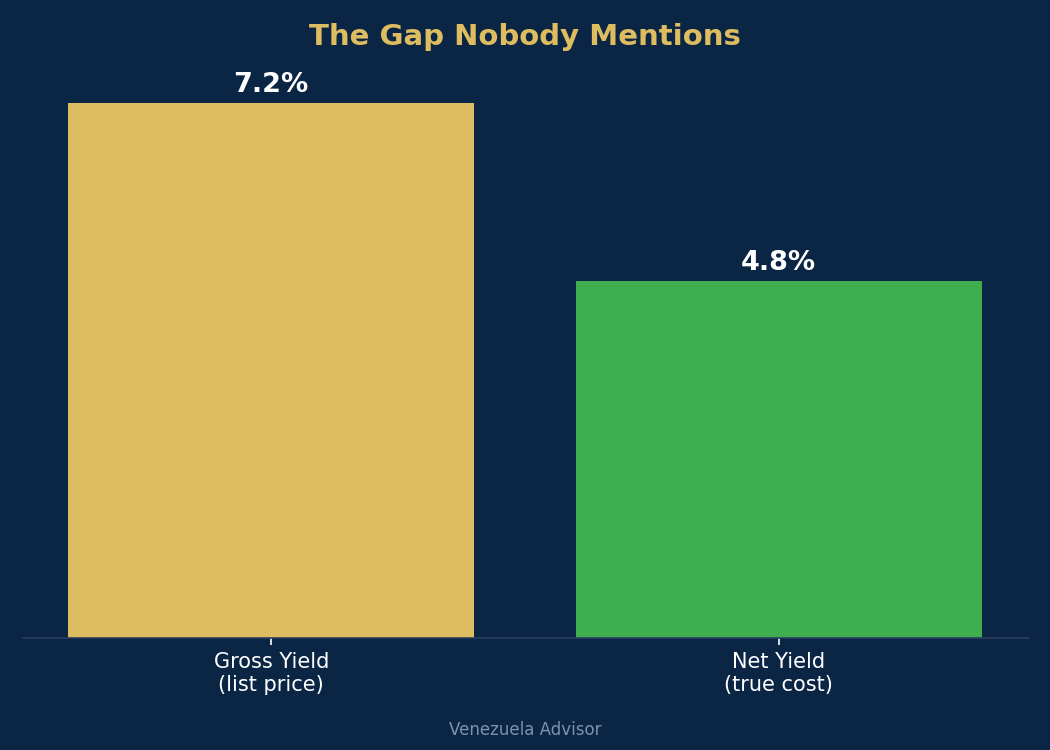
When a seller or agent tells you "this property yields 9% a year," in roughly nine cases out of ten they're quoting gross yield: annual rent divided by purchase price, with nothing subtracted. It's a real number, but it's the wrong number to base an investment decision on, because it ignores everything that separates the rent you collect from the money that actually lands in your account.
The number that should actually matter to you is net yield: what's left after vacancy, maintenance, condo fees, management, and — where applicable — taxes. In our experience working with buyers, the gap between the two typically runs 3 to 4 percentage points — the difference between an attractive investment and a mediocre one.
This distinction matters more in Caracas than in most markets, precisely because closing costs here run higher than in Colombia, Panama, or the United States — a topic we cover in full in our closing costs guide — which means the gap between a naive gross calculation and the real net number tends to be wider here than what a first-time foreign buyer might expect from experience in other countries.
2. The formula that actually matters, step by step
- Gross annual income = monthly rent × 12.
- Subtract a realistic vacancy provision (typically the equivalent of 1 month a year, even in high-demand zones).
- Subtract condo fees and building maintenance (this figure is set by the building's own administration).
- Subtract rental management cost if you won't self-manage (typically 8%–10% of collected rent).
- Divide the result by the total acquisition cost — including closing costs, not just the list price.
3. A full worked example with real market numbers
Numbers convince more reliably than adjectives, so let's walk through a complete case rather than talk in generalities. This is the exact calculation we'd run with a client evaluating a two-bedroom apartment in a well-maintained building.
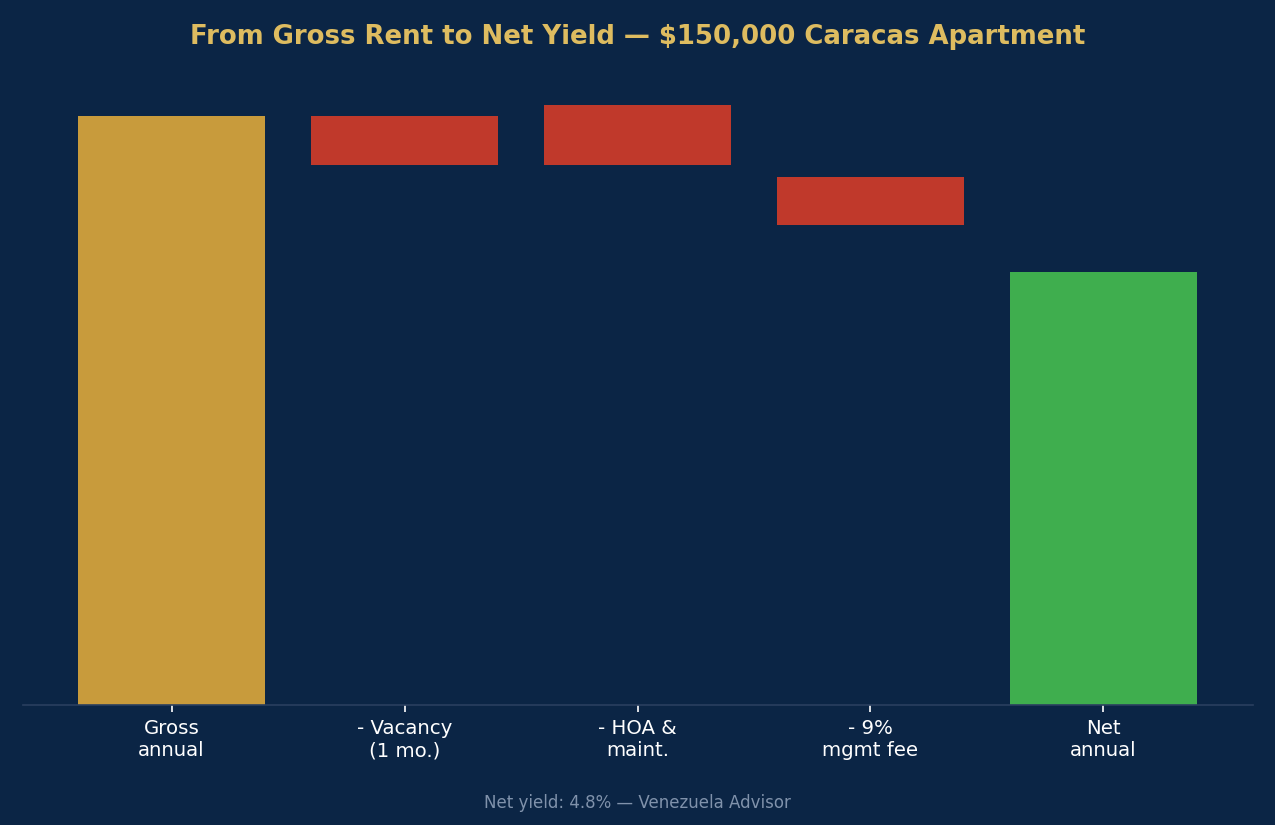
| Item | Annual amount |
|---|---|
| Purchase price + closing costs | $165,000 |
| Monthly rent | $900 |
| Gross annual income (12 months) | $10,800 |
| Less: 1 month vacancy | -$900 |
| Less: condo & maintenance | -$1,100 |
| Less: management fee (9%) | -$873 |
| Net annual income | $7,927 |
| Real net yield | 4.8% |
4. How the math changes by neighborhood
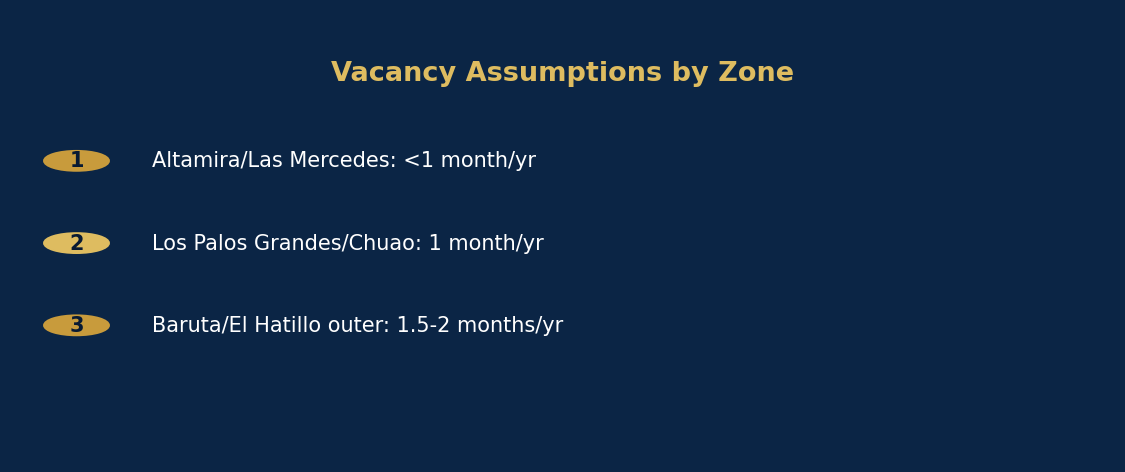
Vacancy and management aren't equal everywhere. In Altamira or Las Mercedes, where demand from professionals and international residents is high, budgeting less than a month of vacancy per year is reasonable. Further from the eastern corridor, it's wiser to be conservative and budget up to two months, precisely because finding the right tenant can take longer.
This isn't a minor adjustment. Shifting your vacancy assumption from one month to two months on our $150,000 example above moves net yield from 4.8% down to roughly 4.2% — a full half-point swing driven entirely by a zone-specific assumption that's easy to overlook if you copy a generic template across every property you evaluate.
| Zone | Estimated vacancy | Typical tenant profile |
|---|---|---|
| Altamira / Las Mercedes | <1 month/year | Professionals, international residents |
| Los Palos Grandes / Chuao | 1 month/year | Executives, expatriate staff |
| Baruta / El Hatillo (outer areas) | 1.5–2 months/year | Local professionals, families |
5. Self-managing vs. hiring a property manager
Whether you manage the rental yourself or delegate to a professional isn't just a comfort question — it directly changes your final net yield number. Self-managing saves that 8%–10% commission, but requires time, local presence, or at least constant availability to resolve issues — a water leak, a late payment, an urgent repair. For investors who don't live in Venezuela, professional management almost always justifies its cost, precisely because the real alternative isn't "save the commission," it's managing remotely with all the friction that implies.
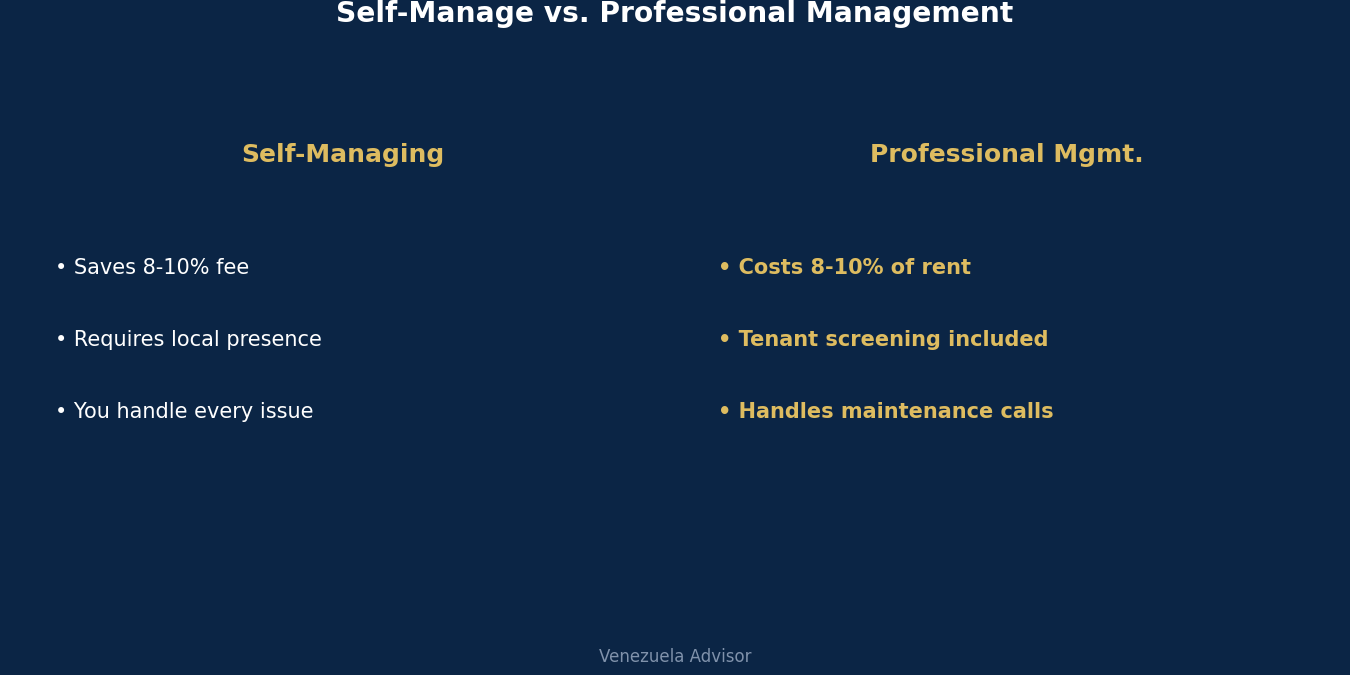
A well-run property management arrangement typically includes tenant screening, rent collection in dollars, coordination of maintenance requests, and periodic property inspections — services that, bundled together, are difficult for a non-resident owner to replicate reliably on their own, no matter how motivated they are to save the fee.
6. The step almost everyone skips: comparing against alternatives
A net yield of 4.8%–6% in dollars, on a physical asset that can also appreciate, is a number that needs context: compare it against returns available to you on financial instruments in your country of residence, and against the capital appreciation potential described in our Caracas neighborhood investment guide. No yield figure means anything evaluated in isolation, and treating 4.8% as automatically "good" or "bad" without that comparison is one of the more common analytical shortcuts we see investors take.
It's also worth comparing against other Latin American rental markets you might be considering instead. A Caracas property offering a genuine 4.8%–6% net yield often outperforms comparable rental yields in more consolidated regional capitals, precisely because entry prices remain low relative to Bogotá or Panama City — the flip side of the liquidity tradeoff we describe throughout this guide series.
Common mistakes that quietly destroy your yield
Budgeting zero vacancy
Even the strongest rental zones in Caracas see some vacancy between tenants. Modeling 0% vacancy makes any property look better than it will actually perform.
Ignoring the condo reserve fund
A building with a healthy maintenance reserve protects your yield from surprise special assessments; one without it can hit you with an unbudgeted five-figure bill at the worst possible time.
Comparing gross yield across different currencies without adjusting
A "9% yield" quoted somewhere else may be calculated on a different cost basis entirely. Always confirm whether any comparison figure is gross or net before drawing conclusions.
A second worked example: a larger property in El Hatillo
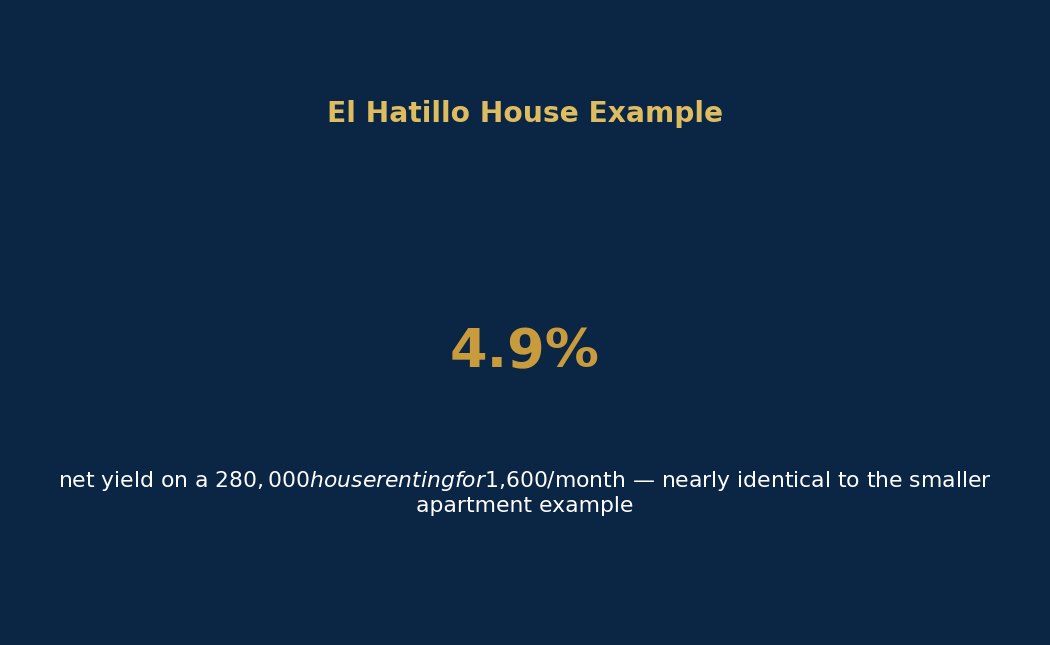
To show how the math holds up with a larger asset, and to reinforce that yield percentage — not absolute dollar amounts — is the number that actually lets you compare properties fairly, consider a house in El Hatillo with a total acquisition cost of $280,000, rented at $1,600 a month to a long-term family tenant. It's tempting to assume a $280,000 house should automatically outperform a $165,000 apartment in absolute terms, and it does in raw dollars — but that comparison tells you nothing about which asset is the better use of your capital.
| Item | Annual amount |
|---|---|
| Gross annual income (12 months) | $19,200 |
| Less: estimated vacancy (1.5 months, less central zone) | -$2,400 |
| Less: house maintenance (higher than a typical apartment) | -$1,800 |
| Less: management fee (9%) | -$1,296 |
| Net annual income | $13,704 |
| Real net yield | 4.9% |
The result lands almost identically to our first example, despite the asset costing nearly double: this is exactly why percentage yield, not absolute dollar income, is the correct metric for comparing opportunities of different sizes against each other.
Short-term rental vs. traditional lease
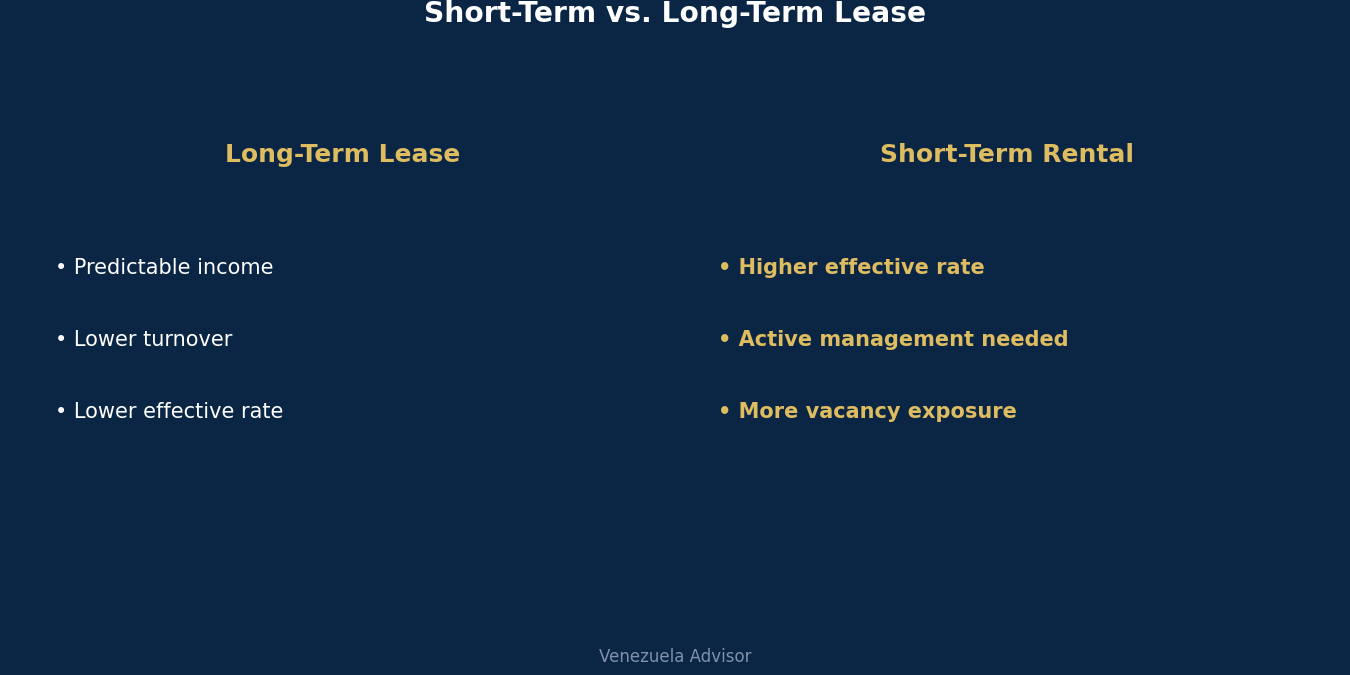
A further decision that directly affects net yield is which type of lease you offer. A traditional long-term lease (one- or two-year contracts) delivers predictable income with lower tenant turnover, but typically at a lower effective monthly rate than a short-term rental aimed at transient executives or international professionals.
Short-term rentals can generate meaningfully higher effective monthly rates, but demand a much more active management style: cleaning between guests, furniture upkeep, and greater exposure to vacant gaps between bookings if demand isn't constant. Our general recommendation is that, unless you or a trusted manager can genuinely dedicate real time to this model, a traditional long-term lease usually offers the best balance of yield and operational peace of mind for a foreign investor who doesn't reside in Venezuela.
There's also a compliance dimension worth flagging: short-term rental platforms increasingly require host verification and local tax registration in many jurisdictions worldwide, and Venezuela's specific requirements in this area are worth confirming directly with your property manager before listing a unit for short-term stays, rather than assuming the same rules apply as in your home country.
The tax component many investors calculate last, or never
Depending on your personal tax situation — both in Venezuela and in your country of residence — rental income may be subject to tax obligations that affect your final net yield beyond the operating expenses already described in this guide. This is one of the areas where a generic online calculator will almost always mislead you, because tax treatment genuinely depends on your specific residency and citizenship combination.
What we can recommend with confidence, regardless of the exact tax detail, is bringing an accountant familiar with your specific situation into the conversation before you treat net yield as the final number in your decision. Waiting until tax season to discover an unexpected obligation is a far more expensive lesson than a single consultation up front.
When it makes sense to sell instead of keep renting
One last question rarely addressed in yield guides, but that every owner should revisit periodically, is whether keeping the property rented remains the best decision versus selling and redeploying the capital elsewhere. If your property's net yield has fallen steadily — for instance, because the zone lost relative appeal to emerging corridors — while resale price remains attractive, it can make more financial sense to exit that position and redirect capital toward an asset with a stronger current yield profile than to hold on out of inertia or emotional attachment to the original investment. This periodic review — ideally once a year — is, in our experience, the difference between a real estate portfolio that's actively managed and one that simply accumulates without ever being optimized.
A practical trigger worth setting for yourself: if net yield drops below what you could reasonably earn on a lower-risk instrument available to you in your country of residence, that's the signal to run the sell-versus-hold math seriously, rather than waiting for a crisis to force the decision on you at the worst possible moment.
Glossary
Gross yield: annual rent divided by purchase price, with no expenses deducted.
Net yield: annual income after vacancy, maintenance, management, and taxes, divided by total acquisition cost.
Vacancy: the portion of the year a property generates no rental income, whether from tenant turnover or lack of a tenant.
Cap rate: a related term sometimes used interchangeably with net yield in international real estate discussions, though local usage in Venezuela tends to favor the simpler "net yield" framing used throughout this guide.
Key takeaways
- Never accept a yield figure without asking explicitly whether it's gross or net.
- Always calculate on total acquisition cost, including closing costs, not the list price.
- Vacancy and management costs vary by zone — be more conservative outside the highest-demand corridors.
- The choice between self-management and professional management should be based on your actual presence in the country, not just the commission cost.
- Review your yield calculation annually against both current rent levels and current resale value — a property that made sense to rent three years ago may make more sense to sell today.
- Compare net yield against both local alternatives and instruments available in your country of residence before treating any single number as a verdict on the investment.
If you already have a property in mind and want us to walk through the full yield calculation with you — including your specific tax situation — we can help before you commit capital. We can also connect you with a property manager already active in the zone you're considering, so the numbers in this guide reflect your actual situation rather than a generic estimate, and so you avoid learning the gap between gross and net the hard way, after closing rather than before it.