
Importing and Exporting from Venezuela: A Practical Guide for New Businesses (2026)
By: Venezuela Advisor — Published 2026 · Share
If your business plan involves moving physical goods across the border — whether restaurant equipment, retail inventory, or export products — this guide covers the registration, documentation, and logistics decisions that determine whether that plan runs smoothly or stalls at customs. Even founders with international shipping experience elsewhere often find that Venezuela's specific combination of documentation requirements and port dynamics doesn't map cleanly onto what worked in other markets, which is exactly why we've structured this guide around the sequence of decisions rather than a generic overview of customs procedure.
- 1. Registering as an importer or exporter
- 2. Standard documentation for an import
- 3. Choosing your entry or exit point
- 4. Why your customs agent matters more than your price quote
- 5. Sector-specific permits to check first
- Working with a freight forwarder alongside your customs agent
- 6. Mistakes we see first-time importers make
- Glossary
- Budgeting beyond the shipping quote itself
- Key takeaways
1. Registering as an importer or exporter
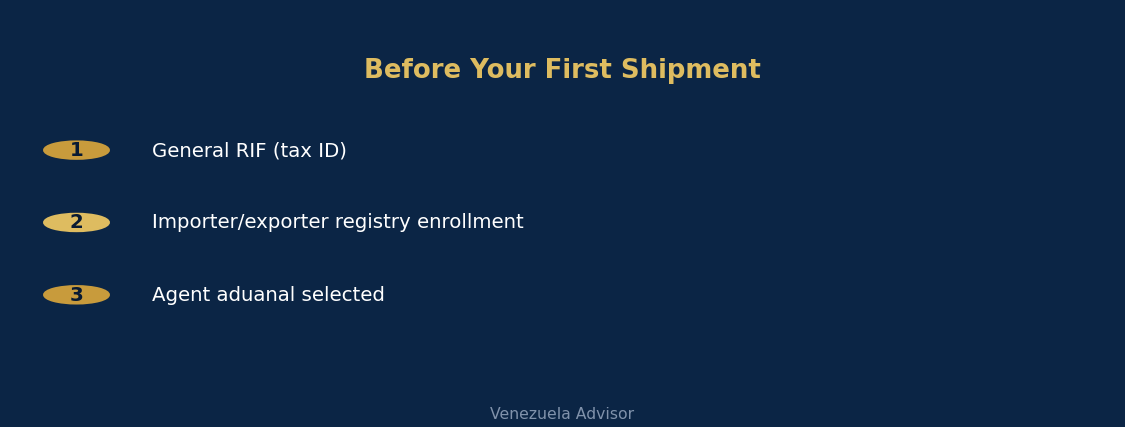
Any company planning to engage in foreign trade needs, beyond the general RIF described in our company formation guide, to enroll specifically in the importer or exporter registries maintained by the relevant customs authority. This step must be completed before scheduling any shipment — attempting to move cargo before registration is finalized is a common and entirely avoidable cause of delay.
We generally recommend treating this registration as part of the company formation process itself, rather than a separate task to handle once the business is already operating. Companies that plan their trade registration in parallel with general formation consistently reach their first shipment faster than those that treat it as an afterthought once the core business is already up and running. This mirrors a pattern we see across nearly every process described in this guide series: tasks planned in parallel from the start consistently outperform tasks bolted on sequentially after the fact, whether we're discussing company formation, real estate closings, or the customs process covered throughout the rest of this guide.
2. Standard documentation for an import
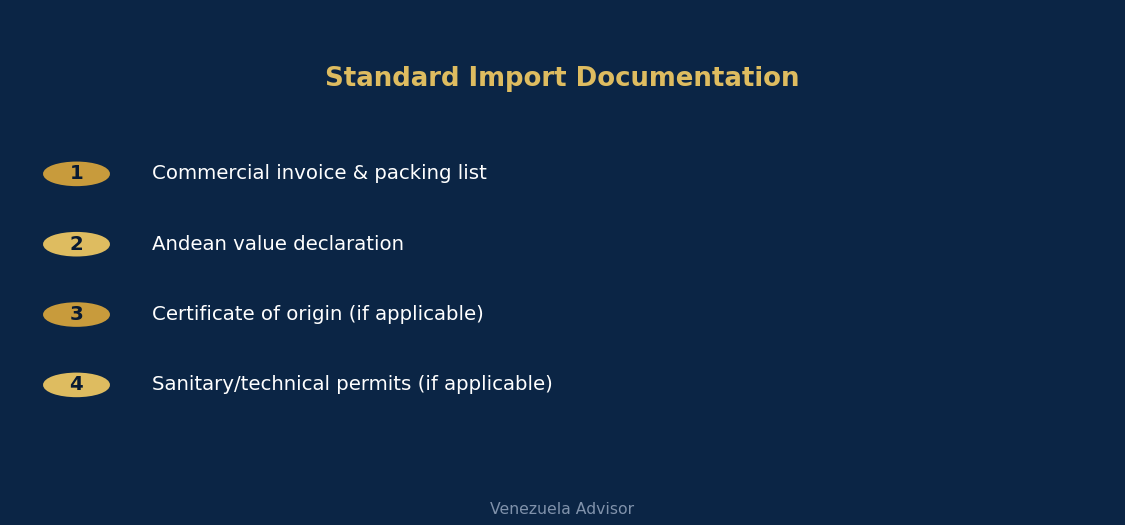
These four documents form the baseline for virtually any import, before layering in anything sector-specific — the same principle that governs the closing documentation described throughout our real estate guides. Missing even one of them at the point of clearance is enough to hold a shipment at port while the gap gets resolved.
- Commercial invoice and packing list from your supplier.
- Andean value declaration or its current equivalent.
- Certificate of origin, when a preferential tariff treatment applies.
- Sanitary or technical registration, depending on the type of merchandise — food, pharmaceuticals, and chemicals in particular.
Confirming with your supplier, well before the shipment leaves origin, that they can actually produce each of these documents in the format Venezuelan customs expects avoids a scramble once the cargo is already in transit and harder to redirect. Suppliers based in countries with different documentation conventions sometimes need explicit guidance on exactly what Venezuelan customs requires, rather than assuming their standard export paperwork will translate directly.
3. Choosing your entry or exit point
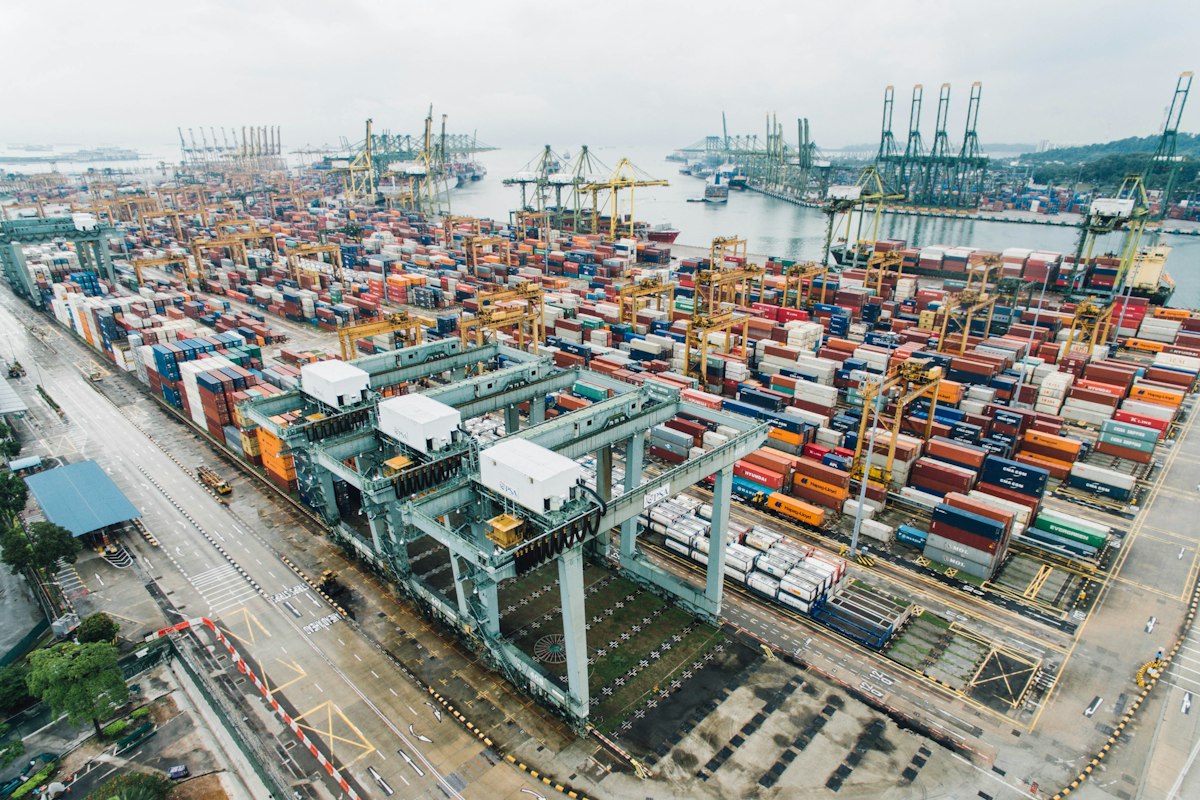
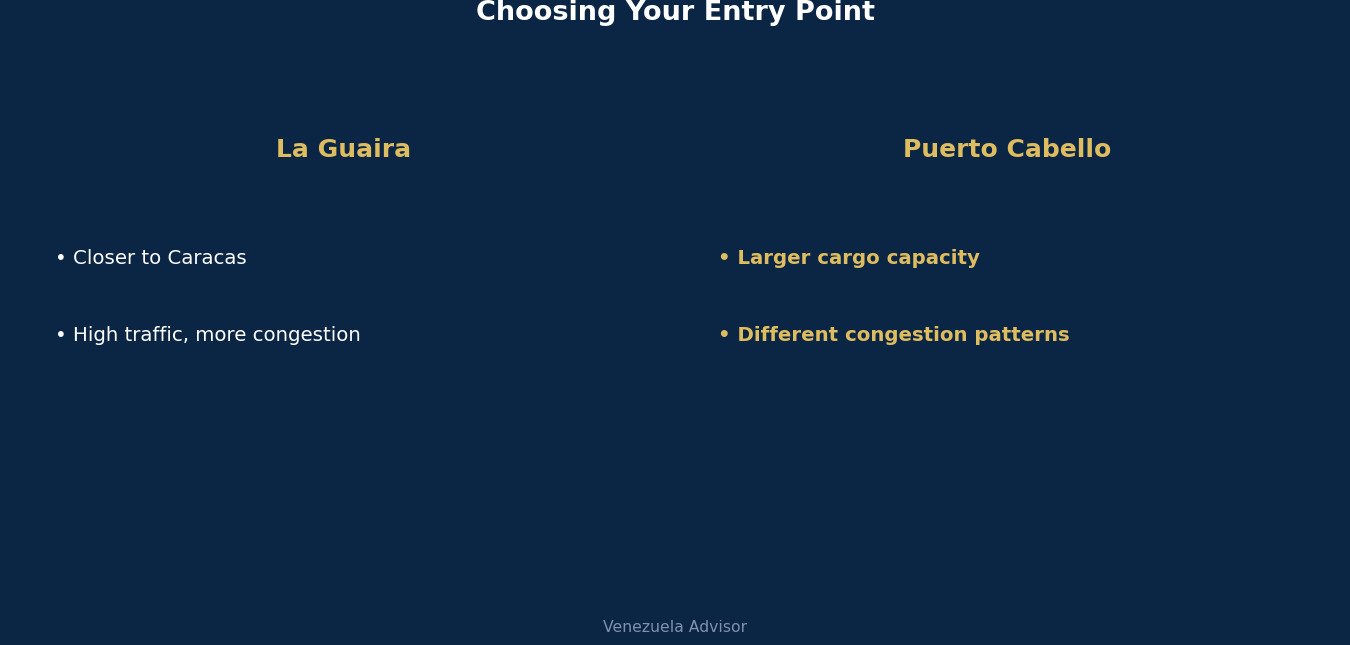
The choice of port or airport directly affects both timing and cost. Ports like La Guaira and Puerto Cabello handle much of Venezuela's foreign trade, each with its own congestion patterns and processing rhythms that shift depending on the season and cargo type.
La Guaira's proximity to Caracas makes it the natural default for businesses based in the capital, but that same convenience means it also carries some of the heaviest traffic in the country, particularly around peak shipping seasons. Puerto Cabello offers greater cargo capacity and, at times, more predictable processing, at the cost of additional inland transport to reach Caracas-based operations. Neither is universally better — the right choice depends on your cargo type, your delivery timeline, and your tolerance for the specific congestion pattern each port currently carries. For businesses with recurring shipments rather than one-off imports, it's often worth testing both ports on early shipments before committing to one as your standard route going forward.
4. Why your customs agent matters more than your price quote
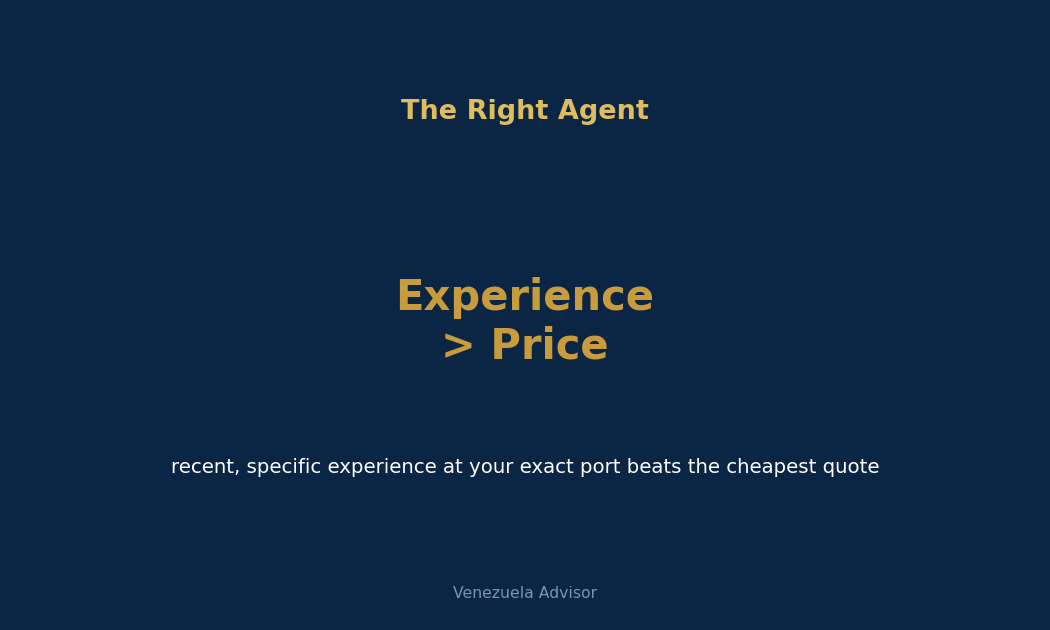
A customs agent with recent, specific experience at the exact port you'll be using is, in practice, as important as the attorney in a real estate transaction: they know the actual current timelines, the documents genuinely required at the counter, and the typical bottlenecks for that time of year.
The cheapest agent quote isn't always the most expensive choice in the end — an inexperienced agent who misses a document requirement or misjudges a classification can generate storage fees, penalties, and delays that dwarf whatever was saved on the initial quote. Ask any agent you're considering for recent references specific to your cargo type and port, not general references from unrelated shipments years ago. A good agent should also be willing to walk you through their proposed classification and documentation approach before the shipment moves, rather than treating that information as proprietary — transparency at this stage is itself a useful signal of competence, much like a real estate attorney's willingness to explain their title review process before you commit to a deposit.
5. Sector-specific permits to check first
Before committing to a shipment, confirm whether your specific product category requires a sanitary registration, a technical standard certification, or any other sector-specific permit. This check belongs at the very start of the process, not after cargo has already left the origin port.
Food and beverage products typically require sanitary registration well in advance of shipment, a process that can take considerably longer than the shipping transit time itself if not started early. Electronics and certain machinery may require technical compliance certificates confirming they meet local safety standards. Pharmaceuticals and medical devices carry the most stringent requirements of all, often involving a separate regulatory approval process entirely distinct from standard customs clearance. If your product falls into any of these categories, the permit timeline — not the shipping timeline — is usually what determines your realistic launch date.
Building a permit timeline into your launch plan
Rather than treating permits as a parallel track to shipping logistics, map both onto a single calendar from the start. If a sanitary registration takes eight weeks and your shipment takes three, ordering the shipment to arrive before the permit clears simply means paying storage fees while you wait — money that a slightly later shipment date would have saved entirely. This kind of sequencing mistake is common precisely because permits and logistics are often handled by different people within the same company, without anyone responsible for reconciling the two timelines into one coherent plan. A single shared calendar, reviewed jointly by whoever owns each function, closes this gap more reliably than any individual reminder system.
What happens if you discover a permit gap after shipping
If cargo arrives before its required permit is in hand, it typically sits in bonded storage accruing fees until the gap is resolved — sometimes for weeks, occasionally longer if the permit application itself runs into complications. Beyond the direct storage cost, this delay cascades into any commitments made to your own customers, compounding a documentation problem into a business relationship problem. Confirming permit status before, not after, cargo leaves origin remains the cheapest way to avoid this scenario entirely — a principle that applies just as directly here as it does to the title and permit verification steps described throughout our real estate guides in this series.
Working with a freight forwarder alongside your customs agent
Many importers conflate the freight forwarder — who arranges the actual transport of goods — with the customs agent, who handles clearance once goods arrive. These are typically separate roles, sometimes filled by the same company and sometimes not, and understanding the distinction helps you evaluate whether a single provider's claim to handle "everything" genuinely covers both functions well, or whether one side of that combined service is weaker than the other.
A freight forwarder with strong pricing on ocean or air transport isn't automatically equipped with strong customs clearance relationships at your specific Venezuelan port of entry, and vice versa. Where possible, we recommend evaluating each function on its own merits — even when working with a single combined provider — rather than assuming competence in one area guarantees competence in the other. For your first few shipments in particular, it's reasonable to ask pointed questions about each function separately, even if you ultimately decide to use one combined provider for convenience, since the cost of that extra diligence is trivial compared to the cost of discovering a weak link only after cargo is already committed.
As your shipping volume grows, some importers find it worthwhile to separate these functions entirely — a freight forwarder chosen purely on shipping cost and reliability, paired with a customs agent chosen purely on port-specific expertise — rather than defaulting to whichever single provider offered to handle the whole process. This added coordination overhead only pays off once shipment volume is high enough to justify it, so it's rarely the right starting point for a first-time importer still learning the process end to end, but it's worth keeping in mind as a future optimization once your operation matures.
6. Mistakes we see first-time importers make
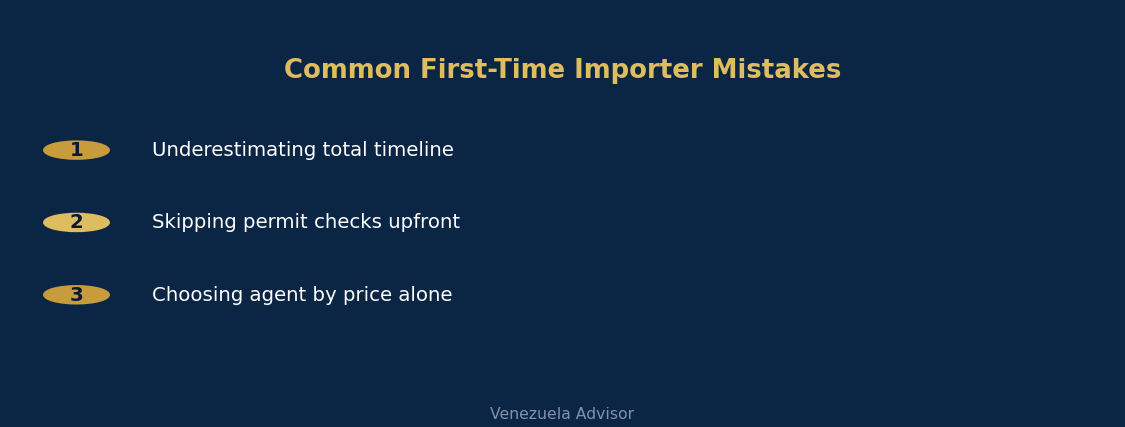
Underestimating the total timeline
Underestimating the total timeline and promising unrealistic delivery dates to their own customers is, by far, the most damaging mistake — it turns a logistics delay into a customer relations problem entirely of the business's own making. Build a buffer into any customer-facing delivery promise until you have several completed shipments under your belt and a realistic sense of your actual timeline. Even experienced importers in other markets tend to underestimate this buffer the first few times they ship into Venezuela specifically, simply because local timelines don't always match what they're used to elsewhere.
Skipping permit checks upfront
As covered above, discovering a missing sanitary or technical permit after cargo has already shipped is one of the costliest mistakes possible — the goods sit in limbo, accruing storage fees, while the permit process that should have started weeks earlier only begins.
Choosing an agent by price alone
The savings from choosing the cheapest quoted agent fee are frequently erased many times over by the costs of an inexperienced agent's mistakes, as discussed in the section above.
Glossary
Agente aduanal: a licensed customs agent authorized to represent importers and exporters before Venezuelan customs authorities.
Certificate of origin: a document certifying the country where goods were produced, often required to claim preferential tariff treatment.
Desaduanaje: the customs clearance process a shipment must complete before released to the importer.
Landed cost: the total cost of a shipment once it's fully cleared and delivered, including freight, duties, agent fees, and inland transport — as opposed to the freight quote alone.
Bonded storage: a customs-controlled storage facility where cargo waits, accruing fees, until clearance requirements are fully satisfied.
Budgeting beyond the shipping quote itself
A shipping quote from a freight forwarder typically covers transport, but rarely the full picture of what actually lands on your books once a shipment clears customs. Import duties, the customs agent's fee, storage charges if clearance takes longer than expected, and inland transport from the port to your final destination all add up, sometimes substantially, beyond the headline freight cost.
Building a complete landed-cost model — freight, duties, agent fees, a reasonable storage contingency, and inland transport — before pricing your product for local sale prevents the uncomfortable discovery that a shipment which looked profitable on a freight quote alone actually breaks even or loses money once every real cost is accounted for. This is a mistake we see even among founders who are otherwise careful about their broader business planning, simply because shipping costs are less familiar territory than the rest of their operation. Running this full model on your first shipment, even if it feels like unnecessary detail at the time, gives you a real cost baseline to price against for every shipment that follows, and it's far easier to build that baseline once, carefully, than to reconstruct it retroactively after several shipments have already gone out the door.
Key takeaways
- Register in the importer/exporter registry before scheduling any shipment, not after.
- Documentation requirements vary by merchandise type — verify sanitary and technical permits early.
- Port choice affects both timing and cost; each has its own congestion rhythm.
- A customs agent's recent experience at your specific port matters more than their quoted price.
- Build realistic delivery timelines into customer promises rather than assuming best-case logistics.
- Model your full landed cost — not just freight — before pricing any imported product for local sale.
- Evaluate freight forwarding and customs clearance as distinct functions, even when using one combined provider.
If you're planning to import or export as part of a Venezuelan business, we can connect you with customs agents experienced in your specific product category and port of choice.