
Special Economic Zones in Venezuela: A Straight-Talk Guide for Investors

By: Venezuela Advisor — Updated 2026
What a special economic zone actually is
A special economic zone (SEZ) is a delimited territory within a country where the government offers a different — usually more favorable — regime than the rest of the national territory: tax exemptions, preferential tariffs, simplified administrative procedures, and sometimes legal stability guaranteed for a set period. The logic is simple: lower the friction of doing business in a specific area to attract capital and jobs.
Two real international cases, sourced
Rather than describe SEZs in the abstract, here are two cases I can back with a real, checkable source each.
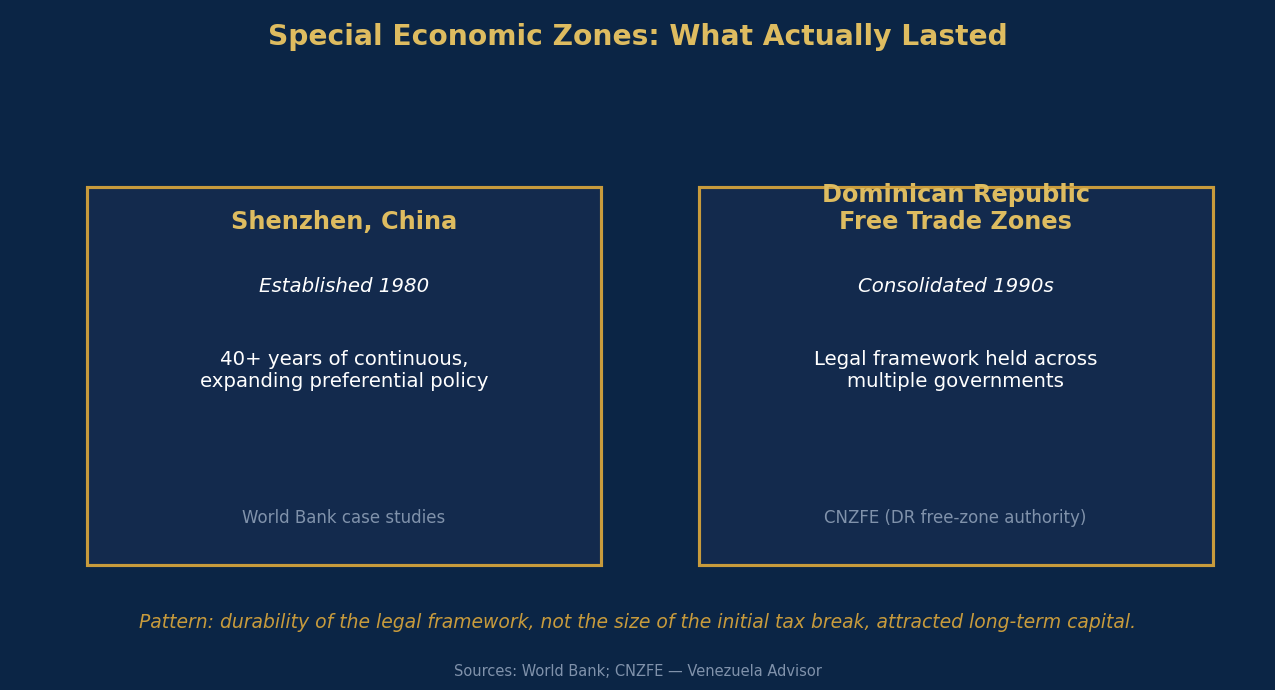
| Case | What lasted | Source |
|---|---|---|
| Shenzhen, China (established 1980) | More than four decades of continuous, expanding preferential policy | World Bank — case studies on China's SEZ program |
| Dominican Republic free trade zones | Legal framework consolidated across multiple governments since the 1990s | Consejo Nacional de Zonas Francas de Exportación (CNZFE), the Dominican government's own free-zone authority |
Why most SEZs announced worldwide underdeliver
This is documented, not speculative: the World Bank has published research noting that a large share of SEZs announced globally fail to reach the investment levels projected at launch. The recurring reasons across countries: connectivity infrastructure (roads, ports, power) that never gets finished on schedule, changes in government that alter or eliminate the incentives before initial capital is recovered, and a shortage of locally available skilled labor for the targeted sectors.
What I can confirm about the Venezuelan case — and what I can't
What I can offer with confidence is the analytical framework above — it applies regardless of which specific zone someone pitches you.
Five questions to ask any SEZ promoter
- Is the benefit written into a law or a decree? A law is much harder to reverse than an executive decree.
- How long has the current regime actually been in force? A multi-year track record beats a fresh announcement.
- What dispute-resolution mechanism exists if the state doesn't honor the terms? International arbitration, local courts, or nothing specified at all — the difference is enormous.
- Does the benefit apply to your specific sector, or is it a general promise? Most SEZs favor manufacturing or logistics, not residential real estate.
- Can you speak with a company that has operated there for more than two years? If the promoter can't connect you to one, that's a red flag.
Key takeaways
- An SEZ's value depends on the durability and legal solidity of its benefits, not on how attractive the pitch sounds.
- Documented World Bank research shows most SEZs worldwide underdeliver relative to their launch promises.
- Venezuela's specific SEZ framework must be verified against current official sources before any decision — this is one topic where verification matters more than in almost any other guide in this series.
- This structure tends to benefit productive sectors far more than individual residential real estate buyers.